
Avian influenza is now recognized as both widespread and costly, with serious implications for animal and human health. Tackling it effectively requires targeted strategies for surveillance and intervention.
An international research team led by Professor Joacim Rocklöv (Heidelberg University) has developed an AI-based predictive model that shows great promise as a valuable tool in this effort.
Background
Avian influenza was first identified in the early 20th century as a highly lethal disease in poultry. Most strains cause mild or asymptomatic infections in birds, with symptoms depending on the viral properties. Viruses that cause severe disease and high mortality in poultry are classified as highly pathogenic avian influenza (HPAI), while those with mild effects are considered low pathogenic avian influenza (LPAI). Beyond their impact on poultry, these viruses raise concerns about spillover — the jump from animals to humans — and the potential emergence of new pandemics.
The study
“Predictiveness and drivers of highly pathogenic avian influenza outbreaks in Europe” is the title of the study published in July 2025 in the journal Scientific Reports by the international group of researchers led by Joacim Rocklöv (Heidelberg University). M.R. Opata, A. Lavarello-Schettini, J.C. Semenza and J. Rocklöv describe an effective predictive model, developed thanks to artificial intelligence, that makes it possible to estimate future avian influenza peaks with good accuracy. Let us take a closer look.
In the past, predictive models have already been used to trigger early-warning systems. The use of such models makes it possible to activate responses in a timely manner, thus limiting impacts on public health and the economy that are by no means negligible.
But if predictive models have already been designed and used in the past, what is new in the study conducted by Professor Rocklöv’s team? This is the first study to carry out a comprehensive predictive analysis at high geospatial resolution in Europe. Using data from a variety of sources describing the development of avian influenza in Europe between 2006 and 2021, predictive and interpretable models were created through machine learning (ML). In particular, the study asked whether eco-climatic and socio-economic variables can predict avian influenza outbreaks, how the importance of time-dependent variables changes with the season and their interactions, which wild bird species are the most predictive of poultry outbreaks, and what combination of variables provides the most accurate forecasts on data not used in model training. When the model was tested on past years, the accuracy of the prediction was 88%.
Key drivers of outbreaks (and therefore essential data for predictive models) turned out to be climate, environmental and vegetation variables, followed by bioclimatic variables, poultry density and finally more general socio-economic conditions (trade and population density).
It emerged that cold temperatures in autumn are the most relevant predictor, while average spring temperatures play a critical role. These climatic variables can influence bird behavior and the environmental survival of the virus, since colder temperatures favor viral persistence. For example, low temperatures affect habitat availability and quality, concentrating wild birds and increasing the likelihood of contact between susceptible and infected individuals. During winter, low availability of water and vegetation indicates a low risk of outbreaks.
Poultry density also represents one of the most influential predictive variables: high values, representing regions with dense poultry populations, push the model towards positive predictions, while low values push it towards negative predictions. In addition, temperature, water index, vegetation index, poultry density and Bio3 (the ratio between the mean daily temperature range and the annual temperature range) play a critical role in avian influenza outbreaks according to the study model. The relationship varies across the seasons, but is dominant in the first and third quarters for the most important variables.
In general, the study shows that climate is the main factor influencing avian influenza outbreaks, followed by environmental and bioclimatic variables.
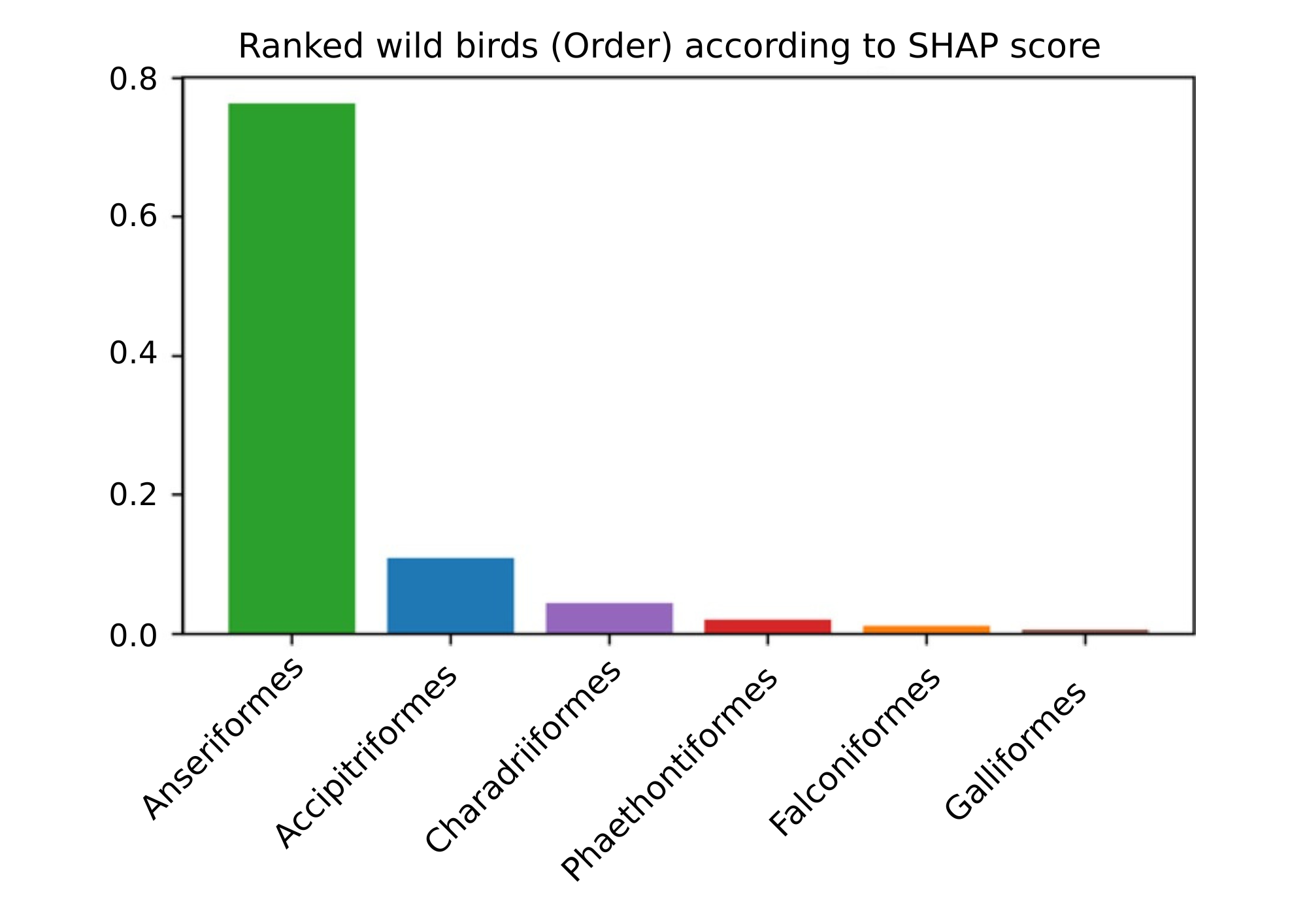
In addition, a strong correlation between outbreaks and the presence of certain bird species was observed. As shown in Figure 1, among these the mute swan (Cygnus olor) has the greatest impact, contributing the most to the positive prediction of outbreaks in part of the data. In second and third place are, respectively, Accipitriformes, unidentified birds of the family Anatidae (order Anseriformes) and gulls (family Laridae, order Charadriiformes), according to SHAP values (SHapley Additive exPlanations, quantitative indicators that measure the contribution of each variable to a machine learning model’s prediction, showing whether and to what extent that variable increases or decreases the probability of the predicted event). The inclusion of wild bird species significantly improved the predictive performance of the model, highlighting their crucial role in the spread of avian influenza viruses.
Why this study matters
The detection of avian influenza outbreaks can trigger a series of containment measures, including the strengthening of biosecurity in poultry farms, movement bans, vaccination, and the culling of the entire flock as well as other farms located near the affected one, in order to prevent further spread of the virus. The implementation of such measures often depends on the timing of the alert, which in turn depends on the sensitivity of the surveillance system.
The study by Professor Rocklöv and his team can help guide sentinel surveillance in order to improve the number of identified cases and to develop early-warning systems for avian influenza outbreaks.
Such maps could therefore inform targeted planning of biosecurity and emergency measures, such as ring vaccination or preventive vaccination for poultry in high-risk areas. In addition, climate-informed interventions, such as movement restrictions or awareness campaigns during the third quarter, can be implemented. For example, agricultural infrastructure can be adapted in line with seasonal climate trends to reduce susceptibility to the virus and bird stress, factors known to play an important role in the spread of avian influenza.
The results of the study highlight the importance of including wild bird species in predictive models. This underlines the need for more robust and systematic surveillance of wild bird populations to improve the ability to predict and mitigate avian influenza outbreaks.
Looking ahead
Future prospects include refining the model by incorporating higher-resolution data, expanding the geographical scope, and including additional variables that could influence the dynamics of avian influenza viruses, such as bird migration routes and land-use changes. Collaboration across disciplines and regions will be essential to improve the predictiveness and applicability of the model.
References
Opata, M.R., Lavarello-Schettini, A., Semenza, J.C. et al. Predictiveness and drivers of highly pathogenic avian influenza outbreaks in Europe. Sci Rep 15, 20286 (2025).
https://doi.org/10.1038/s41598-025-04624-x