

During recent years cage-free egg production systems have increased in numbers throughout Australia, and currently dominate Australian egg sales. However, with increasing consumer demand for protein, cage-free egg farming faces the challenge of meeting the increasing demand for food. Mislaid or floor eggs (FE), which are laid outside of the designated nest boxes, may limit the potential to increase productivity and are a challenge for cage-free egg farmers. This scoping survey study, which included 39 flocks, was designed to explore factors that influence FE prevalence in cage-free egg systems within Australia. The percentage of FE ranged from 0.01% to 17%. There was a notable increase in labour costs for flocks with higher levels of FE (p = 0.04). Additionally, flocks in sheds which utilised tunnel ventilation had significantly lower FE prevalence compared to sheds that used other forms of ventilation (p = 0.0127). There was a negative correlation between flock size and number of FE and, the farmer’s acceptable level of FE (r = -0.4993, p = 0.001; r = -0.4870, p = 0.001 respectively). This suggests that flock size plays an influential role in FE prevalence. Additionally, flocks experiencing higher FE values can expect it will affect labour related costs. This study emphasizes the variability of FE laying, which is affected by various factors related to the design and management of cage-free systems.
➤ Ruby Putt1, Hubert Brouwers1, Peter J. Groves2 and Wendy I. Muir1
1 School of Life and Environmental Sciences, Poultry Research Foundation, Faculty of Science, The University of Sydney; ruby.putt@sydney.edu.au, hubert.brouwers@sydney.edu.au, wendy.muir@sydney.edu.au
2 Sydney School of Veterinary Science, Poultry Research Foundation, Faculty of Science, The University of Sydney; peter.groves@sydney.edu.au
Introduction
The production of fresh table eggs plays a crucial role in meeting the global demand for food. The Australian egg industry is shifting towards cage-free systems, including free range and barn-laid systems, which accounted for 71.7% of egg sale volume in 2023 (Australian Eggs, 2023). Traditionally, caged systems can achieve a more efficient use of resources per unit of production (Sumner, 2011). Therefore, egg production in cage-free systems raises challenges for productivity and food safety compared to traditional caged systems (Sumner, 2011). Floor eggs are also a major challenge for cage-free systems. They can represent a significant loss of up to 10% of total daily egg production. They also require intensive labour for staff to encourage the movement of hens towards the nesting boxes as well as any floor egg collection (Bist et al., 2023; Brannan & Anderson, 2021; Vroegindeweij et al., 2018).
Environmental factors within sheds, such as ventilation and temperature control, can influence laying behavior and egg production. Under stressful environmental conditions (for example hot or poorly ventilated sheds), hens avoided upper levels of the shed; concurrently with a higher incidence of eggs laid on the floor areas (Biswal et al., 2022). Furthermore, small egg producers face financial constraints that limit their ability to invest in advanced monitoring and management practices, potentially exacerbating FE issues when compared to larger operations (Dhillon & Moncur, 2023; Rada & Fuglie, 2019).
Recent findings on FE in Australian flocks (Ciarelli et al., 2024) were opportunistic evaluations and not drawn from studies specifically designed to evaluate FE. Therefore, purpose-designed studies to explore possible relationships between FE and features of the cage-free systems, including breed-specific behaviours, environmental stressors, and management practices are required. By improving our understanding of factors that contribute to the incidence of FE, targeted solutions for the minimization of FE can be implemented to optimise egg production efficiency while meeting evolving consumer and regulatory expectations. Hence, a survey was designed to capture a snapshot of the current demographics of cage-free egg production in Australia. The incidence of FE together with flock size, housing system, ventilation system and the impact of FE on on-farm labour costs was ascertained.
Method
Initially mediated through Australian Eggs, a not-for-profit company providing marketing and research & development (R&D) services for Australian egg farmers each participant received an information statement about the study, an outline of the survey questions and a consent form. Once consent was received the farmer was contacted and completed a short 16 question phone-based survey that established features of the farm system and shed design, flock demographics (i.e. breed, age, size), floor-egg prevalence at peak lay and flock health status.
Survey responses were entered into REDCap, a secure web application for building and managing online surveys and databases. Each farm and flock had a unique identifier. Data were separated by flock, i.e. where a farm had multiple flocks, a separate survey was completed for each flock. Farms were not identifiable in the output and the original data is encrypted and stored securely in REDCap. The survey responses were tabulated automatically using REDCap ’Data Export’ function. T-tests, correlation and regression equations were generated using SPSS. The data are presented as mean values ± standard error of means. Statistical significance is set at p < 0.05.
Results
This study encapsulated data from 39 flocks within Australia. Their locations included New South Wales (n = 29), Queensland (n = 5), Tasmania (n = 2) and Western Australia (n = 3). Among these 39 flocks, the majority identified as a free-range system (n = 31) followed by cage-free (n = 2) and pasture (n = 2). The production system was not identified for 4 flocks. There were 3 hen breeds being Hy-Line Brown (n = 15), Lohmann Brown (n = 5) and ISA Brown (n =19). There was no significant difference between FE prevalence (%) for the three breeds (p = 0.49) (Table 1). Flock size varied, ranging from 200 to 33300 hens.
The percentage of floor eggs at peak lay ranged between 0.01–17%, with a mean of 3.53% and median 2.49%. The level of floor eggs at peak lay that the farmer identified as being acceptable ranged from 0.20-10%, with a mean of 4.48% and median 2.00%.
Across the 39 flocks, 9 (23%) experienced an increase in labour costs due to the level of floor eggs, with no effect on labour costs in the remaining 30 flocks (p = 0.04). The average incidence of FE in the former was 5.95%, and 2.81% in the latter.
When flock size was broken into quartiles (Q) from smallest to largest, the occurrence of FE at peak lay was; Q1 = 7.20%, Q2 = 3.77, Q3 = 1.70 and Q4 = 1.26%, illustrating a negative correlation of FE with flock size (y = 6.1268-0.0002*x; 0.95 confidence interval, r = -.50, p = 0.001) (Table 1). That is, as FE at peak lay increased, flock size decreased. Similarly, the level of FE at peak lay considered to be acceptable by the farmer had a negative correlation with flock size (y = 18850.8718-2261.5721*x; 0.95 confidence interval, r = -0.49, p = 0.001). That is, the acceptable level of FE at peak lay increased as flock size decreased.
The type of shed ventilation impacted the level of FE. Specifically, flocks in sheds which were ventilated tunnel (mechanical) had significantly lower FE prevalence compared to sheds that were ventilated by other mechanisms (P = 0.0127) (Table 1).
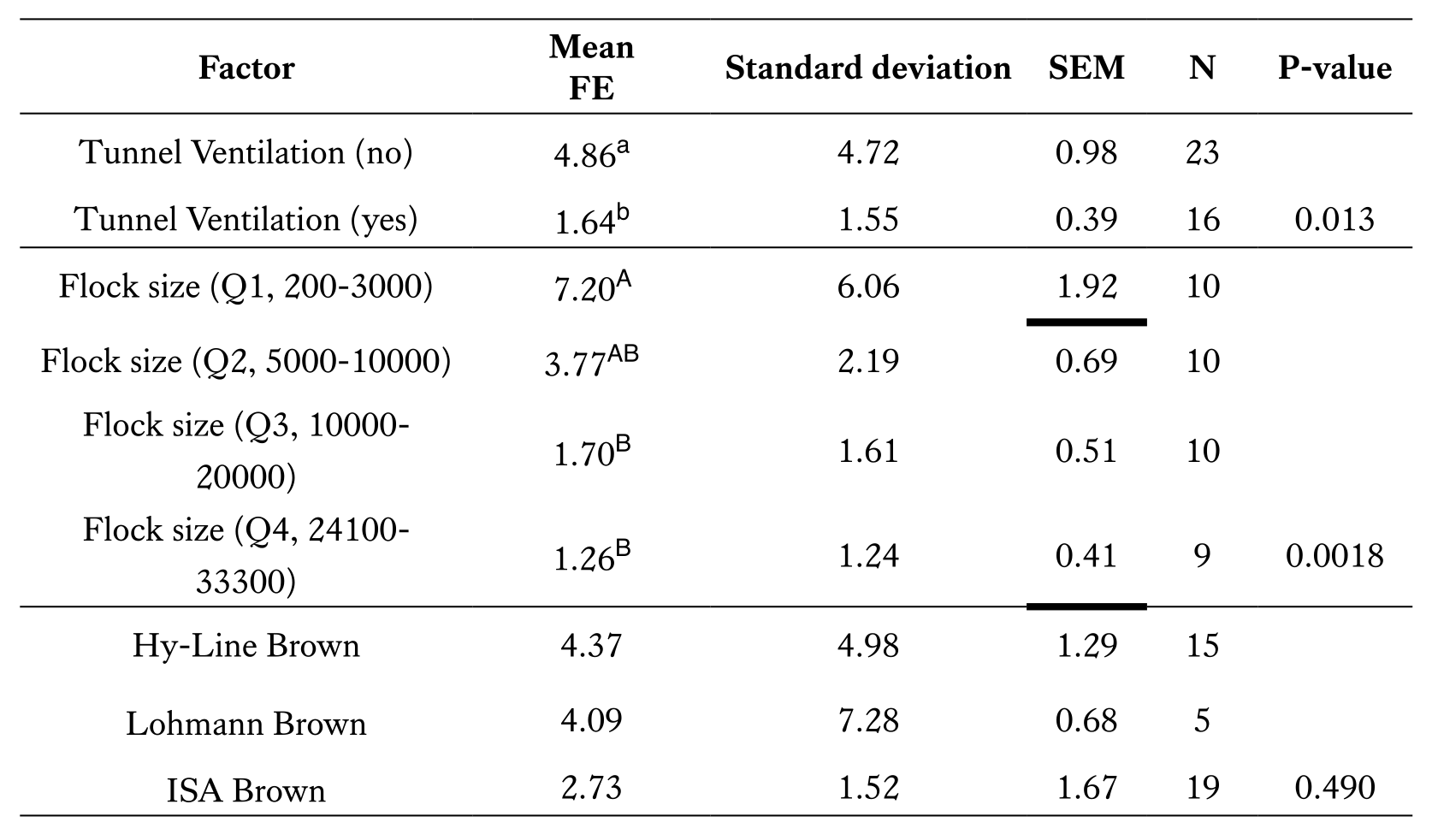
ab and AB rows with different superscripts are different at p<0.05. N = number of flocks.
Discussion
Consistent with other research this study found the proportion of FE from cage-free egg-production systems to vary significantly between 0.01-17%. Earlier scientific evidence from Dorminey et al. (1970) reported large variation in FE of the same flock, ranging from 3.5 up to 22.9%. Hence, to maintain consistency between flocks the level of FE at peak lay was used in this survey. The variability in the levels of FE is likely due to multifaceted factors including the design and management of a cage-free system.
As flock size increased, FE prevalence and the level of FE that was acceptable to the farmer also decreased. For the flocks involved in this survey, the larger flocks had lower incidence of FE (p = 0.005). Smaller enterprises, in contrast, may face challenges in managing FE due to more limited finances for investment in data collection, technology and research (Oliveira et al., 2022). This can also result in less stringent monitoring and fewer interventions for the minimization of FE (Blasch et al., 2022; Mizik, 2022). Overall, adaptability, research, and technology play crucial roles in egg production efficiency, with larger farms benefiting from better resources and more rigorous data collection practices.
It is not surprising that the farming operations that reported an increase in labour costs to address FE also reported higher levels of FE than those that did not experience an increase in costs due to FE. Other research supports this notion as FE must be collected manually, which is labour intensive and time consuming, creating a financial burden for the business (Chai et al., 2023). Additionally, collecting eggs can account for up to 37% of the work of a farm hand (Matthews & Sumner, 2015). Oliveira et al. (2019) indicated that 5% FE is not uncommon in a cage-free system, while others report 10% (Chai et al., 2023), or as high as 28% (Ciarelli et al., 2024). Therefore, FE are a cost to the farming operation, in both direct costs and lost product.
Flocks housed in sheds with mechanical tunnel ventilation produced less FE. Tunnel ventilation maintains a lower temperature during hotter ambient climates compared to naturally ventilated sheds (Silva et al., 2013), and the airflow facilitates convective heat loss from the surface of the bird’s body (Tong et al., 2019). Without appropriate ventilation, the presence of heat stress has detrimental consequences on a bird’s productive efficiency, health and welfare (Biswal et al., 2022). Under conditions of heat stress birds will prioritise biological functioning, and thermoregulation to reduce their core body temperature (Farag & Alagawany, 2018), spending less time walking and using enrichments (i.e. perches and ramps) and more time drinking and resting (Biswal et al., 2022). This can increase the likelihood of FE as birds utilise the floor areas and avoid more elevated areas including the nesting boxes.
This survey is the first phase of a larger study designed to identify solutions for the mitigation of FE in cage-free egg production systems. A subsequent, more in-depth survey of these flocks is currently being undertaken, with results to follow.
Acknowledgement: we thank Australian Eggs for funding this project and the egg farmers that participated in the survey
From the proceedings of the Australian Poultry Science Symposium 2025, by courtesy of the Professor Ruby Putt.
References
Australian Eggs (2023) Australian Eggs. Retrieved 20/09/2024 from https://www.australianeggs.org.au/egg-industry
Bist RB, Yang X, Subedi S & Chai L (2023) Poultry Science 102: 1027-1029.
Biswal J, Vijayalakshmy K, Bhattacharya TK & Rahman H (2022) World Poultry Science Journal 78: 179-196.
Blasch J, van der Kroon B, van Beukering P, Munster R, Fabiani S, Nino P & Vanino S (2022) European Review of Agricultural Economics 49: 33-81.
Brannan KE & Anderson KE (2021) Journal of Applied Poultry Research 30: 1001-1018.
Chai L, Dunkley C & Ritzs C (2023) University of Georgia Extension. 1: 1-6.
Ciarelli C, Groves PJ & Muir WI (2024) Journal of Applied Poultry Research 33: 1004-1064.
Dhillon R & Moncur Q (2023) Sustainability 15: 154-178.
Dorminey RW, Parker JE & McCluskey WH (1970) Poultry Science 49: 1657-1661.
Farag MR & Alagawany M (2018) Journal of Thermal Biology 76: 101-106.
Oliveria LSN, Garcia RG, Burbarelli MFC, Dutra FM, Binott E, Nooriller RM, Basaia DCK, Machad MV, Komiyama CM & Caldara FR (2022) Brazilian Journal of Poultry Science 24: 1-8.
Matthews WA & Sumner DA (2015) Poultry Science 94: 552-557.
Mizik T (2022) Precision Agriculture 24: 384-406.
Oliveira JL, Xin HW, Chai LL & Millman ST (2019) Poultry Science 98: 1664-1677.
Rada NE & Fuglie KO (2019) Food Policy 84: 147-152.
Silva GF, Pereira DF, Bueno LGF, Santos TS & Tavares, BO (2013) Italian Journal of Animal Science 12: 286-294.
Sumner DA, Gow H, Hayes D, Matthews W, Norwood B, Rosen-Molina & Thurman W (2011) Poultry Science 90: 241-250.
Tong XJ, Hong SW & Zhao LY (2019) Biosystems Engineering 178: 275-293.
Vroegindeweij BA, Blaauw SK, Ijsselmuiden JMM & Van Henten EJ (2018) Biosystems Engineering 174: 295-315.