
Silicium is a naturally occurring trace element that supports bone formation, collagen synthesis, and structural integrity in tissues and eggshell membranes. In poultry, dietary bioavailable silicium can improve skeletal strength, egg and eggshell quality, laying performance, and hatchability, making it a valuable additive across production systems.
➤ Barbara Brutsaert1, Giuditta Tilli2, Maarten De Gussem2,3
1 VetPharm, Noordkaai 24, Izegem 8870, Belgium (barbara.brutsaert@vetpharm-global.com)
2 Vetworks bvba, Knokstraat 38, Poeke B-9880, Belgium (giuditta.tilli@vetworks.eu; maarten.degussem@vetworks.eu)
3 Faculty of Veterinary medicine, University of Ghent, Salisburylaan 133, 9820, Merelbeke, Belgium
The role of silicium in bone health, connective tissue integrity and egg quality
Silicium (or silicon) is a naturally occurring trace element widely present in the environment (particularly in soil and plants). Silicium rarely exists in its bioavailable form, as it rapidly binds with oxygen to polymerize and form silica and silicates. Orthosilicic acid (OSA), silicium’s bioavailable form, is nevertheless recognized as an essential nutrient with demonstrated biological value1.
Biological distribution and functions
Silicium is found in all organs and tissues, with the highest concentrations in connective tissues, typically rich in collagen, and mineralized structures such as bone2. Research in both humans and animals shows that dietary bioavailable silicium plays a significant role in collagen formation and supporting overall skeletal health. Its involvement includes:
- stimulating collagen synthesis, essential for the architecture, strength, and elasticity of connective tissues and bones;
- enhancing bone development and mineralization;
- promoting osteoblasts and fibroblasts formation;
- interacting with calcium to support optimal bone metabolism.
These combined effects highlight silicium’s importance in maintaining strong, healthy collagen and skeletal structures1-3.
Silicium and egg and eggshell quality
Beyond its role in bone physiology, silicium contributes to the structural integrity of eggshell membranes. By supporting collagen synthesis, silicium helps reinforce the mechanical properties of these membranes, which are crucial for:
- shell mineralization;
- elasticity and resistance to mechanical stress;
- barrier function against pathogens.
Silicium is also essential for the vitelline membrane, which plays a key role in:
- maintaining yolk centralization;
- regulating nutrient exchange;
- protecting the developing embryo from the alkaline environment of the albumen.
Scientific evidence confirms the presence and functional importance of collagen in both the eggshell and vitelline membranes, underscoring silicium’s relevance in reproductive performance and egg quality4,5.
Bioavailable silicium supplementation as a tool to support collagen, skeletal health and performance in modern poultry production
Selective breeding in commercial poultry has substantially increased skeletal demands across production systems. In broilers, rapid muscle accretion places considerable strain on the developing skeleton, while in layers, continuous egg production requires sustained mineral mobilization and structural resilience. These pressures heighten the importance of nutritional strategies that support bone integrity and connective tissue strength.
Bioavailable silicium has demonstrated beneficial effects on collagen synthesis, bone mineralization, and overall skeletal robustness. Its inclusion as a dietary additive may therefore offer advantages throughout the poultry production chain. Findings from previous studies in broilers further highlight silicium’s potential to enhance skeletal strength and reduce the incidence of structural disorders6. Although silicium is not classified as an essential nutrient, the use of bioavailable silicium‑based products in poultry husbandry may contribute positively to animal welfare, skeletal health, and productive performance.
Considering the background, a series of trials was conducted to assess its efficacy throughout the entire poultry production chain, examining its impact from breeders to commercial flocks.
Performance of broiler breeder flocks supplemented with bioavailable silicium
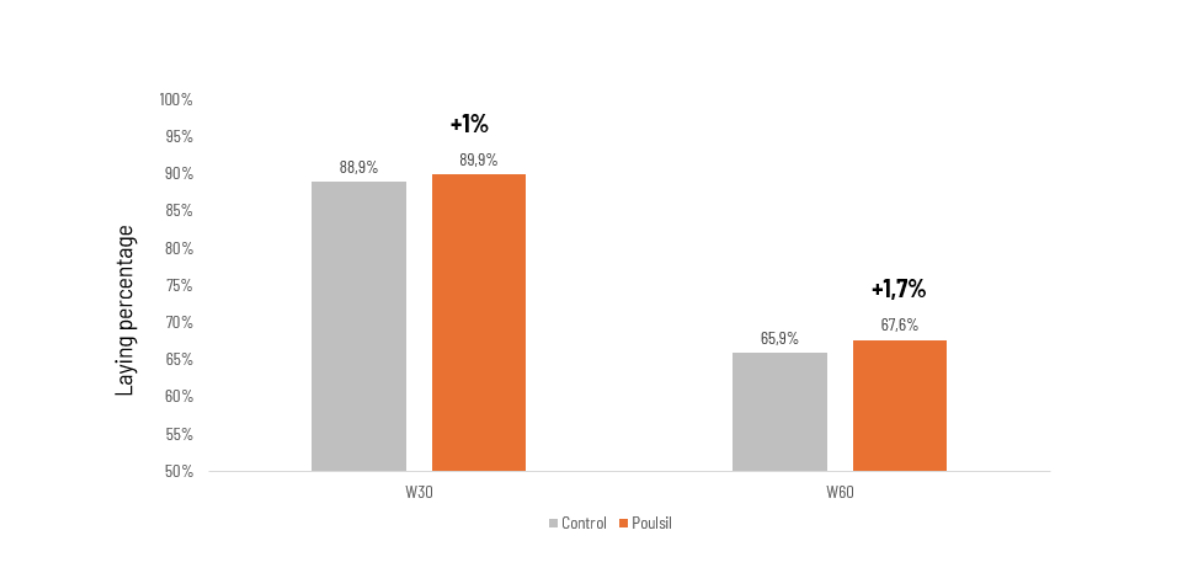
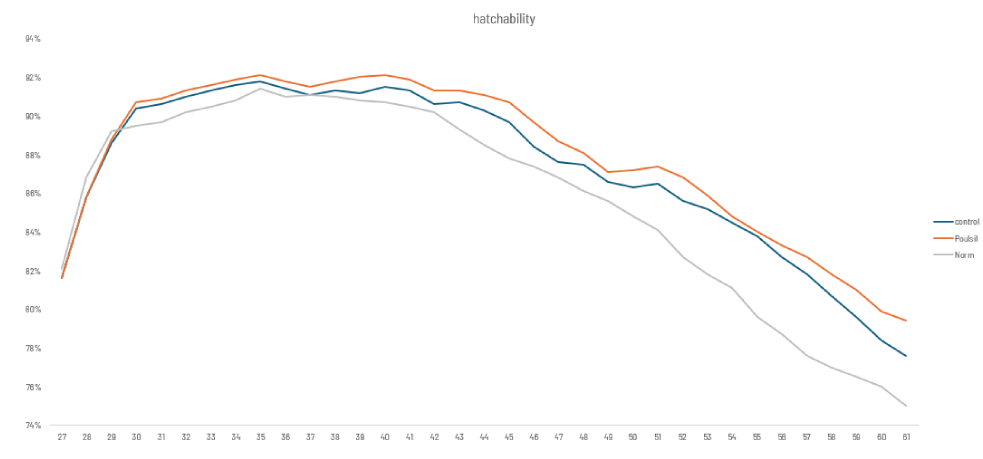
Across multiple broiler breeder operations, internal trials conducted in Belgium, China, and the Philippines consistently demonstrated the positive impact of supplementing a bioavailable silicium product. Flocks receiving bioavailable silicium showed improved laying performance, with increases of 1% to 2% in key production phases (Belgium, Figure 1) and, in some cases, up to a 3.8% rise in total egg output (China). Enhancements in eggshell quality were also evident, including greater shell stiffness, increased thickness, and a lower incidence of cracked eggs (Belgium). These improvements translated into better hatchery outcomes, with higher hatchability rates and a notable increase in the number of day‑old chicks produced (Belgium, Figure 2), exceedingly more than 4 additional chicks per breeder hen (Belgium).
Performance of layer flocks supplemented with bioavailable silicium
Across multiple commercial layer operations, trials conducted in Portugal, the Philippines, and France consistently demonstrated the positive impact of supplementing bioavailable silicium. Supplemented flocks showed improved laying performance, with higher laying percentages and increased average egg weight across production phases. Enhancements in egg quality were also evident, including a marked reduction in cracked and broken eggs, contributing to more first grade sellable eggs.
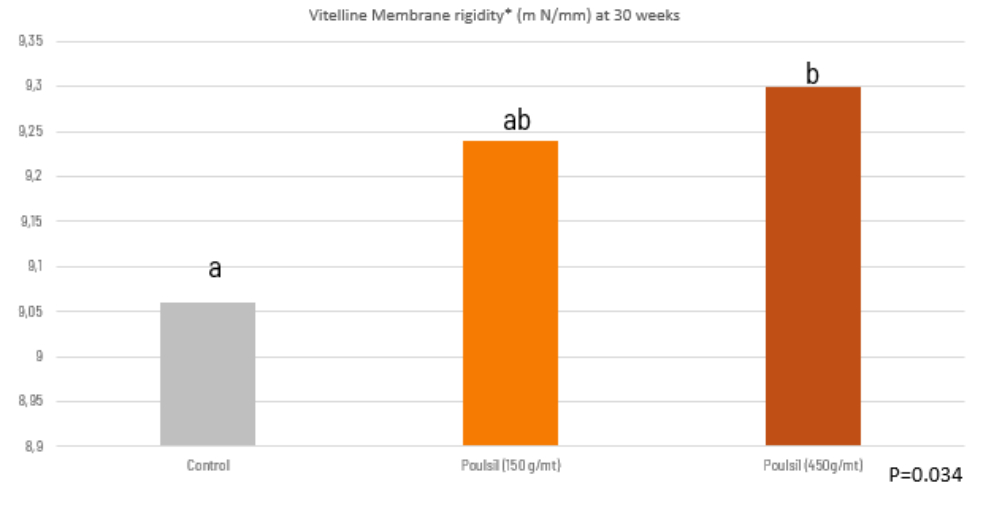
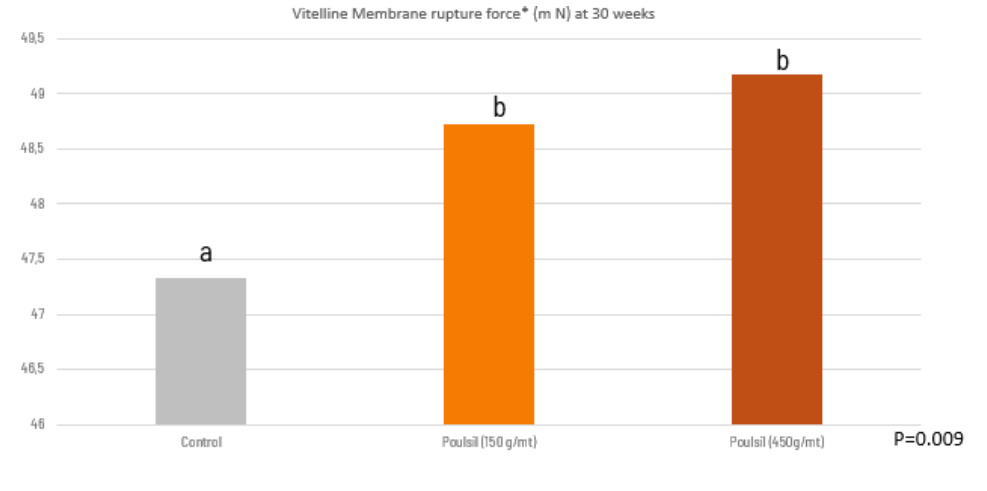
Internal egg quality improved, as eggs from supplemented hens displayed a stronger vitelline membrane (Figures 3 and 4), supporting reduced yolk rupture and improved suitability for handling, storage, and processing. Additional benefits were observed in feed efficiency improved as well, with treated hens exhibiting a lower feed conversion ratio, indicating more efficient nutrient utilization.
Silicium as a key driver for flock efficiency
Across both breeder and layer operations worldwide, the use of bioavailable silicium consistently delivered measurable benefits throughout the poultry production chain. In broiler breeders, supplementation beginning at week 21 resulted in additional eggs and a higher number of chicks hatched, corresponding to an estimated return on investment (ROI) of 9.6 based on a DOC market price of €0.41. Continuous administration from week 22 to week 61 improved eggshell quality, laying performance, and hatchability, demonstrating clear advantages at both farm and hatchery level.
Similar positive outcomes were observed in commercial layers, where silicium supplementation enhanced productivity, egg quality, and feed efficiency across diverse production environments.
Taken together, these findings highlight bioavailable silicium as a valuable nutritional strategy to support reproductive efficiency, eggshell integrity, and overall flock performance in modern poultry systems.
Bibliography
1Jugdaohsingh R. Silicon and bone health. J Nutr Health Aging. 2007 Mar-Apr;11(2):99-110. PMID: 17435952; PMCID: PMC2658806 https://pmc.ncbi.nlm.nih.gov/articles/PMC2658806/
2Götz W, Tobiasch E, Witzleben S, Schulze M. Effects of Silicon Compounds on Biomineralization, Osteogenesis, and Hard Tissue Formation. Pharmaceutics. 2019 Mar 12;11(3):117. doi: 10.3390/pharmaceutics11030117. PMID: 30871062; PMCID: PMC6471146.
https://pmc.ncbi.nlm.nih.gov/articles/PMC6471146/
3Pritchard A, Nielsen BD, Robison C, Manfredi JM. Low dietary silicon supplementation may not affect bone and cartilage in mature, sedentary horses. J Anim Sci. 2020 Dec 1;98(12):skaa377. doi: 10.1093/jas/skaa377. PMID: 33216909; PMCID: PMC7749713. https://pmc.ncbi.nlm.nih.gov/articles/PMC7749713/
4Pillai, M.M., Saha, R. & Tayalia, P. Avian eggshell membrane as a material for tissue engineering: A review. J Mater Sci 58, 6865–6886 (2023).
https://doi.org/10.1007/s10853-023-08434-2
5YH Zhao, YJ Chi. Characterization of collagen from eggshell membrane. Biotechnology (Faisalabad), 2009.
https://scialert.net/abstract/?doi=biotech.2009.254.258
6Prentice, Sophie Elizabeth. The effects of silicon on skeletal integrity. Nottingham Trent University (United Kingdom) ProQuest Dissertations & Theses, 2019. 27767110. https://www.proquest.com/openview/63985a0bb7b30c9befc9b27da3215992/1?pq-origsite=gscholar&cbl=51922&diss=y