
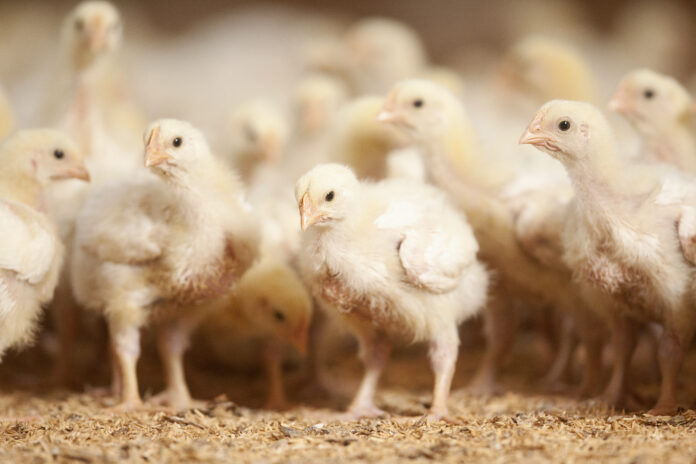
Brooding is the critical early stage of a chicken’s life, typically covering the first few weeks after hatching. During this time, chicks are highly vulnerable and require careful management to ensure their health and development. By focusing on welfare during brooding, producers lay the foundation for healthier, more productive birds throughout their lifecycle.
Biosecurity
Daily flock monitoring is an important part of biosecurity and welfare programs. Flock managers should evaluate bird appearance and flock behavior each time they enter a house. A record of daily mortality and culls should be kept to indicate issues that may be related to the introduction of a disease. Flock managers should also know when and how to notify a supervisor or veterinarian to verify the health status of the flock and begin treatment if necessary.
House preparation
The chick is highly dependent upon the manager to provide the correct litter temperature. Chicks do not have the ability to regulate body temperature for the first 5 days and thermoregulation is not fully developed until 14 days of age. If the litter and air temperatures are too cold, internal body temperature will decrease, leading to huddling, decreased activity, reduced feed and water intake, stunted growth, susceptibility to disease, and loss of flock uniformity. Begin heating the brooding area 48 hours prior to chick placement.
If the house setup does not allow brood chamber curtains to be used, the entire house should be heated and ventilated to optimize chick comfort and temperature needs. If brooder guards (paper, metal or wire partitions) are used, they should be constructed and positioned to prevent chick entrapment and injury. Ideally, litter should be used to fully cover the bottom of the brooder guard and stable partitions should be used to ensure the divider remains vertical.
Bird comfort, water and feed access are critical to ensure optimal welfare outcomes for new chicks. Adjust the height of the feeder and drinkers for chicks. Supplementary drinkers can be used but do not place them under the heat source. The water will become too warm and evaporate quickly, increasing the risk of chicks becoming dehydrated. Pre-fill drip plates under nipples with water to stimulate water consumption. Supplementary feeders can be used for the first 7 days to ensure easy access to feed and good feed intake.
Enrichments
Typical enrichments that can be used in broiler breeder farms include physical enrichments such as ramps, perches, platforms, slats or items that provide additional shelter (small huts/tents). Nutritional and social enrichments stimulate foraging or dust-bathing activity and include items like bales, pecking blocks, or scattering feed. It is important to note that not all enrichments can be used in both rearing and production and should therefore be carefully planned and implemented for the age and type of chicken. Some enrichments, such as slats and perches, may be used in both rearing and laying farms but should be lowered for chicks to access and raised to the appropriate height in the laying house.
Transporting and unloading
A primary objective should be to prevent transport delays of chicks from the hatchery to the farm. Although the yolk sac provides nutrition and hydration for the chick, efficient placement on the farm is critical to a good start for the flock.
On arrival at the farm, face the vehicle into the prevailing wind to prevent wind chill on the chicks during unloading. Before unloading chicks at the farm, the floor and ambient temperature should be verified. If the house is too cool, chicks should remain within the climate-controlled chick truck to prevent thermal stress.
After unloading, the chicks should go straight to the brooding area. Do not stack chick boxes outside of the house. If doing a quality check and count sample, it should be done simultaneously with unloading by trained personnel.
Placement
Careful and strategic placement of chicks in the brood area is important for animal welfare. When placing chicks take into consideration where and how chicks will be placed to optimize chick comfort, security, and welfare.
All staff should take care when handling chick boxes during unloading from the truck, when transporting them within the house, and during the placement process. The goal should be to prevent rough movement such as tilting or dropping chick boxes, since this can potentially injure chicks. Ideally, boxes should always remain level until each individual box is tipped for chick placement.
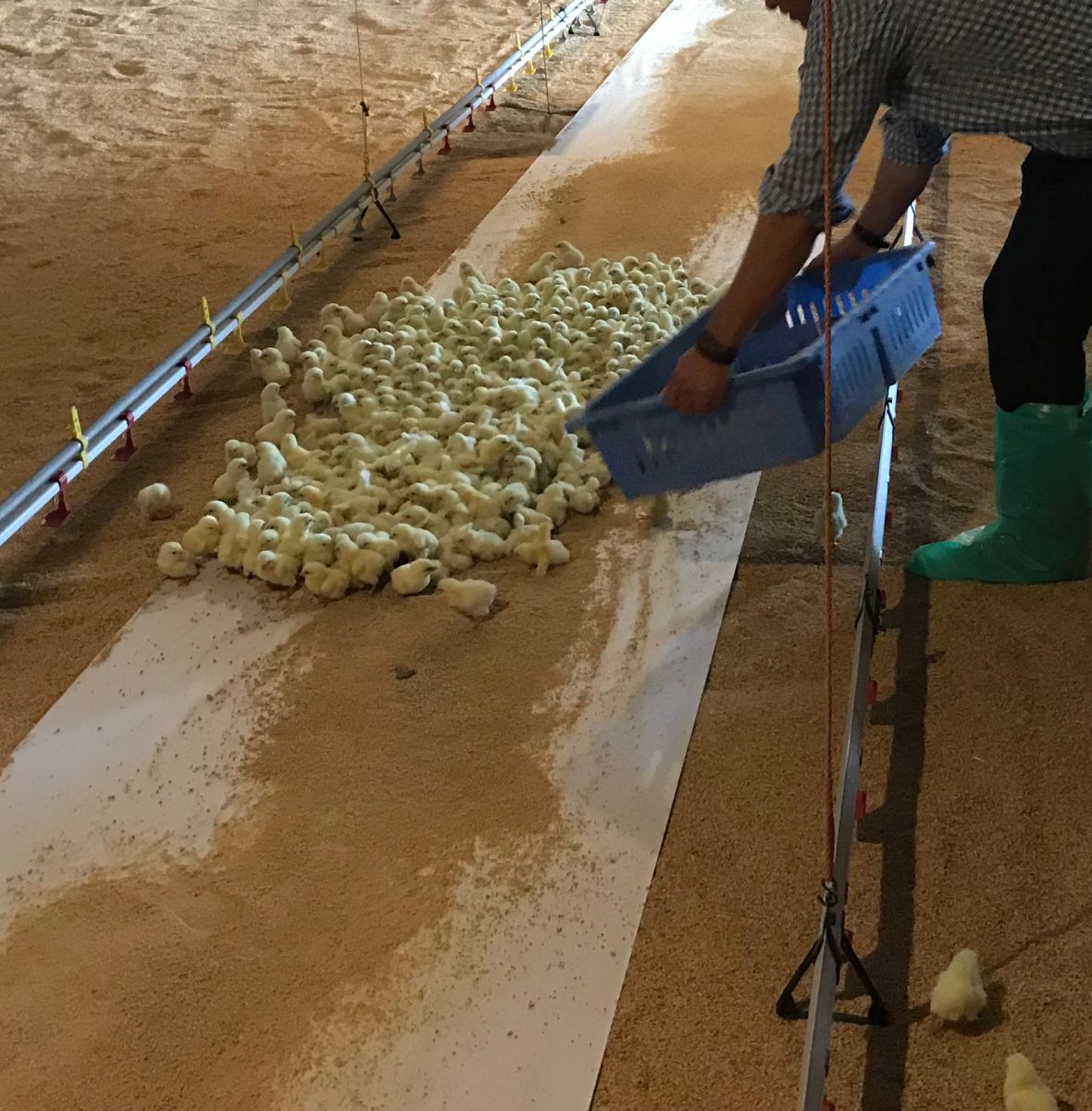
Farm staff must gently place the chicks in accordance with company drop height limits. The drop height should be no greater than 15 cm (6 in) for chicks. This means that the person must hold the box securely with both hands and the tipping should minimize the drop distance from the bottom of the box to the litter.
The location where chicks are placed is critically important. Chicks should be gently placed directly on litter, supplementary feed trays, or the paper that has feed. Do not place chicks on top of solid equipment or on top of other chicks. When placing chicks on the litter, chicks should have easy access to water and feed, and should be near but not directly underneath the heat source (brooders).
Ideally, chick unloading should be quick and efficient to minimize exposure to external climates that may result in thermal stress for the chicks. Place all boxes in the house or brood area so that chicks will be evenly distributed from the first moment of placement. Once boxes are distributed, begin at the back of the house or brood area and place chicks in a careful and calm manner moving towards the front of the house. This will help prevent chick injury and chicks being around the feet of the staff during the reception process. Remove all paper liners and chick boxes during the process to prevent areas of potential entrapment for the chicks and dispose of these items in a biosecure manner. After placement, all staff should leave the house for 2 hours to let the chicks become acclimated to the reception area.
Post-placement
If lighting and temperature in the brooding area are optimal, chicks should naturally and quickly explore the brooding area to find feed and water. Evaluating chick behavior regularly within the first 24 hours of placement and objectively measuring crop fill is an easy way to verify correct setup and optimal conditions for chick comfort. If too many crops are hard, evaluate water availability, water temperature, and flow rate to determine why chicks may not be accessing water in the brood area. If too many crops are soft, evaluate feed availability, location and presentation and verify that the correct feed was delivered to the farm.
Hatched chick internal temperature should be 40 to 40.6 °C (104 to 105 °F). Chick internal temperature above 41 °C (106 °F) in the first 4 days can lead to panting and temperature below 40 °C (104 °F) indicates that the chick is too cold. Chick internal temperature can be measured using a small thermometer with a soft tip. Quick-reading, digital thermometers are recommended for these chick checks. When sampling chicks to verify body temperature, it is important to prevent stress and injury to the chick. If using a quick-reading, digital thermometer for cloacal temperatures, carefully insert the metal tip of the thermometer into the cloaca. Securely hold the chick while supporting the entire body of the chick during the verification process.
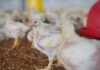
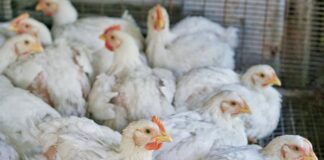
Every time you enter a poultry house, you should see some birds eating, playing, drinking, chirping, and resting. Birds should never be huddling. Careful observation of chick distribution within the brooding area and observation of chick activity can assess the comfort level of the chicks. If distribution is irregular, if activity level is extremely low, or if chicks are extremely noisy, these can be signs of possible stress and the reason(s) should be investigated immediately.
Expanding the brooding area
As the brooding area is expanded, observe chick distribution and behavior. Chicks are naturally curious and will want to explore, but will still need to have the correct temperature, lighting and ventilation to ensure they are comfortable, remain active, and can easily find feed and water within the expanded area. If supplemental drinker and/or feeder trays are used during brooding, they should be gradually removed from the brooding area over the period of several days before the house is completely opened.
Conclusions
Animal welfare directly supports good flock performance by creating conditions that promote health, reduce stress, and improve productivity. When birds are raised in clean, comfortable environments with proper nutrition, ventilation, and space, they are less likely to suffer from disease or injury. Reduced stress levels facilitate good immune development and consistent growth rates. Additionally, flocks with good welfare outcomes have low mortality and good uniformity, which are essential for efficient farm operations.