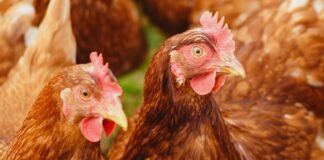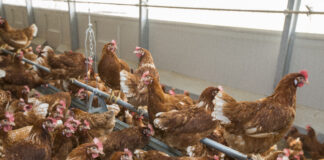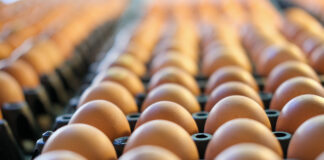

The objective of the present study was to evaluate the effect of incorporating different levels of MOLM and its extract – as natural antioxidants – in low-protein diets for laying hens on productive performance, blood biochemistry, egg storage, and economic efficiency in addition to the manure characteristics of laying hens.
The study consisted of two experiments and was carried out simultaneously at the laying hen farms of El Ekhwa Company in Sadat City. Chemical analysis and measurements were carried out at the Environmental Studies and Research Institute (ESRI), the Faculty of Veterinary Medicine, University of Sadat City, and the Animal Health Research Institute, Agriculture Research Center, Giza.
The first experiment. 150 Lohman Brown laying hens, at 60 weeks of age with 70% egg laying rate on average, were randomly divided into five treatment groups each of thirty birds. Each group had three replicates. Each replicate had 10 laying hens which were allocated in individual cages (40 x 40 x 40 cm). The first treatment (positive control) received a commercial diet (17% CP without Moringa), while the second treatment (negative control) received a basal diet (14% CP without Moringa), treatments 3, 4 and 5 received diets (14% CP) containing 5%, 7.5% and 10% of MOLM and with access to normal drinking water.
The second experiment. The first and second groups were also used in this experiment as control. In addition to control, ninety Lohman Brown hens, at 60 weeks of age with 70% egg laying rate on average, were randomly divided into three groups each of thirty birds each group had 3 replicates, each replicate had 10 birds which were allocated in individual cages (40 x 40 x 40 cm). Treatments 6, 7 and 8 received diets with 14% protein and offered 1.5ml/l, 2.25ml/l and 3ml/l Moringa leaf extract (MOLX) in the drinking water.
Preparation of Moringa leaf powder (MOLM)
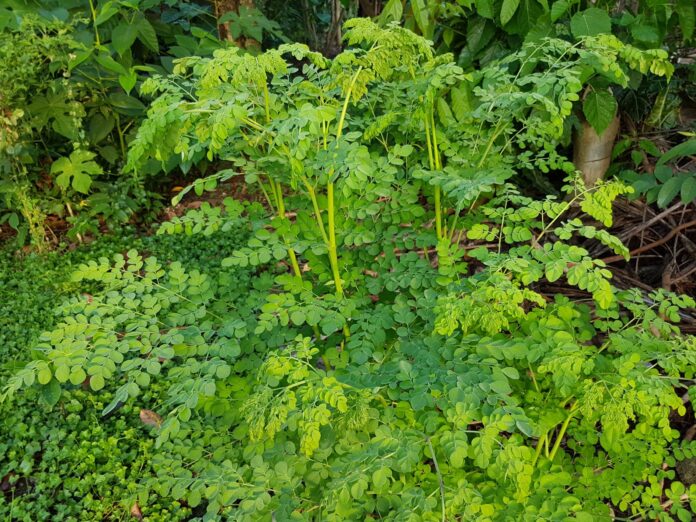
Moringa leaves were separated from the branches, spread out and dried under shade at room temperature for one week, until they became crispy for easy milling. The leaves were then ground into a meal using a hammer mill of mesh size 3mm to make the MOLM, which was incorporated into the experimental diets, as described by Morton (1991); Shelton and Baker (1994).
Preparations of Moringa extract (MOLX)
About 10 kg of Moringa oleifera leaf powder were placed in plastic container with 25 liters of aqueous ethanol (ethanol: water, 80:20 v/v) and soaked for 24 hours. After soaking, the mixture was filtered using filter paper. Then, the Moringa mixture was separated with distillation. Distillation is a separation process that involves heating a liquid to its boiling point, transferring the vapor to a different portion of the apparatus, then condensing the vapor and collecting the condensate in another container. The Moringa solution volume was 3000 mL, yielding an extract with a concentration of 3.3:1 v/v. The Moringa extract was stored in a refrigerator for 1 week until use in the drinking water.
Data collection procedure included:
-
performance measurements;
-
egg production measurements;
-
egg quality measurements;
-
blood parameters;
-
manure parameters, ammonia emissions and manure pH determination;
-
egg storage parameters;
-
economic efficiency (EEF);
-
chemical analysis.
Results
Productive performance
-
Daily laying percentage (%) was significantly (P<0.05) improved by increasing MOLM level. Meanwhile, egg weight (g), daily egg mass production (g/bird), and feed conversion ratio (FCR) kg feed/kg eggs significantly (P<0.05) recorded the best values (67.2;45.3 and 2.65, respectively) with MOLM-5% group and decreased by increasing dietary MOLM level, where the worst values (62.1;41 and 2.92, respectively) were achieved by MOLM-10% group.
-
Group fed dietary 5% MOLM or group fed dietary 1.5 ml/l MOLX recorded significantly (P<0.05) the best daily laying percentage, egg weight, weight and feed conversion ratio of the laying hens comparing with control and other experimental trials.
-
Laying hens groups fed 5% dietary Moringa Leaf MOLM and group fed 1.5 ml/l dietary MOLX significantly (P<0.05) achieved the best values of shell weight (%); shell thickness (mm); egg shape index (%) and eggshell hardness (kg) compared with the control and experimental groups.
-
The effect of various levels of MOLM on the internal egg quality after the fourth week of experiment showed that laying hens group fed dietary 5% MOLM significantly (P<0.05) recorded the highest percentage and values of albumen weight (%); albumen index (%); yolk index (%) and haugh unit while, the low protein diet without MOLM group was the worst one.
-
Group fed 10% dietary MOLM significantly (P<0.05) showed the highest yolk color score value (10) after the fourth week compared with control and other experimental groups but after eight weeks, group fed 7.5% dietary MOLM significantly (P<0.05) showed the highest yolk color score value (9).
-
The albumen proportion increased linearly while the yolk proportion decreased linearly accompanying the increase in MOLM levels in the diet.
-
Laying hens group fed dietary 1.5ml/l MOLX significantly (P<0.05) recorded the highest percentage and values of albumen weight (%); albumen index (%); yolk index (%); yolk color score and haugh unit compared with control and other experimental groups.
-
Laying hens groups fed dietary 7.5% MOLM significantly (P<0.05) and group fed 1.5ml/l dietary MOLX recorded the highest values of shell thickness (mm) and egg shape index (%).
-
However, variability of eggshell hardness (kg) appeared to be the best value (46.2) significantly (P<0.05) recorded with the group fed 1.5ml/l dietary MOLX but there were non-significant differences control or other two dietary MOLM groups.
-
Results of the effect of various levels of MOLM and MOLX on the internal egg quality after 8 weeks of experiment showed that laying hens groups fed dietary either 5% MOLM or 7.5% MOLM and 1.5ml/l MOLX significantly (P<0.05) recorded the best percentage and values of albumen weight (%); albumen index (%); yolk index (%); yolk color score and haugh unit, while the low protein diet without MOLM group was the worst one.
-
In egg yolk groups fed 10% dietary MOLM and group fed 3ml/l MOLX significantly (P<0.05) achieved the best values of triglycerides (TG); total lipids (TL) and cholesterol (CH) compared to control and other experimental groups.
Blood biochemistry
Laying hens groups fed 10% dietary MOLM and 3ml/l MOLX significantly (P<0.05) achieved the best values of total lipids (TL), total protein (TP), triglycerides (TG), albumin (ALB), cholesterol (LDL), ALT/GPT, AST/GOT, total antioxidant capacity (TAC), cholesterol (CL) compared to control and other experimental groups.
Manure characteristics
After 4 weeks of experiment:
-
Laying hens group fed 10% dietary MOLM significantly (P<0.05) achieved the best values of ash, nitrogen, and phosphorus being (23.41, 2.6 and 57.35, respectively) compared to control and other experimental groups.
-
Groups fed 3 ml/l MOLX significantly (P<0.05) achieved better values of ash, nitrogen, and phosphorus.
After 8 weeks of experiment:
-
Laying hens group fed 10% dietary MOLM significantly (P<0.05) achieved the best values of ash, nitrogen, and phosphorus.
-
Group fed dietary 3ml/l MOLX significantly (P<0.05) achieved better values of ash, nitrogen, and phosphorus.
Ammonia emissions
Laying hens group fed 10% dietary MOLM and groups fed 3 ml/l MOLX significantly (P<0.05) achieved the best values of Ammonia (ppm) compared to control and other experimental groups.
Egg storage fed dietary MOLM and MOLX
No significant differences between laying hens groups fed 5% or 7.5% or 10% dietary MOLM and 1.5ml/l or 2.25ml/l or 3ml/l dietary MOLX among the values of egg weight loss (%), albumen height, yolk height and Haugh unit after 10 or 20 and 30 days storage. Therefore, economically group fed 5% dietary MOLM and group fed 1.5ml/l dietary MOLX significantly (P<0.05) achieved the best egg quality values after 10, 20 and 30 days of storage compared to control groups.
Economic efficiency
-
Results showed an improvement in the average values of net revenue, economic efficiency and relative economic efficiency due to feeding laying hens the diets containing 5% dietary Moringa oleifera MOLM (0.124; 310) or offering with 1.5ml/l Moringa oleifera MOLX in drinking water (0.111; 430), respectively, compared to control group and other experimental diets.
-
The lowest value of economic efficiency was obtained by laying hens group fed 7.5% and 10% dietary Moringa oleifera MOLM (65; 55) or offered with 2.25ml/l Moringa oleifera MOLX in drinking water (90), respectively. These results indicate that dietary 5% Moringa oleifera powder MOLM or dietary 1.5ml/l dietary Moringa oleifera MOLX are the best treatment.
-
From an economic point of view, it is possible to use low protein diets (3% lower than recommended) for feeding Lohman Brown laying hens, particularly with using 5% MOLM in feed or 1.5ml/l of MOLX in drinking water.