
How might the Dutch poultry sector look in 2040? In a series of forward-looking analyses, Rabobank explores what is required to maintain an internationally leading and competitive agri-food sector that operates within the limits of climate and nature. This article outlines Rabobank’s vision for the Dutch poultry sector in 2040, based strictly on the data and statements provided.
Poultry production under pressure, yet resilient
In recent years, the poultry sector has benefited from favourable market conditions. Poultry products fit virtually every religion and almost every diet, supporting steady consumption growth. At the same time, challenges related to animal welfare, zoonoses, and emissions of particulate matter and ammonia are driving a further transformation of the sector.
By 2040, poultry production in the Netherlands is expected to take place on fewer farms. Compared with 2023, the number of laying hens will be 20% lower and the number of broilers 30% lower. The total number of poultry farms will have decreased by more than half, while the average number of locations per company will have increased. Emissions will be further reduced, all animals will have more space, and avian influenza will no longer be an issue. Production will be more strongly focused on the Netherlands and neighbouring countries, with higher costs recovered through strong chain coordination and certification.
Slight decline in production volumes
Consumption of eggs and poultry meat continues to grow steadily. However, due to declining exports and stricter requirements for animal welfare and ammonia emissions, total production volumes in 2040 will be slightly lower than today. Certification schemes and sustainable supply chain agreements ensure that prices remain at a satisfactory level.
Further reduction of environmental impact
By 2040, the poultry sector will have significantly reduced ammonia and particulate matter emissions through a combination of new emission-reducing technologies and an overall production contraction of approximately 25%. This contraction is largely driven by lower stocking densities for animal welfare reasons. The sector will be fully energy-neutral, with no biomass used for heat generation; many farms will even act as net energy suppliers. Manure utilisation will be fully circular and no longer pose a bottleneck for the sector.
Continued improvements in animal welfare
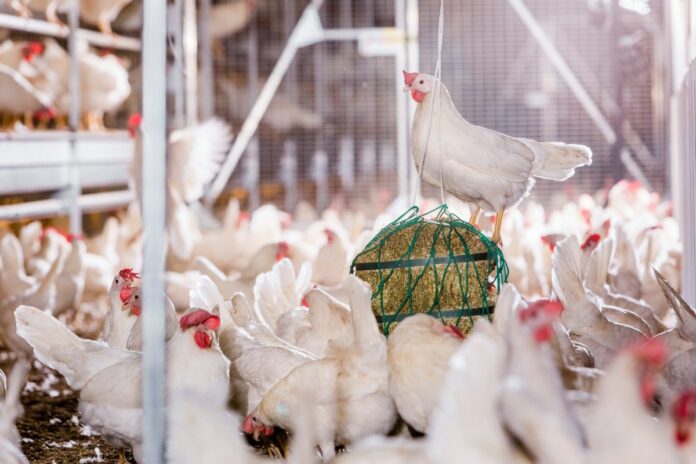
Measures stemming from the Convenant Dierwaardige Veehouderij will further enhance animal welfare standards. New poultry houses will generally include covered outdoor ranges, and cage systems will no longer exist in the Netherlands. Antibiotic use will be further reduced to very low levels. Vaccination against avian influenza will have been standard practice for some time, allowing chickens to range outdoors safely. Societal demand for more space per laying hen will result in a larger market share for free-range and organic eggs.
Production will be increasingly oriented towards the domestic and European market, particularly Germany, the United Kingdom, and Belgium.
From niche to norm: sustainability in broiler production
The Dutch poultry sector is clearly shifting towards more sustainable broiler production. Since 2023, virtually all major Dutch supermarkets, including Albert Heijn, Jumbo, Lidl, and Plus, have sold only chicken meat meeting at least the Beter Leven one-star welfare standard. This certification requires slower-growing breeds, more space per bird, and longer growth periods. Currently, more than 65% of Dutch broiler farms are certified under this one-star scheme.
Fast-food chains are following the same path. From 2026 onwards, KFC will comply with the European Chicken Commitment, allowing only slower-growing broiler breeds.
Rabobank supports this transition by financing and advising companies throughout the chain, from poultry farmers to processors and retailers. According to the bank, sustainability is no longer a niche but a structural movement across the entire poultry value chain.
Fewer, but larger companies
Compared with 2023, the number of animals has declined significantly: 20% fewer laying hens and 30% fewer broilers. The number of poultry farms has decreased by more than half (source: Agrimatie, CBS, PBL, Rabobank, 2023). At the same time, the average size of companies has increased by almost 25%. This growth is not due to more animals per location, but rather to companies operating across multiple sites.
Laying hen production remains concentrated on sandy soils in the central, southern, and eastern Netherlands (Gelderland, North Limburg, and North Brabant). However, as around 10% of farms are located near Natura 2000 areas, these regions will undergo significant restructuring. Broiler production remains more evenly distributed across the country.
Lower exports and strong chain coordination
To serve specific market demand in the Netherlands and neighbouring countries, strong chain coordination will be essential across poultry sub-sectors. This coordination aligns supply and demand, develops and implements chain programmes, and safeguards profitability throughout the chain. In demand-driven supply chains, consumers pay the additional costs incurred by farmers to meet climate, nature, and animal welfare objectives.
Source: Rabobank – Nederlandse pluimveehouderij in 2040: nog meer aandacht voor dierenwelzijn (Sector Manager Pig and Poultry Farming).