
In November 2025, the European Food Safety Authority (EFSA) presented the annual report on avian influenza covering 2024. Data were collected from all EU Member States, by European Free Trade Association countries (Iceland, Norway, Switzerland), EU candidate countries (Georgia, North Macedonia) and other countries in Europe or at the Europe–Asia interface, including the United Kingdom (Northern Ireland), Ukraine, Moldova and Turkey, required to implement surveillance programs for the avian influenza virus (AIV) in both poultry and wild birds, collectively known as the Union Surveillance Programme (USP), in accordance with Regulation (EU) 2016/429 (“Animal Health Law”).
Avian influenza (AI) is a contagious viral disease caused by a virus from the Orthomyxoviridae family, primarily affecting poultry and wild waterbirds. Avian influenza viruses are classified as highly pathogenic (HPAIV) or low pathogenic (LPAIV) based on their molecular characteristics and ability to cause disease and mortality in chickens. In poultry, LPAIV infections often cause mild respiratory signs or remain asymptomatic, while HPAIV infections, particularly in chickens and turkeys, typically result in severe disease and high mortality. Poultry with LPAI may show mild or no symptoms, while HPAI causes severe illness and death. Both spread rapidly through farms, making strict biosecurity measures crucial. LPAI viruses can mutate into highly pathogenic strains, making surveillance of LPAIV strains essential.
In poultry production systems, this mutation potential is a major concern, as it can lead to sudden HPAI outbreaks, though so far only H5 and H7 subtypes have mutated to become HPAIV.
What is concerning is that highly pathogenic viruses are increasingly affecting wild birds and now appear to be adapting to mammals as well. Animal-to-human spillover, however, has occurred only occasionally.
The EFSA report provides an overview of HPAI spread from 2016-2023, highlighting how the virus showed a rather dynamic pattern with changing subtypes, host ranges, and epidemiological characteristics, reviewing each year’s epidemic and its peculiarities. Data show that the 2021-2022 epidemic was the most severe ever recorded in Europe, dominated by H5N1, with additional detections of H5N8 and H5N5. Meanwhile, the 2022-2023 epidemic massively affected wild birds and, as mentioned, was also observed in mammals, including wild carnivores, fur farming animals, marine mammals, and pets, though not frequently.
The report continues by presenting sampling data divided into four sections: poultry sector, captive birds, wild birds, and mammals. Regarding the poultry sector, 27,739 establishments were sampled, with a total of 40,555 sampling events and 218,667 samples collected.
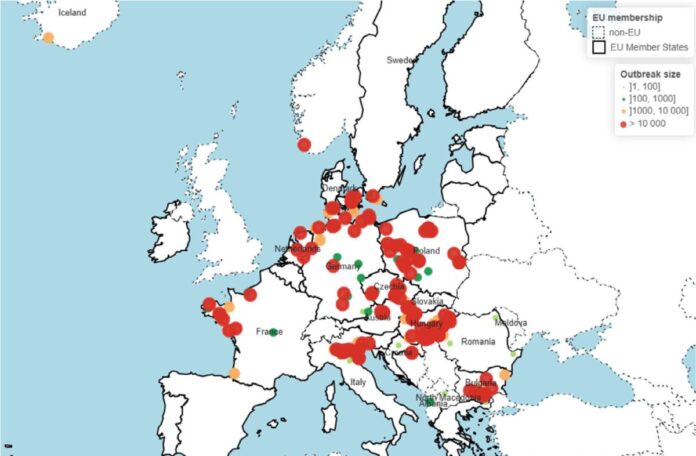
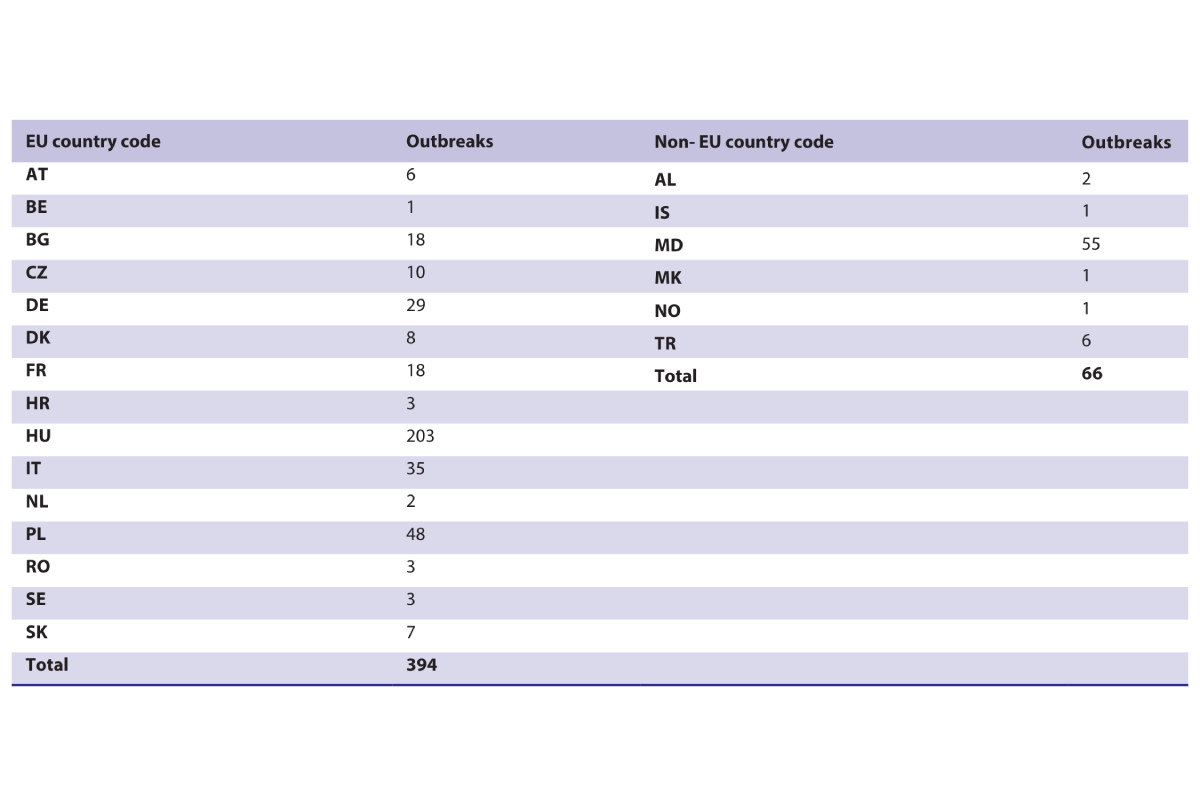
ADIS (Animal Disease Information System), the EU information system for animal diseases, recorded 394 outbreaks in EU countries and 66 in non-EU countries in 2024 (Table 1 and Figure 1). In detail, fifteen EU countries (Austria, Belgium, Bulgaria, Czech Republic, Germany, Denmark, France, Croatia, Hungary, Italy, Netherlands, Poland, Romania, Sweden, Slovakia) and six non-EU countries were affected (Albania, Iceland, Moldova, North Macedonia, Norway, Turkey).
Source
European Food Safety Authority (EFSA), Abrahantes, J. C., Aznar, I., Boom, M., Catalin, I., Dórea, F., Grant, M., Mulligan, K. F., & Zancanaro, G. (2025). Avian Influenza annual report 2024. EFSA Journal, 23(12), e9761.