

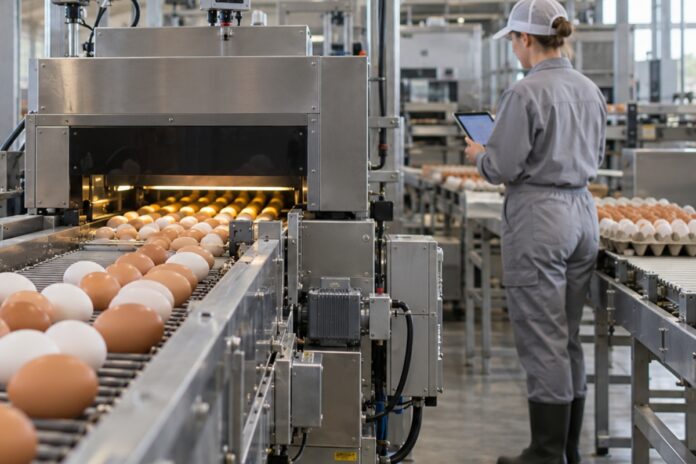
RaboResearch and the World Egg Organisation examine how digital tools, automation and artificial intelligence could change the way eggs are produced, packed and marketed.
The next gains in egg production may come not only from better genetics, nutrition or flock management, but also from making better use of information already collected across the supply chain.
This is the central message of a new report published by RaboResearch in collaboration with the World Egg Organisation (WEO). The future of egg value chains: How data, digital tools, and smart, connected systems will reshape the industry looks at how digitalization could affect the sector over the next decade and beyond.
Adoption is still at an early stage and varies widely between regions and production systems. Yet the reasons to invest are becoming clearer. Labour is harder to find, feed and energy costs remain volatile, disease risks are high, and customers increasingly expect evidence on welfare, sustainability and traceability.
Sensors are already able to collect information on climate, feed, water, energy use and equipment. Cameras can monitor bird behaviour and distribution, floor eggs, mortality and equipment status, while acoustic systems may help detect changes in bird health or stress. Robotics and automation can reduce repetitive work and improve consistency.
Artificial intelligence adds another layer by turning these streams of information into alerts, forecasts and recommendations. The aim is not to replace farmers, veterinarians or nutritionists, but to help them identify problems earlier and make better-informed decisions.
From individual farms to a connected chain
The larger opportunity, according to RaboResearch, lies in connecting data between the different stages of the egg value chain.
Flock forecasts, for example, could be compared with grading results, stocks and customer demand. Producers and packing operations would then be able to identify shortages or surpluses earlier and adjust their plans.
In many cases, the data already exists but remains scattered across systems that were not designed to communicate with each other. Progress will therefore depend as much on integration and common standards as on new sensors, cameras or AI applications.
There are also unresolved questions. Companies will need to decide who owns the data, how it can be shared safely and how the benefits should be divided. Cybersecurity, investment costs and staff skills will also influence the pace of adoption.
Most of the industry is still building basic data visibility or starting to connect separate systems. Only a minority of leading companies have moved towards predictive management, and RaboResearch expects a broadly coordinated value chain to take a decade or more to emerge.
Rather than fully automated egg production, the report sees “supervised autonomy” as the more realistic direction: digital systems will take on more monitoring and forecasting, while people will remain responsible for strategy, investment and professional judgement.