
Maintaining strict biosecurity is vital in poultry farming, with cleaning and disinfection (C&D) serving as a cornerstone for flock health and performance. On-field evidences show that well-implemented C&D can generate a return on investment and improve the performance of the flock even when infection pressure is low.
Giuditta Tilli1, Hilde Van Meirhaeghe1, Hedia Nasri Smaili2, Ana Mansilla2, Giulia Graziosi3, Tiago Prucha1, Maarten De Gussem1,4
1Vetworks bv, Knokstraat 38, B-9880 Poeke, Belgium – giuditta.tilli@vetworks.eu; maarten.degussem@vetworks.eu)
2CID lines, an Ecolab Company, Waterpoortstraat 2, 8900 Ieper, Belgium
3Department of Veterinary Medical Sciences, University of Bologna, Via Tolara di Sopra, 50, 40064 Ozzano dell’Emilia (BO), Italy
4Faculty of Veterinary medicine, Ghent University, Salisburylaan 133, 9820, Merelbeke, Belgium
Background
Maintaining high biosecurity and hygiene standards in poultry production is essential for animal health, welfare, and production efficiency. When considering the wide range of biosecurity measures applicable to poultry farms, cleaning and disinfection (C&D) procedures stand out as a fundamental decontamination tool between two consecutive flocks, limiting the persistence of viral and bacterial pathogens, and creating the conditions for optimal flock performance.
Looking at the evidence available today, some scientific studies show how certain biosecurity measures can have a positive impact on key technical parameters. In the specific case of C&D, recent research indicates that well‑implemented C&D protocols can positively influence flock performance (increase in weight gain) (Ngom et al., 2025), reinforcing the idea that biosecurity is not only a preventive measure but also a factor that can positively support productive outcomes.
However, beyond applying these measures, it is equally important to understand how their effectiveness can be evaluated on-farm. For this reason, assessing C&D efficacy is a crucial component of any biosecurity program. In terms of what can be practically adopted, several methodologies are available to verify whether C&D have been carried out successfully, ranging from visual inspection to microbiological sampling and ATP bioluminescence testing to samples for bacterial load. Each method provides a different level of sensitivity and can be used to monitor compliance, identify critical points, and guide continuous improvement.
Table 1 summarizes the main approaches currently used to assess the effectiveness of C&D procedures according to recent scientific literature (adapted from Makovska et al.).
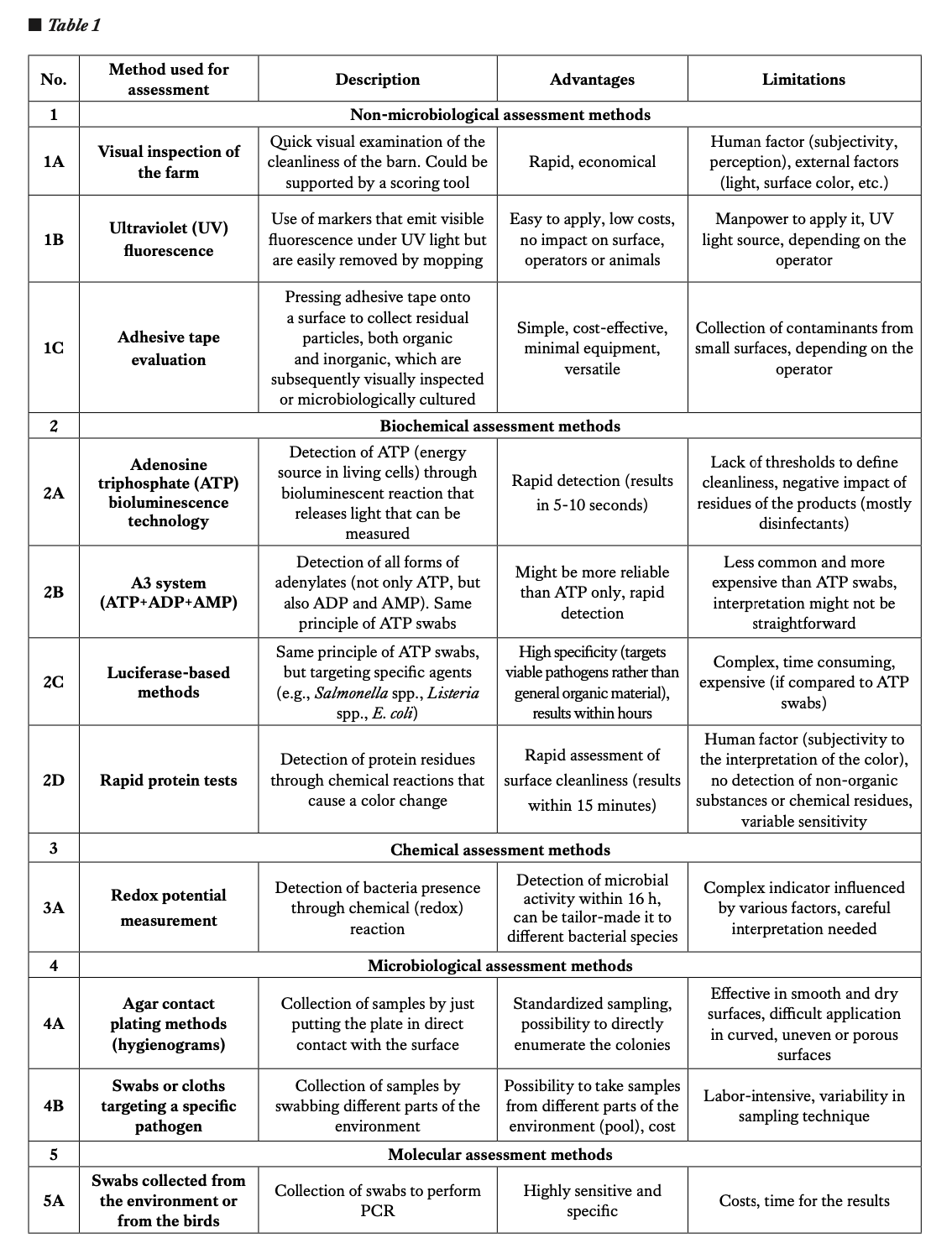 These methods represent what is currently available and practical for evaluating the effectiveness of C&D according to the scientific literature. Field validation, however, is a different challenge: commercial farms are dynamic environments where structural differences (e.g., coated vs. not coated floor in the poultry barn), management routines, and daily variability can influence the outcomes of the assessment. For this reason, an integrated approach that combines different assessment methods is recommended when assessing C&D, as it provides a complete and reliable picture of how effective the procedures truly are.
On-field application
To give a practical example on the efficacy of C&D, a field trial was carried out on a set of commercial broiler farms in Belgium. The goal was to compare the microbiological situation in the poultry barn environment before and after introducing a different hygiene protocol and a training on how to properly apply it, with the final purpose of measuring the impact of a complete hygiene program on production results. The products used were a strong alkaline detergent composed of sodium hydroxide and potassium hydroxide (1.5% dilution), and a broad-spectrum disinfectant composed of quaternary ammonium and glutaraldehyde (1% dilution). The tested hygiene program is reported below:
- Dry cleaning: removal of organic matter from the barn environmental surfaces
- Wet cleaning: application of detergent foam with high pressure foam lance (50-150 bar) and cold water, 30 minutes contact time
- Rinsing with water
- Drying
- Disinfection: application of disinfectant foam application with high pressure foam lance (50-150 bar)
- Drying
- Ventilation (after 24 h from the application of the disinfection)
The measurement of the efficacy of the C&D procedures was performed by assessing the barn environment subject to the application of the different products during the downtime. Seven different areas of the empty barn were sampled: floor, feeders, drinkers, walls, ceiling, air inlets, and feed hoppers. From each of the surfaces, the level of C&D was measured by adopting some of the methods reported in Table 1, in particular: ATP swabs (no. 2A, Figure 1), bacterial count (no. 4B), enterococci count (no. 4B), and screening for E. coli and fungi (no. 4B). Finally, performance parameters of the flock starting after the sampled downtime period were statistically correlated to look for the efficacy of C&D in the cleanliness of the environment with how the flock was performing.
Considering this specific study, the application of such protocol resulted in increased average daily gain (+ 0.00165 kg/day), and a reduction of around 7% relative mortality when compared to a different C&D program.

Looking ahead
When it comes to biosecurity, one of the biggest challenges is creating real awareness and helping people appreciate its importance. This becomes even harder when measures are applied over and over again, and their effects are not immediately visible or easy to quantify. After a while, it is natural for farmers and staff operating in the farms to wonder whether implementation and compliance with biosecurity truly makes a difference. That is why having clear, concrete results is so valuable: they help show that biosecurity is a practical tool that protects the flock and supports the farm’s performance. The present small‑scale trial adds field‑based evidence from commercial farms, indicating that the implementation of structured C&D procedures can yield measurable performance improvements, corresponding in this case to an increase of up to +2.41% in economic return after accounting for the cost of application, and considering the positive reduction of mortality and increase of average daily gain. Providing such practical, data‑driven metrics may support broader adoption of biosecurity measures and targeted training, reinforcing the concept that biosecurity interventions are not only biologically effective but also operationally advantageous under commercial conditions.
Within the broader effort to promote biosecurity education among poultry‑sector stakeholders (farmers, managers, veterinarians, and others), it is essential to ensure that these types of data are collected and disseminated. Such evidence‑based information supports informed decision‑making and contributes to strengthening the overall perception and understanding of biosecurity.
Bibliography
Makovska, K., et al. (2025). Assessment of cleaning and disinfection efficiency in poultry farms: Current methods and field perspectives. Frontiers in Veterinary Science, 12, Article 1581217. https://doi.org/10.3389/fvets.2025.1581217
Ngom, S., et al. (2025). Effect of biosecurity practices on broiler performance under low infection pressure. Veterinary Medicine and Science, Advance online publication. https://doi.org/10.1002/vms3.70526