
This study was carried out at the Poultry Research and Development Unit, El Wadi Company Farms and Poultry Nutrition Laboratory, Environmental Studies and Research Institute, Minufiya University, El Sadat Branch.
Preparation of feed additives
L-carnitine (LC) used in the experiment (Carniking®) was 3-carboxy-2-hydroxypropyl trimethylammonium hydroxide manufactured by Lohmann Animal Health GmbH & Co. KG, Germany; the inner salt was obtained from the International Free Trade Company (IFT). The herbal mixture (HM), composed of 6 different medicinal and aromatic plants, was purchased commercially in dried form as a supplement and consists mainly of thyme (Thymus vulgaris L.), oregano (Origanum vulgare L.), clove (Syzygium aromaticum L.), marjoram (Origanum marjorana L.), rosemary (Rosmarinus officinalis) and peppermint (Mentha piperita), that were mixed and ground to become a fine powder, then kept in clean, dry, sealed plastic bags.
The mixture was supplemented during the preparation of the experimental diets.
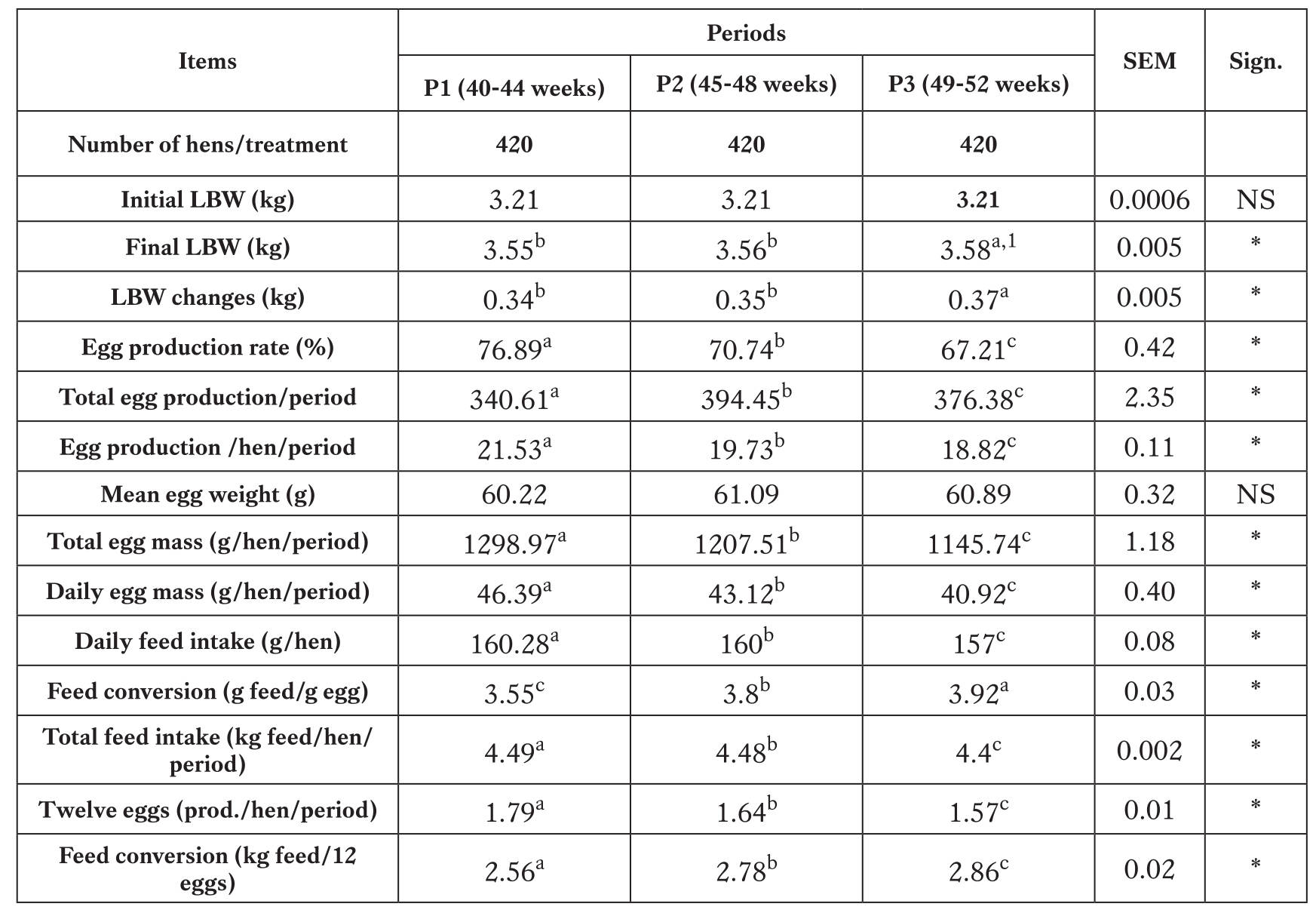
a, b, c, d: Means followed by different superscripts in the same row are significantly different (p <0.05).
NS: not significant; SEM: standard error of the mean.
The objective of this investigation was to study the productive and reproductive performance of broiler breeder hens as affected by LC, as an artificial antioxidant, and HM, as a natural antioxidant, supplementation during the period from 40 to 52 weeks of age in laying hens.
A total of 462 Ross 308 broiler breeder hens at 40 weeks of age were used to evaluate the effect of dietary supplementation with LC and HM on productive and reproductive performance, egg quality traits, blood parameters, microbiological status and economic efficiency.
Feed was restricted according to the breeder program. Water was supplied ad libitum. All hens were kept under the same managerial, hygienic and environmental conditions throughout the entire experimental period, which lasted for 12 weeks.
The corn-soybean meal basal diet was formulated to cover the nutrient requirements recommended for the breed and served as the control diet; 3 supplemented levels of L-carnitine (10, 20 and 30 mg/kg diet) respectively for T1, T2 and T3, and 3 supplemented levels of herbal mixture (5, 10 and 15 g/kg diet) respectively for T4, T5 and T6.
Initial body weight, final body weight, body weight change, egg production, egg production rate, egg weight, egg mass, feed efficiency ratio, hatchability, egg quality and composition analysis were determined. Blood parameters, microbiological and immunological studies, embryonic studies were determined and economic efficiency was calculated.
The results indicated that:
- Addition of HM as a natural antioxidant to laying hens diets increased egg number and improved feed conversion more than LC, used as an artificial antioxidant.
- Addition of HM tended to improve fertility, hatchability and hatchability of fertile eggs, and decreased both embryonic early and late dead compared to LC supplemented groups.
- Inclusion of dietary levels of HM in broiler breeder hens’ diets up to 15 g/kg significantly improved internal and external egg quality parameters.
- Addition of HM increased antioxidant capacity in blood plasma while decreased LDL, HDL, total cholesterol, triglycerides and total lipids in blood plasma.
- The combination of 15 g HM/kg diet is the most successful additive for improving hatchability under the condition of this study.
- Further studies must be carried out to investigate the possibility of using natural antioxidants in commercial broiler breeder hens’ diets for a long period of time during laying periods.
In general, based on the experimental results obtained herein and from an economic point of view, it may be concluded that supplementation with the herbal mixture at a level of 15 g/kg diet in broiler breeder hens improved productive and reproductive performance, as well as economic efficiency, compared to the artificial antioxidant L-carnitine during the 40–52 week laying period.
Economic efficiency
The economic efficiency of the study was calculated based on an analysis of outputs and inputs, considering the total revenue per hen per period and the total cost per hen per period. Calculations were made according to market prices during the experimental period: 1 kg of L-carnitine = 500 EGP, 1 kg of herbal mixture = 5 EGP and the price of one day-old chick = 2.5 EGP.
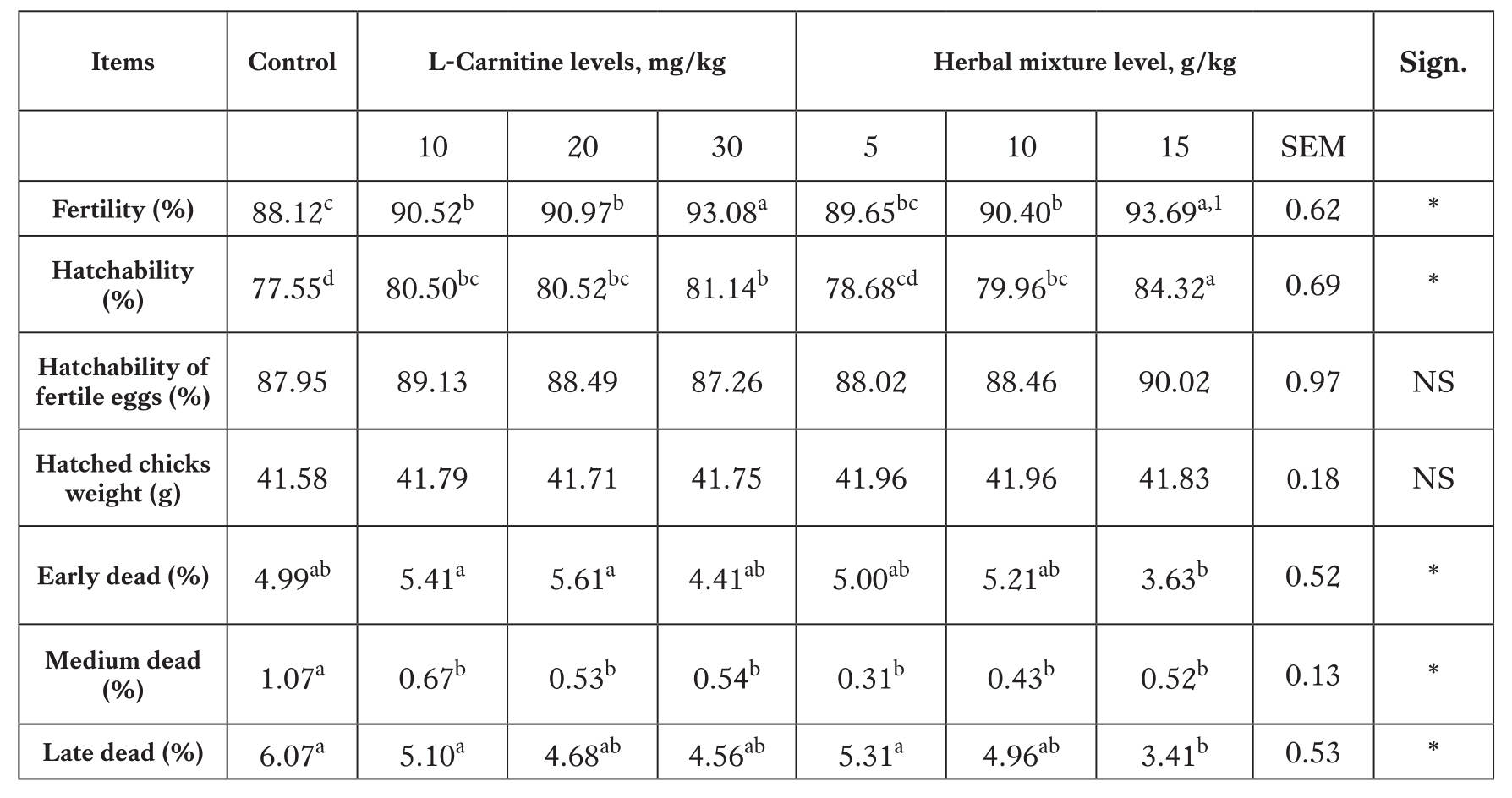
a, b, c, d: Means followed by different superscripts in the same row are significantly different (p<0.05).
NS: not significant; SEM: standard error of the mean.