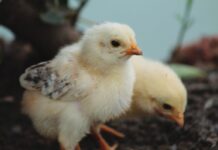

On-farm hatching is an innovative hatching technique that provides early feeding post hatch to newborn chicks. Several experimental studies and field trials show that flocks hatched on-farm have better intestinal health and health in general, resulting in fewer antibiotic treatments and better welfare.
➤ Hilde Van Meirhaeghe1,2, Giuditta Tilli1, Maarten De Gussem1,2
1 Vetworks bvba, Knokstraat 38, Poeke B-9880, Belgium2 Faculty of Veterinary Medicine, University of Ghent, Salisburylaan 133, 9820, Merelbeke, Belgium
It is a challenge for the poultry industry today to meet consumer demands for more welfare and less antimicrobial use in a sustainable way with good return on investment (ROI) for the producers.
The main indications for antimicrobial use (AMU) in broilers occur during the first week of life, against bacterial translocation and septicemia (e.g., E. coli, Enterococci) and after three to four weeks for intestinal problems such as coccidiosis and dysbacteriosis (Joosten et al., 2019).
Why early feeding?
Hatching chicks in a hatchery was a great invention that made the expansion of the poultry industry possible. To do this successfully all chicks must hatch within a narrow hatch window, to avoid early-hatched chicks becoming dehydrated. After hatch, chicks need to be transported to the farm before they have access to feed and water. Nature has provided the chick with a reserve of nutrients inside the yolk sac for three days. Therefore, chicks will not starve if not fed, but they use all the energy, fat and protein from the yolk to survive. By providing early feeding, additional nutrients can be used to start early development, maturation and growth: chicks get a better start. Early feeding will enhance the development of intestines and the immune system. The intestinal villi have greater capacity to absorb nutrients. Early establishment of the intestinal microbiome and faster closure of tight junctions make a more functional gut barrier to avoid bacterial translocation. It seems controversial but with early feeding the yolk sac is reabsorbed faster, so maternal antibodies are more effective. Early feeding makes the metabolic level higher so chicks can keep up their body temperature.
To get most of the genetic potential in performance, intestinal health is very important. The effect of early feeding on performance is most significant in the first weeks (de Jong et al., 2020). Early feeding makes the intestinal tract better equipped to resist intestinal diseases like coccidiosis and dysbacteriosis, resulting in fewer wet litter problems and consequently fewer painful conditions like footpad dermatitis, hock burn and breast blisters.
Early feeding can be done pre- and post- hatch. Several experimental studies have shown benefits of in-ovo early feeding at transfer (Uni et al., 2005), but none of these studies resulted in practical applications until now. After hatching, early feeding can be done in the hatcher or by hatching the eggs on the farm. In this article we focus on the latter.
On-farm hatching
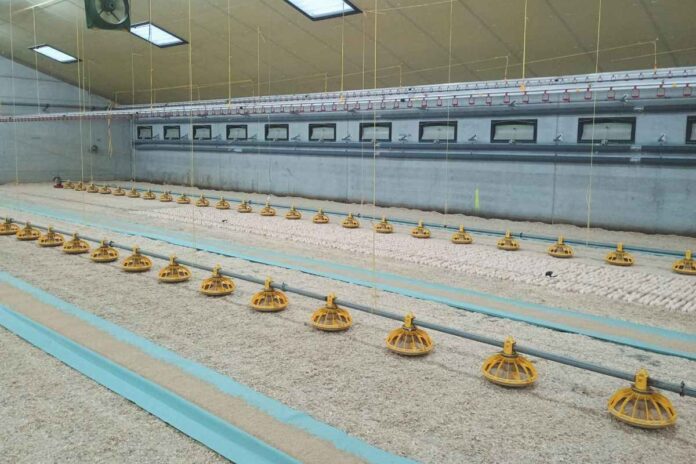
On-farm hatching is not only a system to deliver early feeding, but also to hatch chicks in a more comfortable environment with less stress. Eggs are incubated in the hatchery until transfer at D18. After candling, infertile eggs are removed, and instead of being placed in the hatcher are transported to the farm and placed in the house in trays or on the litter to hatch. Just as in the hatcher the environment in the house needs to be controlled and eggshell temperature is measured with ovoscans. The house is heated to 34 °C with floor and litter temperature 28 °C. About 50 g of feed per chick is put on paper close by where eggs are placed.
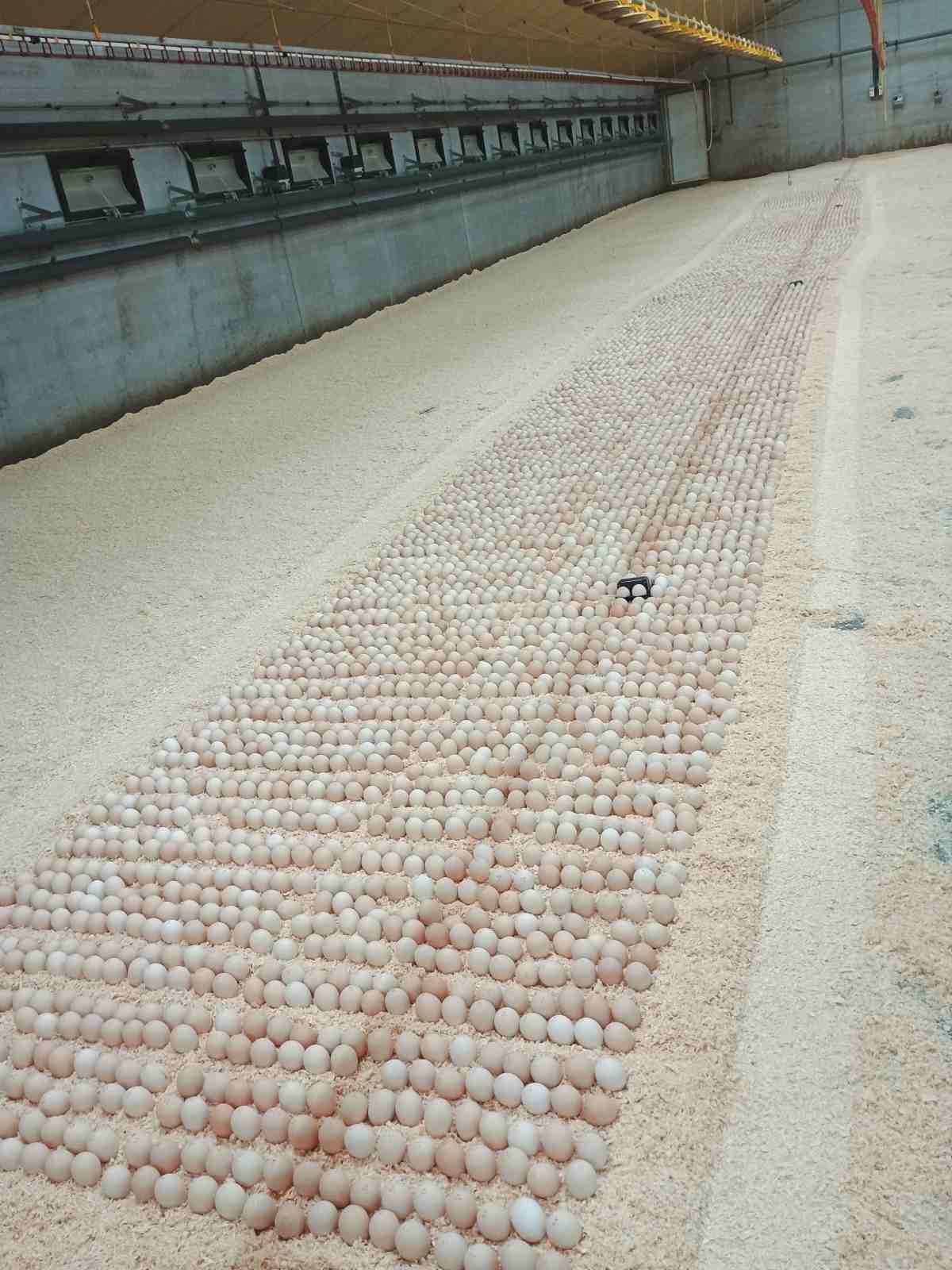
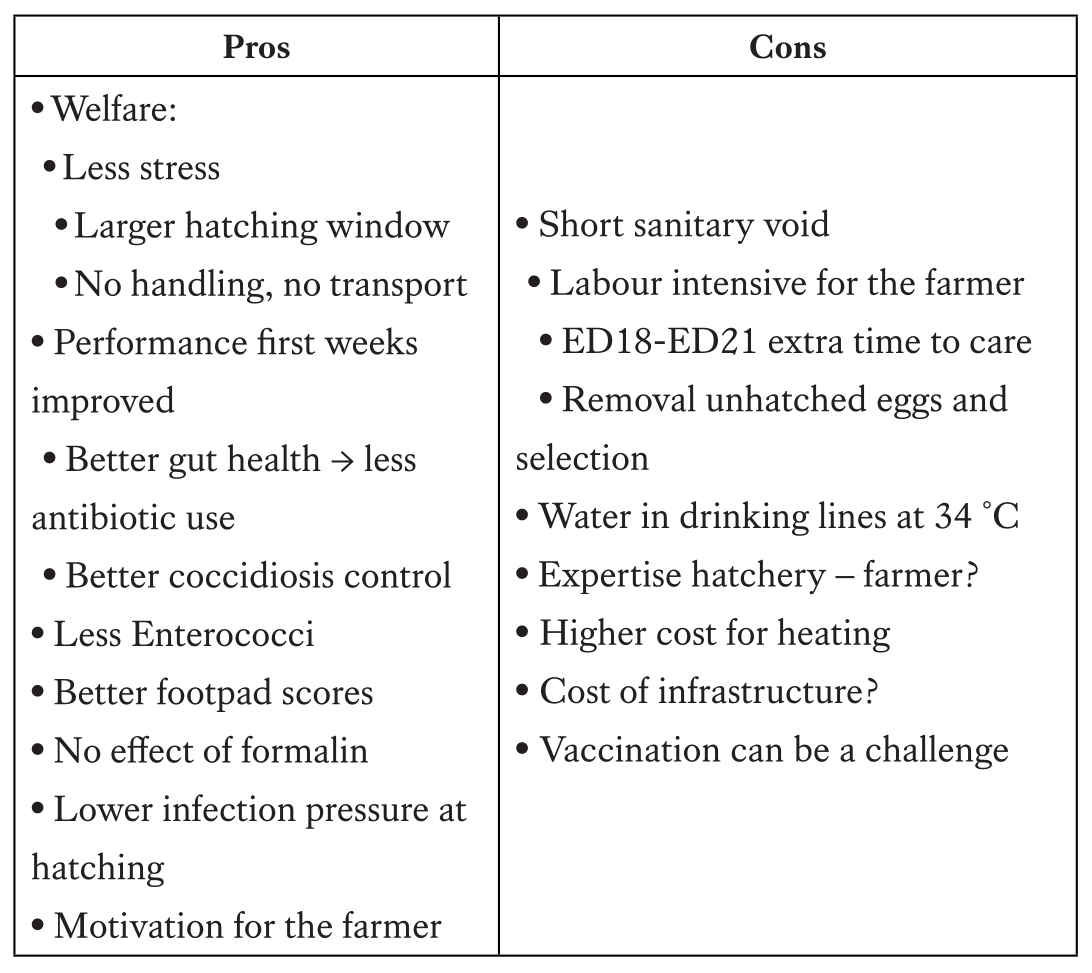
The chicks start hatching as from D19 until D21 like in the hatchery, but feed and water are immediately available, so no risk of dehydration of the early hatched chicks. Another advantage is that there is less stress for the chicks, no handling of the chicks and no transport. The infection pressure of pathogens and dust is lower in the house compared to the hatcher machine and less risk of cross-contamination. Challenges for the farmer are that it is more labor intensive: three days extra care, non-hatched eggs need to be removed, and non-viable chicks need to be selected in the first week. Empty eggshells can remain in the litter. Hatchability is comparable or even better than conventional hatching, taking into account selection of second grade chicks. The number of chicks is calculated at D7 based on number of eggs placed, removed non-hatched eggs and first week selection. Compared to conventional hatching, there is a higher cost for three days extra heating and if the farmer wants to do the same number of cycles per year, sanitary void is shorter.
Reduced antimicrobial use
A recent study (Jerab et al., 2023) compared antimicrobial use in flocks hatched conventionally and flocks hatched on farm. There was a reduction in the use of antimicrobials in on-farm hatched flocks, mainly because there was less AMU in first week and for locomotory problems (Enterococcus spp.) and fewer intestinal diseases. In the study 15% of all flocks were raised without antibiotics, 48% of these were on-farm hatched versus only 12% conventionally hatched.
What are the practical issues?
It is important that the climate in the house is well controlled, especially from ED18-ED21, just like in the hatchery eggshell temperature has to be monitored, so the farmer can adjust at all times.
Special attention is needed to clean the waterlines, because of high temperatures for three days the waterlines need to be flushed regularly.
Non hatched eggs can contain live embryos, so for welfare reasons they need to be removed and euthanized in a humane way. Depending on the system, this can be easier and faster if they remain in a tray, than if each egg has to be picked up manually.
Biosecurity risks need to be avoided: all equipment -trays, support system, robots used on different farms and going back to the hatchery have to be properly cleaned and disinfected.
Vaccination of the day-old chicks on farm can be challenging. Many vaccines (e.g. Newcastle disease, Gumboro, coccidiosis) can be administered in-ovo at transfer in the hatchery. Some vaccines (infectious bronchitis) need to be sprayed at the farm, with special spray machines that can reach more than 4 meters so the chicks can be reached from the side without walking through them.
Conclusions
On-farm hatching is an innovative technique to hatch chicks with less stress and reduced risk of infection. Chicks have immediate access to feed and water, this improves early development of a healthy gut and a strong immune system to resist diseases in general, so fewer antimicrobial treatments are needed.
On-farm hatching is a promising innovative strategy to improve welfare and performance and reduce antimicrobial use (Table 1).
Today on-farm hatching is mainly used in broilers, but maybe in the future, combined with early sexing techniques, it could also be used in layers and breeders.
Bibliography
Joosten, P., Timmerman, A., & Van den Broek, J. (2019). Quantitative and qualitative analysis of antimicrobial usage at farm and flock level on 181 broiler farms in nine European countries. Journal of Antimicrobial Chemotherapy. https://doi.org/10.1093/jac/dky498
de Jong, I. C., van Riel, J. W., & van Krimpen, M. M. (2020). Effects of early feeding on broiler performance and gut health. Poultry Science, 99(7), 3456–3468. https://doi.org/10.1016/j.psj.2020.06.052
Uni, Z., Ganot, S., & Sklan, D. (2005). In-ovo feeding improves early growth and gastrointestinal development in chicks. Poultry Science, 84(5), 764–770. https://doi.org/10.1093/ps/84.5.764
Jerab, J. C., Smith, L., & Kovac, M. (2023). Impact of on-farm hatching on antimicrobial use and broiler welfare. Animals, 13(32), 3270. https://doi.org/10.3390/ani13203270