
10–13 November 2026 in Hanover – Guiding theme: “Intelligence in animal farming” – Comprehensive technical program – DLG Spotlight: Emission Reduction – eurotier.com
Reducing emissions in pig and poultry production has become a key factor in animal welfare, climate and environmental protection as well as compliance with regulatory requirements. As emission efficient housing systems evolve rapidly, EuroTier 2026, the world’s leading trade fair for animal farming and livestock management; , will offer a comprehensive overview of the latest developments. The DLG Spotlight “Emission Reduction” in Hanover, Germany, will present both proven practical approaches and innovative concepts currently being tested, complemented by expert presentations on the two DLG Expert Stages for Pig and Poultry.
Reducing emissions in pig and poultry production has become a key factor in animal welfare, climate and environmental protection as well as compliance with regulatory requirements. As emission efficient housing systems evolve rapidly, EuroTier 2026, the world’s leading trade fair for animal farming and livestock management; , will offer a comprehensive overview of the latest developments. The DLG Spotlight “Emission Reduction” in Hanover, Germany, will present both proven practical approaches and innovative concepts currently being tested, complemented by expert presentations on the two DLG Expert Stages for Pig and Poultry.
Rising regulatory pressures and need for integrated solutions
Livestock farms have faced increasing environmental expectations in recent years. Ammonia and greenhouse gas emissions remain the primary focus, while odor and particulate emissions continue to receive attention. Farms must therefore optimize their production systems to meet environmental standards, ensuring that all solutions remain practical, economically viable and reliable. emission reduction is no longer a stand alone issue, but part of holistic farm management.
Emission reduction in pig production
One of the most effective emission reduction measures in pig production begins with feeding management.The goal is to reduce nitrogen excretion—primarily urea—to limit ammonia formation at the housing level. This is achieved by supplying amino acids tailored to the animals’ specific requirements. Nitrogen- and phosphorus-reduced feeding strategies are recognized Best Available Techniques (BAT) and can significantly lower ammonia emissions.
Housing technology and management
Alongside feeding strategies, modern housing technology measures play a decisive role in reducing emissions. Ammonia in the housing forms when feces and urine come into contact; the reaction starts quickly and intensifies the longer the mixture remains on floors or other surfaces.
Reducing the emitting surface area in manure channels — for example using V shaped plastic gutters — decreases the cross section and reduces ammonia release. Many systems also shorten the retention time of manure inside the barn, keeping emissions low.
Reducing the emitting surface area in manure channels — for example using V shaped plastic gutters — decreases the cross section and reduces ammonia release. Many systems also shorten the retention time of manure inside the barn, keeping emissions low.
Air scrubbers and additional technologies
In large mechanically ventilated barns, air scrubbers have become an essential element of emission control. These systems can reduce ammonia and dust emissions by at least 70 percent, while also significantly lowering odor levels. For larger installations, air scrubbers are mandatory under the German Federal Immission Control Act (BImSchG).
Other promising approaches include slurry acidification. Lowering the pH shifts nitrogen into ammonium form, preventing volatilization. Studies report emission reductions exceeding 60 percent, though structural adjustments and corrosion protection are required
Other promising approaches include slurry acidification. Lowering the pH shifts nitrogen into ammonium form, preventing volatilization. Studies report emission reductions exceeding 60 percent, though structural adjustments and corrosion protection are required
Emission reduction in poultry production
In poultry production, ammonia emissions arise primarily from microbiological decomposition processes in manure and litter. Accordingly, many measures focus on optimized litter and housing climate management. For example, pH lowering additives can be incorporated into the litter. By strongly reducing the pH in the litter to around pH 2, microbial activity is inhibited, and ammonia is chemically bound in the manure layer as ammonium sulfate.
DLG spotlight and expert stages at EuroTier 2026
The DLG Spotlight “Emission Reduction” at EuroTier 2026 will present hands on solutions demonstrating how modern livestock farming and environmental protection can be successfully combined. Exhibitors will showcase technologies and management tools for reducing emissions in pig and poultry systems, offering farmers practical ideas and solutions for optimizing their operations. At the center is the understanding that effective emission reduction requires a coordinated mix of feeding, management and technology.
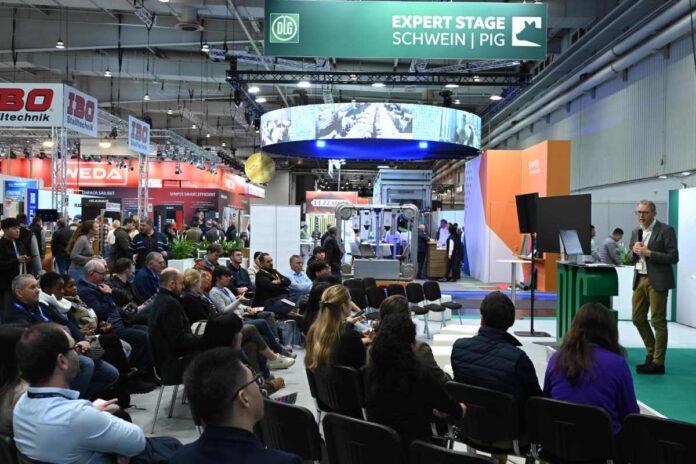
The spotlight is complemented by two species specific stage formats: the “DLG Expert Stage Pig” and the “DLG Expert Stage Poultry”.
At the DLG Expert Stage Pig, exhibitors join practitioners, researchers and advisory experts to discuss how animal welfare, feeding and emission reduction can be implemented in an economically viable way.
The DLG Expert Stage Poultry focuses on the specific requirements of poultry production—including hygiene, animal welfare, feeding and environmental impact. Current production concepts, innovative housing approaches and future trends for a competitive and sustainable poultry sector will be presented.
The spotlight is complemented by two species specific stage formats: the “DLG Expert Stage Pig” and the “DLG Expert Stage Poultry”.
At the DLG Expert Stage Pig, exhibitors join practitioners, researchers and advisory experts to discuss how animal welfare, feeding and emission reduction can be implemented in an economically viable way.
The DLG Expert Stage Poultry focuses on the specific requirements of poultry production—including hygiene, animal welfare, feeding and environmental impact. Current production concepts, innovative housing approaches and future trends for a competitive and sustainable poultry sector will be presented.
Source: EuroTier press release