


Salmonella infections in poultry production represent a turning point rather than a simple laboratory finding. In breeder and egg production systems, the identification of Salmonella Pullorum, Salmonella Gallinarum, or Salmonella Enteritidis triggers distinct epidemiological, economic, and public health consequences. This article presents a practical and science-based framework linking laboratory diagnosis with farm-level management decisions. Unlike many poultry pathogens that primarily affect bird health, Salmonella directly links flock productivity, hatchery performance, and public health. A single diagnostic report can influence egg flow, vaccination strategy, biosecurity level, and in certain cases the future of the flock itself.
The critical issue, therefore, is not only detection, but interpretation. Misreading laboratory data may lead either to costly overreaction or to dangerous inaction. The role of diagnostics is to guide decisions, not to trigger panic.
Stepwise diagnosis: from suspicion to confirmation
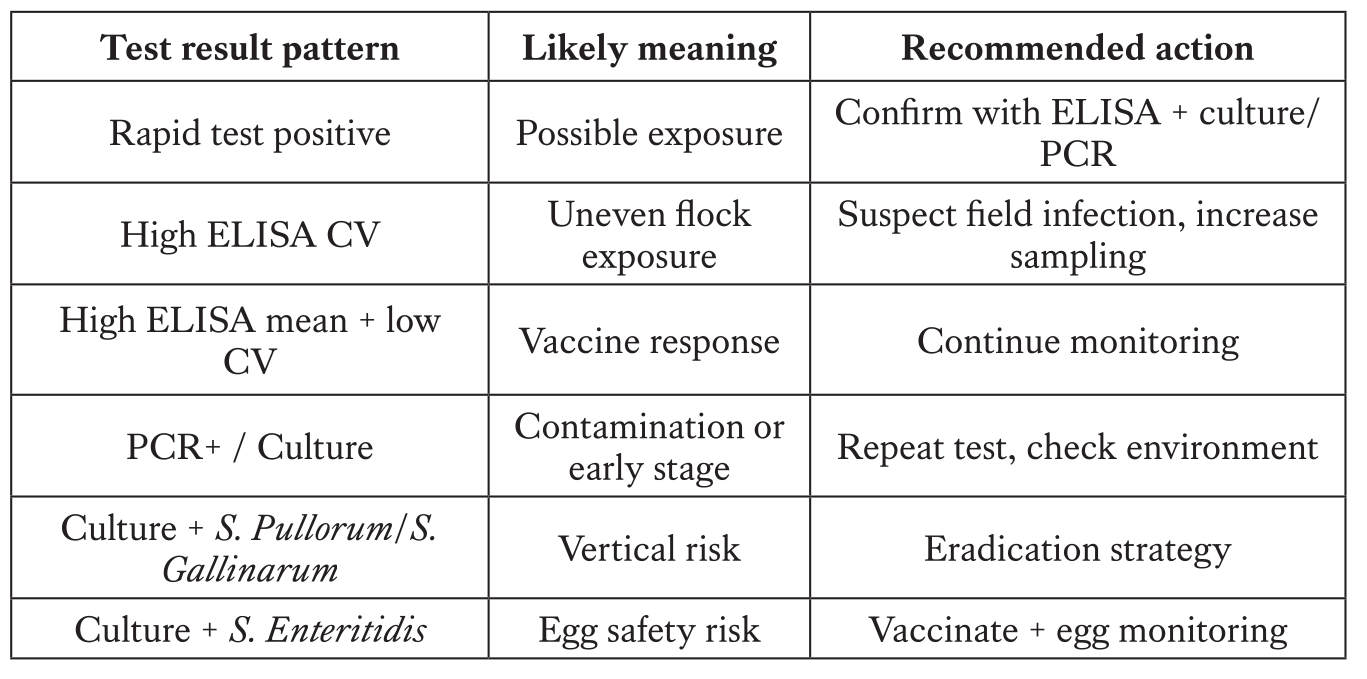
Field diagnosis usually begins with rapid screening tests. These tools are valuable for early warning, but they should not be treated as definitive evidence. A positive rapid result indicates possible exposure, not confirmed infection. At this stage, the correct action is increased sampling, review of hygiene weaknesses, and progression toward serology and bacteriology, not immediate drastic interventions.
Serology, particularly ELISA, adds another layer of information by describing the flock’s immune response. In vaccinated breeders, antibody levels typically follow a predictable and relatively uniform pattern. When titers rise clearly above baseline values provided by commercial kits and variation among samples increases, interpretation shifts toward field challenge rather than vaccine response alone.
The coefficient of variation (CV) becomes a practical field indicator. Lower CV values generally reflect uniform vaccine-induced immunity. Increasing CV suggests uneven exposure within the flock and supports suspicion of active infection pressure. ELISA therefore helps determine whether the immune system is reacting abnormally and whether confirmatory testing is required. Definitive interpretation depends on bacteriological isolation and molecular detection. At this stage, serovar identification determines the management pathway.
 Why the serovar changes the decision
Not all Salmonella findings have the same meaning. S. Pullorum and S. Gallinarum are host-adapted and capable of vertical transmission. Their invasion of reproductive tissues allows infection to pass through eggs to the next generation. Because of this long-term epidemiological impact, their detection in breeder flocks often justifies eradication-oriented decisions.
S. Enteritidis, in contrast, is primarily a food safety concern. Adult breeders may remain clinically normal while eggs become internally contaminated. Management therefore focuses on risk mitigation: vaccination, egg monitoring, environmental testing, and reinforced biosecurity, rather than automatic depopulation.
Other serovars frequently indicate environmental contamination rather than systemic infection, directing attention toward sanitation and hygiene improvement.
Microbiology explains persistence
The biological behavior of Salmonella explains why flocks may show repeated immune stimulation. These Gram-negative bacteria can survive for weeks or months in litter, dust, feed systems, drinker lines, and equipment surfaces. Moisture, organic matter, and biofilms create protective niches where bacteria persist despite routine disinfection.
Even well-vaccinated flocks may therefore remain under environmental challenge if reservoirs such as feed bins, egg belts, rodents, or insects are not controlled. Salmonella is susceptible to many disinfectants when cleaning removes organic matter first. Effective agents include formaldehyde and glutaraldehyde, oxidizing compounds such as hydrogen peroxide and peracetic acid, chlorine-based disinfectants in low organic loads, phenolic compounds, and quaternary ammonium compounds on clean surfaces. Heat above 70 °C rapidly inactivates the organism. Suboptimal concentrations, insufficient contact time, or heavy organic contamination allow survival, particularly in biofilms. Drying and downtime between flocks significantly reduces environmental burden.
 Transmission dynamics
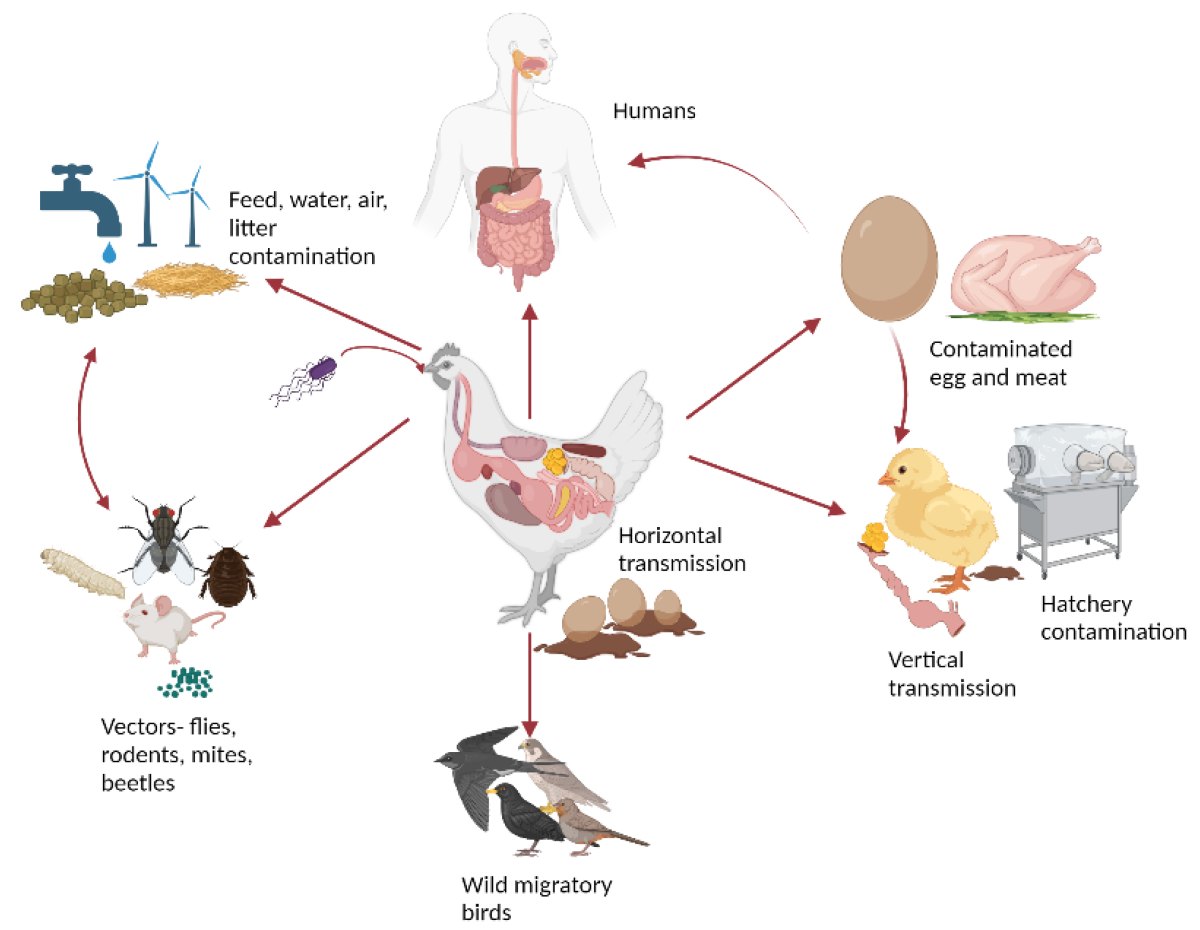
Vertical transmission defines the severity of S. Pullorum disease and fowl typhoid. Infection of the ovary allows bacteria to enter eggs before shell formation, producing infected chicks and sustaining infection cycles. S. Enteritidis also contaminates internal egg contents, linking poultry infection to human outbreaks. Horizontal transmission occurs via fecal contamination, feed, rodents, insects, equipment, and personnel. Environmental persistence means that infection pressure may continue long after clinical signs disappear. Understanding which pathway dominates helps managers prioritize hatchery sanitation, egg safety monitoring, or environmental hygiene.
Clinical and pathological features: supportive but not definitive
Breeder infections are frequently subclinical. Subtle indicators such as decreased egg production, poorer shell quality, or declining hatchability may be the first field signs.
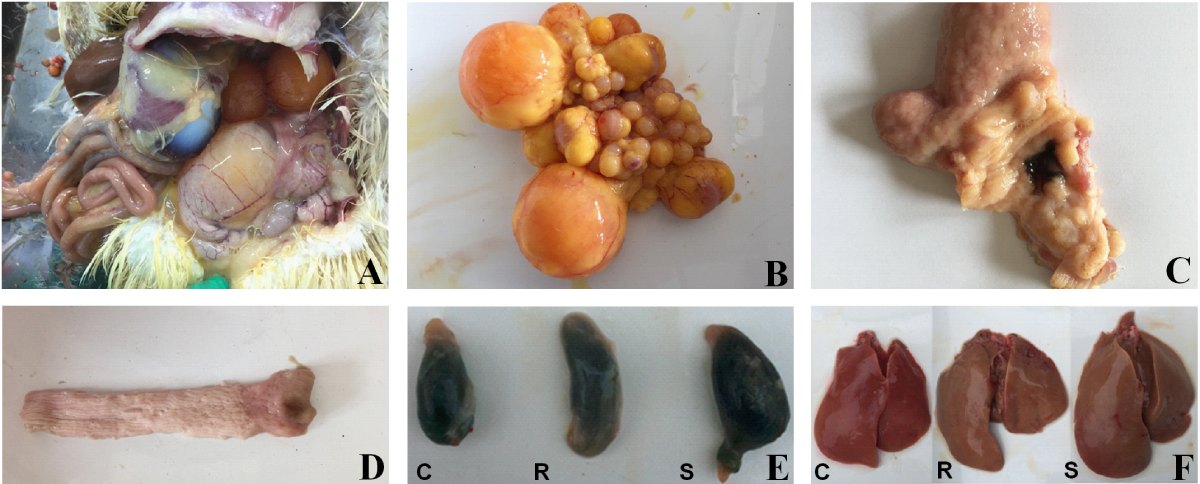
S. Pullorum disease predominantly affects young chicks, causing depression, white diarrhea, pasted vents, and high mortality. Fowl typhoid in older birds leads to septicemia, reduced egg production, and mortality. S. Enteritidis infection is often subclinical in adult breeders, making surveillance essential.
Necropsy commonly reveals enlarged liver and spleen, bronze liver discoloration, ovarian regression, caseous cecal cores, and peritonitis, especially in host-adapted infections.
Laboratory diagnosis as a management decision point
Isolation confirms Salmonella presence, but serotyping defines risk category. Detection of S. Pullorum or S. Gallinarum typically necessitates eradication due to vertical transmission. Identification of S. Enteritidis requires risk-reduction measures including vaccination, intensified biosecurity, egg testing, and trace-back. Thus, laboratory findings guide management philosophy.
Impact on hatching and table eggs
In breeder operations, S. Pullorum and S. Gallinarum infections compromise hatchability and chick viability. S. Enteritidis poses a major risk in table eggs, directly affecting public health and regulatory compliance.
Vaccination strategies
Live attenuated and inactivated vaccines reduce colonization and organ invasion, particularly against S. Enteritidis. However, vaccination does not eliminate infection and must complement surveillance and biosecurity.
Limitations of antimicrobial treatment
Antibiotics may reduce mortality but rarely eliminate carriers, interfere with monitoring, and promote resistance. Therefore, treatment is not a sustainable control strategy.
Prevention as a multi-layered system
Effective control integrates Salmonella-free chick sourcing, hatchery sanitation, heat-treated feed, rodent control, environmental monitoring, and strict biosecurity. Routine bacteriology and serology support early intervention.
Diagnostics as a decision tool: not just a test result
The real value of diagnostics lies in linking data to action. Rapid tests raise suspicion. ELISA describes immune dynamics. Culture and PCR identify the agent that determines the management response. When interpreted correctly, these tools prevent unnecessary treatments, poorly timed vaccination changes, and missed infections.
In breeder production, laboratory results are not the end of the process but the beginning of structured decision making. Interpretation is not detection alone, but protects productivity, reduces costs, and safeguards public health.
Practical field interpretation
When a Salmonella-related result appears, decisions should follow interpretation rather than reaction. A rapid positive slide agglutination test should not immediately trigger drastic measures, as it primarily reflects exposure to Salmonella antigens and may include maternal antibodies or vaccine-induced responses. Instead, it should trigger expanded investigation, acting as an early screening signal that identifies flocks requiring deeper evaluation through serology, bacteriology, or molecular testing.
ELISA patterns above kit baselines combined with rising CV suggest active field exposure rather than simple vaccine response. Uniform titers with low variability are more consistent with controlled vaccine immunity, whereas heterogeneous titers across the flock indicate uneven bacterial circulation. In this context, ELISA serves as a flock-level epidemiological tool rather than proof of bacterial presence.
PCR using commercial diagnostic kits provides rapid and sensitive detection of Salmonella genetic material and is particularly valuable in hatcheries, environmental monitoring, and early infection stages. However, PCR positivity should be interpreted carefully, as it may detect DNA from nonviable organisms after disinfection. A PCR-positive, culture-negative result therefore suggests contamination pressure or early-stage presence rather than confirmed active infection, and must be evaluated alongside serology and flock history.
Culture or PCR confirmation identifies the serovar that defines the management pathway. Isolation of host-adapted serovars such as S. Pullorum or S. Gallinarum indicates systemic and vertically transmissible infection with high management impact, while detection of S. Enteritidis signals zoonotic risk and egg-safety implications. Environmental serovars may point to hygiene gaps rather than flock infection.
Laboratory findings always gain meaning when matched with vaccination history, production performance, clinical signs, and environmental conditions. Only through integrated interpretation can veterinarians avoid overreaction, prevent unnecessary losses, and implement proportional control measures that protect both breeder productivity and public health.
References
Barrow, P. A., & Freitas Neto, O. C. (2011). Pullorum disease and fowl typhoid – new thoughts on old diseases: A review. Avian Pathology, 40(1), 1–13. https://doi.org/10.1080/03079457.2010.542575
BioChek. (2023). BioChek Salmonella ELISA test kit manual. BioChek BV.
Davies, R., & Wales, A. (2010). Salmonella contamination of cereal ingredients for animal feeds. Food Research International, 43(2), 626–631. https://doi.org/10.1016/j.foodres.2009.07.014
Desin, T. S., Köster, W., & Potter, A. A. (2013). Salmonella vaccines in poultry: Past, present and future. Expert Review of Vaccines, 12(1), 87–96. https://doi.org/10.1586/erv.12.138
Gantois, I., Ducatelle, R., Pasmans, F., Haesebrouck, F., Gast, R., Humphrey, T. J., & Van Immerseel, F. (2009). Mechanisms of egg contamination by Salmonella Enteritidis. FEMS Microbiology Reviews, 33(4), 718–738. https://doi.org/10.1111/j.1574-6976.2008.00161.x
International Organization for Standardization. (2017). ISO 6579-1:2017 Microbiology of the food chain — Horizontal method for the detection, enumeration and serotyping of Salmonella — Part 1: Detection of Salmonella spp. ISO.
Shivaprasad, H. L. (2013). Fowl typhoid and pullorum disease. Revue Scientifique et Technique (OIE), 19(2), 405–424.
Zhang, Y., Chen, Y., Gu, T., Xu, Q., Zhu, G., & Chen, G. (2019). Effects of Salmonella enterica serovar Enteritidis infection on egg production and the immune response of the laying duck (Anas platyrhynchos). Poultry Science. Advance online publication. https://doi.org/10.3382/ps/pey532