

 Commercial field data from broiler breeder birds at Namib Poultry Industries showed that automated grading improved flock structure. Compared with manual grading, automated grading reduced weight variability (CV) by 0.70 percentage points and increased uniformity by 3.28 percentage points. The results highlight the value of automated weighing and grading for more precise flock management. Future developments will combine automated grading and vaccination workflows, thereby reducing handling and supporting animal welfare.
Body weight control: the hidden driver of flock performance
Maintaining precise control over body weight remains one of the most decisive factors in broiler breeder management. Body weight development is closely linked to reproductive performance, flock synchronization and overall production efficiency. Birds that deviate from target weight ranges may respond differently to feeding programs, leading to greater variation within the flock and increased management complexity. Flock uniformity has been identified as an important determinant of production efficiency, animal welfare and overall economic outcomes in poultry production, while numerous environmental, nutritional, and management factors can contribute to variability among birds (Choi et al., 2026).
Consequently, not only average body weight but also the distribution of weights within a flock becomes highly relevant. Two key parameters are commonly used to describe this distribution: the coefficient of variation (CV), which reflects weight dispersion, and uniformity, which represents the proportion of birds within a defined target range. Together, these indicators provide a practical framework for evaluating flock structure and management success under commercial conditions.
A flock exhibiting low variability and high uniformity comprises a substantial proportion of birds within defined body-weight targets. This is particularly relevant in the context of broiler breeder production, as it facilitates the optimization of feeding programs and photostimulation schedules for the entire flock. Previous studies have highlighted the importance of maintaining flock uniformity in broiler breeder production, demonstrating clear associations between body-weight consistency and productive performance (Abbas et al., 2010).
Conventional grading practices are intended to reduce this variation, yet they still rely heavily on manual handling. This results in substantial labor requirements, variability in execution, limited data resolution, and increased frequency of bird handling. From both a management and animal welfare perspective, these limitations highlight the need for more standardized and objective approaches.
Automated grading technologies address these challenges by combining weighing, classification, and digital data acquisition into a single process. Such developments reflect a broader transition towards precision livestock farming (PLF), where digital technologies are increasingly used to support welfare monitoring and management decisions in poultry production (Rowe et al., 2019).
In this context, the present study evaluates an automated grading device (Agri Advanced Technologies, 2026) under commercial field conditions. The objective was to determine whether automated grading is associated with measurable differences in variability and uniformity and to assess the practical relevance of such systems for modern broiler breeder management.
Automated grading: the GRADY system
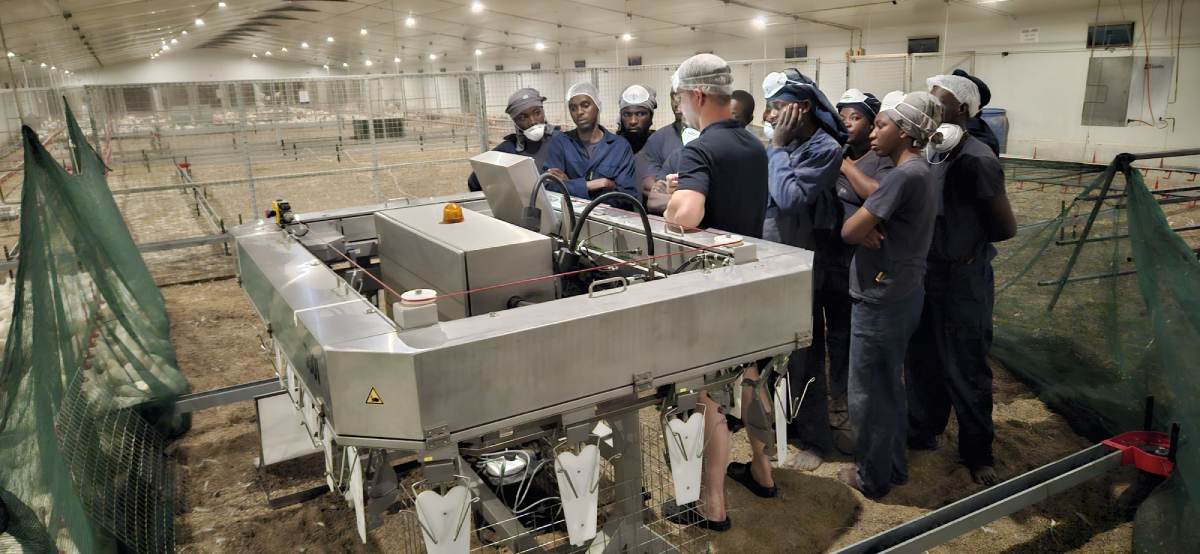
The GRADY system is a computer-controlled grading system designed for broiler breeder operations. The system integrates weighing, classification, and digital data recording into a single workflow, allowing birds to be weighed and sorted according to predefined weight categories.
Each bird is weighed using a high-precision load cell and automatically assigned to one of up to three weight classes. Classification thresholds are established from an initial sample at the beginning of the grading process and subsequently applied to the flock. Individual weights are recorded digitally, enabling the automatic calculation of performance indicators such as average body weight, coefficient of variation, and other flock-level parameters.
Under optimal conditions, the system can process up to 3,700 birds per hour, while practical throughput can exceed 2,600 birds per hour using a relatively small workforce (Agri Advanced Technologies, 2026). By standardizing both weighing and classification, the system seeks to reduce variation associated with manual procedures while simultaneously generating a more robust dataset for flock management.
Case study: implementation at Namib Poultry Industries
The evaluation was conducted using data collected at Namib Poultry Industries, one of Namibia’s major integrated poultry producers. Founded in 2011, the company operates a fully integrated production system comprising rearing houses, breeder farms, a hatchery, broiler farms, a feed mill, and a processing plant near Windhoek. Namib Poultry Industries is also the first company in Africa to implement the automated grading system.
The company operates nine rearing houses, each housing approximately 10,000 Ross 308FF breeders and supplies a broiler production system with a weekly processing capacity of approximately 350,000 birds. Operational performance data demonstrates the high production standards: During the financial year, breeder flocks produced 196.67 total eggs and 184.5 hatching eggs per housed hen, incubating only clean hatching eggs collected from nest boxes. Average flock uniformity increased from 88.5% prior to the implementation of automated grading to 94.3% thereafter.
The dataset analyzed in this study reflects routine management procedures and provides a comparison of flocks managed with and without automated grading under commercial conditions. Data from 3,803 birds were included in the analysis[1]. Of these, 2,463 birds originated from manually graded flocks, while 1,340 originated from automatically graded flocks.
To evaluate the effect of grading independently of biological variation, linear regression models were fitted for both coefficient of variation (CV) and flock uniformity. Grading strategy (manual vs. automated) was included as the primary explanatory variable, while age and sex were incorporated as covariates. Because growth-related effects are known to be non-linear, age was modeled using a second-order polynomial term. Additional sex-specific models were fitted to assess the consistency of grading effects in male and female birds. Robust standard errors were applied to account for potential heteroscedasticity and to ensure reliable statistical inference under commercial field conditions. The models explained a substantial proportion of the observed variation, with R² values of 0.51 for CV and 0.54 for uniformity.
 Results: changes in flock structure
Clear differences in flock structure emerged when manually graded and automatically graded flocks were compared.
Automated grading was associated with a reduction in flock variability (Figure 1). After accounting for biological factors, the use of GRADY was associated with a reduction in CV of approximately 0.70 units.
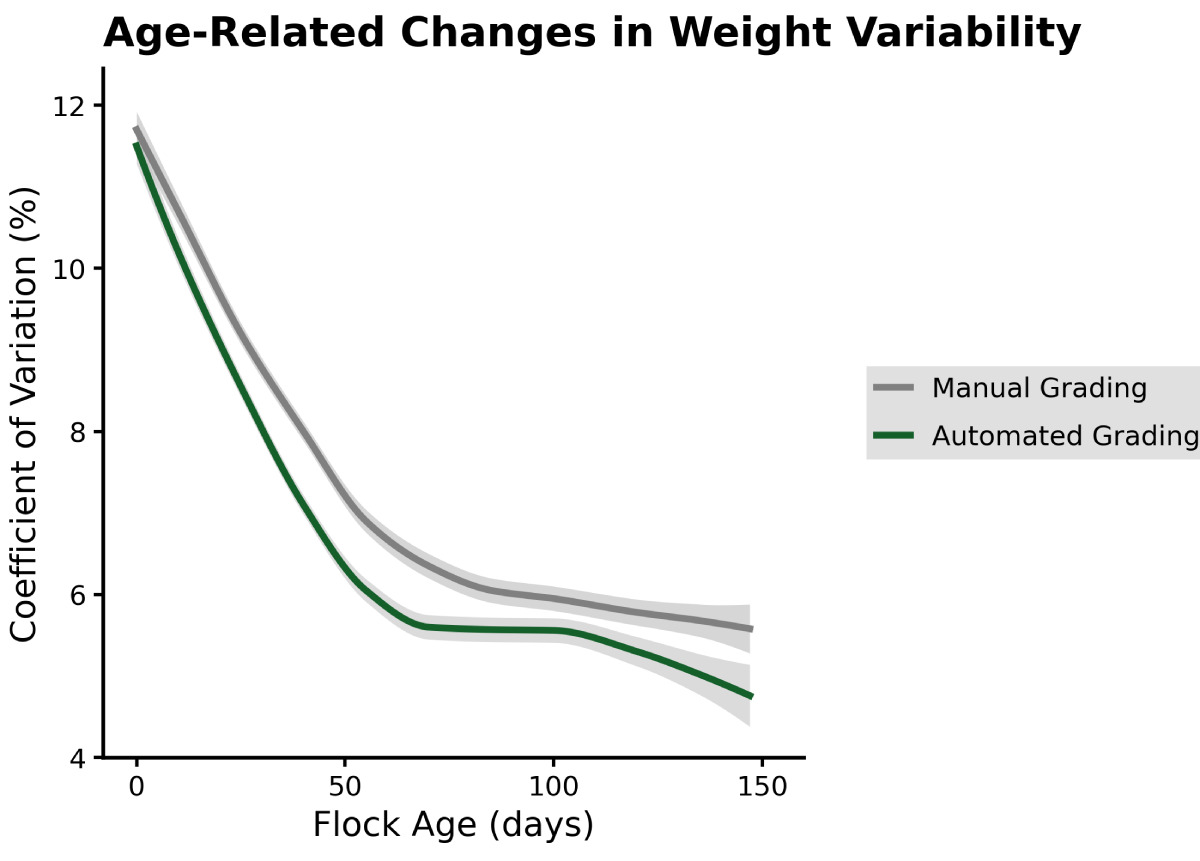
Although the numerical value itself may appear modest, its biological significance lies in what it represents: a tighter clustering of individual body weights around the flock mean. Birds of automatically graded flocks showed a higher similarity in body weight than birds managed through conventional manual grading. Consequently, flock structure became more homogeneous, predictable, and easier to manage.
Importantly, this effect was not restricted to a specific part of the population. Among male birds, automated grading was associated with a reduction in CV of approximately 0.76 units, while among females, the reduction was approximately 0.64 units.
A similar pattern emerged when uniformity was evaluated (Figure 2). Automated grading was associated with an increase in uniformity of approximately 3.28 percentage points. Rather than describing variation around an average, uniformity reflects how many birds remain within the desired weight range. An increase in uniformity therefore indicates that a larger proportion of the flock developed within management targets.
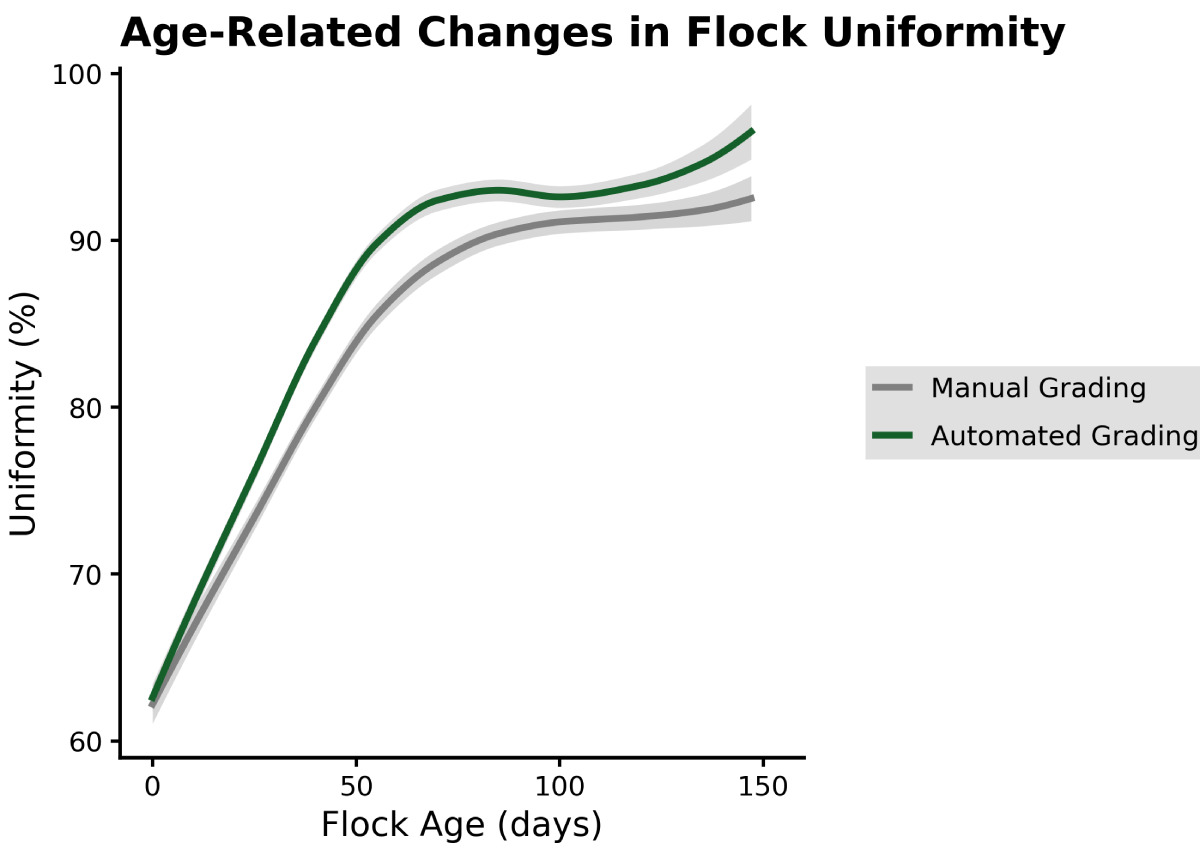
Again, the effect was observed in both sexes. Uniformity increased by approximately 3.31 percentage points in males and 3.25 percentage points in females. This consistency reinforces the conclusion that automated grading influences overall flock structure rather than isolated groups of birds.
Approximately 51% of the observed variation in CV and 54% of the variation in uniformity could be explained by the variables included in the models. For commercial field data, this represents a considerable proportion of the observed variability, supporting the robustness of the findings.
From data to decisions: operational impact
The practical relevance of reduced variability and increased uniformity extends far beyond statistical measures. In broiler breeder management, weight distribution directly influences how effectively flocks respond to feeding programs and other management interventions.
A narrower weight distribution allows a larger proportion of birds to be managed within defined targets. This improves the precision of feed allocation and reduces the number of birds falling outside the desired performance window. In turn, management decisions can be applied to a more synchronized population.
This observation reflects an important advantage of automated systems. The value of weighing technology lies not only in collecting data but also in generating information that managers can use with confidence when making daily decisions.
The digital recording of individual bird weights also provides a much more detailed description of flock structure than is typically available through manual procedures. Rather than relying solely on periodic sample weights, managers gain a more comprehensive view of the flock’s weight distribution.
Animal welfare and operational efficiency
The implications of automated grading extend beyond flock management.
Manual weighing requires repeated catching, handling, and sorting of birds, all of which demand considerable labor resources. These procedures can also introduce inconsistency because outcomes depend on human execution and sampling practices.
By integrating weighing and classification within a standardized workflow, automated grading reduces the frequency of handling events and streamlines routine management procedures. Reduced handling aligns with the industry’s growing interest in minimizing unnecessary bird interactions while maintaining high standards of flock management. PLF technologies have increasingly been developed to support both animal welfare and management efficiency through improved monitoring and decision-making (Rowe et al., 2019).
Operationally, automation also provides consistency. Standardized measurements reduce dependence on individual operators and create a more repeatable management process. At the same time, automated systems increase throughput while maintaining the quality and traceability of recorded information.
Although this study did not directly measure labor savings or welfare outcomes, the observed reduction in handling requirements and the availability of high-resolution flock data suggest clear operational advantages that warrant further investigation.
Production outcomes
The most important outcome of this field evaluation is not simply the detection of differences. Rather, the findings indicate that automated grading is associated with a measurable shift in the distribution of body weight across the flock.
The observed improvement in flock uniformity is particularly relevant in breeder operations because it indicates that a greater proportion of birds remain within the desired target weight range throughout rearing. Previous studies have demonstrated that broiler breeder flocks with higher levels of uniformity achieve improved production performance, including higher hen-day production, improved hen-house production, and better hatchability compared with less uniform flocks (Abbas et al., 2010). These observations underline the biological and economic relevance of maintaining consistent body-weight development throughout rearing and therefore support higher levels of hatching egg production.
Similarly, body-weight development itself is recognized as a major determinant of breeder performance. Recent work has shown that modifications in body-weight growth trajectories can significantly influence egg production, egg mass, and chick output in modern broiler breeder hens (Noetzold et al., 2025). Taken together, these findings underline the biological importance of maintaining a consistent and well-controlled weight distribution during the rearing period.
From a commercial perspective, the results suggest that automated grading contributes to a more predictable flock structure. Birds develop within a narrower weight range, management decisions can be applied to a more homogeneous population, and deviations from target development become easier to identify and address.
Recent advances in automated poultry weighing systems further illustrate the potential of digital weight acquisition to support flock monitoring while enabling low-stress body-weight assessment (Dhungana et al., 2026). Viewed within this broader context, the present findings suggest that automated grading can contribute not only to improved flock uniformity but also to more data-driven management practices.
The findings should be interpreted within the context of commercial production systems. Because automated grading was implemented at flock level, the study compares routinely managed flocks rather than treatment groups within the same flock. Nevertheless, the consistency of the observed effects across multiple analyses, including separate evaluations of male and female birds, supports the conclusion that automated grading contributes positively to flock uniformity and weight distribution under practical production conditions.
Towards data-driven flock management
Poultry production is increasingly moving towards precision livestock farming, where management decisions are informed by detailed digital datasets rather than limited snapshots of flock performance (Rowe et al., 2019). Within such systems, body weight represents one of the most valuable indicators of flock status because it directly reflects growth, development, and management effectiveness.
Automated weighing and grading technologies provide the foundation for this transition by transforming weight data from an occasional measurement into a valuable management resource. As integration with digital farm management platforms continues to expand, weight information may increasingly be combined with feeding, environmental, and production data to support predictive management approaches.
The present evaluation suggests that this transition is not merely technological. It has the potential to fundamentally improve how producers monitor flock development, manage body weight targets, and maintain flock uniformity throughout the rearing period.
In conclusion, the field evaluation conducted at Namib Poultry Industries demonstrates that automated grading is associated with measurable improvements in two of the most important indicators of flock structure: variability and uniformity. Compared with conventional manual grading, automated grading was associated with lower CV values and higher uniformity across the entire population, with consistent results observed in both male and female birds.
From a practical perspective, these findings are highly relevant. Improved flock uniformity creates the basis for more consistent flock development, more precise feed management, and better alignment of birds with production targets. The combination of automated grading and digital weight acquisition also provides producers with a more objective and reliable understanding of flock structure than is typically achievable through conventional sampling approaches.
Further studies are planned to evaluate the interaction between automated weighing, grading and vaccination processes under commercial conditions. This is made possible by extending the existing GRADY system with an automated vaccination system (personal communication) at Namib Poultry Industries. Future investigations will focus on how integrated automation technologies can further support flock management, operational efficiency and animal welfare while generating valuable data for the continued development of precision poultry farming.
References
Abbas, S.A., Elseid, A.A.G., & Ahmed, M.K.A. (2010). Effect of Body Weight Uniformity on the Productivity of Broiler Breeder Hens. International Journal of Poultry Science, 9(3), 225–230.
Agri Advanced Technologies (2026). www.agri-at.com
Choi, J., Goo, D., Ko, H., Lee, J., & Kim, W.K. (2026). Factors Affecting Flock Uniformity in Broiler Production: Individual, Environmental, and Management Characteristics. Animals, 16(2), 185.
Dhungana, A., Paneru, B., Dahal, S., Song, Z., & Chai, L. (2026). Development and Validation of Internet of Things-Enabled Weighing System for Cage-Free Poultry Houses. Sensors, 26(4), 1279.
Noetzold, T.L., Kwakkel, R.P., Fancher, B., Silva, M., Thomson, A., & Zuidhof, M.J. (2025). Body Weight Optimization of Broiler Breeder Hens. 2. Reproductive Performance. Poultry Science, 104(11), 105833.
Rowe, E., Dawkins, M.S., & Gebhardt-Henrich, S.G. (2019). A Systematic Review of Precision Livestock Farming in the Poultry Sector: Is Technology Focused on Improving Bird Welfare? Animals, 9(9), 614.