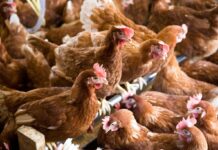

Following three confirmed avian influenza outbreaks in poultry holdings in Schleswig-Holstein, the state reinstated a general biosecurity order across the region on 27 October 2026. The cases were detected in the districts of Nordfriesland, Segeberg and Schleswig-Flensburg. The state described them as the first three confirmed outbreaks in domestic poultry this autumn; the Friedrich-Loeffler-Institut (FLI) confirmed the H5N1 subtype.
The district of Nordfriesland also reported that 22 chickens died at a small poultry holding on a Hallig before the disease was officially confirmed. The available sources do not establish whether this was the same case in Nordfriesland included among the three outbreaks confirmed by the state.
The FLI has also confirmed avian influenza in two wild birds, but the state’s announcement does not specify where they were found. More than 30 other birds tested positive in preliminary screening by the state laboratory; confirmation by the FLI is pending. Samples have so far come from Nordfriesland, Pinneberg and Stormarn.
Minister warns of a severe outbreak
“We must prepare for a severe avian influenza outbreak in the coming weeks,” Agriculture Minister Cornelia Schmachtenberg said. She urged all poultry keepers, including those with only a few birds, to review their protective measures and apply them consistently in their day-to-day management.
The general order covers poultry and captive birds, as defined in the order. Keepers who have not yet submitted the information required to register their holding must do so with the relevant veterinary office.
Biosecurity measures
All keepers covered by the order must disinfect their footwear and wash and disinfect their hands before entering poultry houses or other places where the birds are kept. Entrances must also be equipped with suitable footwear-disinfection facilities, such as baths or mats. The order prohibits bringing poultry or captive birds onto a holding through markets, fairs or itinerant trade.
Additional requirements apply to holdings with 1,000 or fewer birds of the species listed in the order. These include protective clothing and footwear used exclusively at the holding, as well as cleaning and disinfecting transport vehicles after each use.
The ministry also reminds keepers of the general rules on feeding and watering: poultry must be fed in places inaccessible to wild birds; feed, litter and other materials must be protected from them; and surface water accessible to wild birds must not be used to water poultry.
Restricted zones
Restricted zones have been established around the affected holdings in Segeberg and Schleswig-Flensburg. They comprise a protection zone with a minimum radius of 3 kilometres and a surveillance zone with a minimum radius of 10 kilometres. The state announcement says the zones also extend into parts of Stormarn and Nordfriesland; NDR reports that parts of the independent city of Flensburg are affected as well. Measures include compulsory housing and a ban on moving live poultry.
A separate housing order has also been in force in parts of Nordfriesland since 28 October. It covers the islands and Halligen, coastal areas and locations near major bodies of water. Elsewhere in the district, it applies to holdings with more than 50 birds of the same species. Keepers must also comply with any other orders issued by their district or independent city authorities.
Requirements for keepers
If birds show symptoms or there is an unusually high level of mortality, the ministry says a veterinary examination must be arranged without delay. Keepers who have not yet submitted the information required to register their holding must do so with the relevant veterinary office.