
Poultry farms and other bird holdings in Europe and the Americas have reported new cases of avian influenza, while Japan has reported a presumptive case. Authorities are also continuing surveillance after earlier Newcastle disease outbreaks in Europe and Brazil.
This update covers reports available up to 27 November. It includes some outbreaks confirmed before 23 November that were reported or updated during the week and does not represent a complete record of outbreaks worldwide. Flock sizes indicate the number of birds on affected premises, not necessarily the number that died from infection.
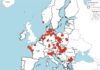
Avian influenza in Europe
Three commercial poultry premises tested positive for highly pathogenic avian influenza (HPAI) H5N1 in England. The first two cases were confirmed on 25 November, near Frodsham in Cheshire and Leominster in Herefordshire. A third followed on 26 November near Wesham, Lancashire.
Protection and surveillance zones were established around the premises, and the birds were due to be culled. The British Free Range Egg Producers Association said the Frodsham premises held approximately 16,700 turkeys, while the Leominster flock comprised around 25,000 broiler breeders.
In northern Germany, H5N1 was detected at a poultry farm in Lalendorf, Mecklenburg-Western Pomerania, with approximately 3,500 geese and ducks. Restrictions were introduced around the premises to limit the spread of the virus.
Another H5N1 outbreak was officially confirmed on 25 November at a private poultry holding in Thiessow, on the island of Rügen. On 26 November, the district of Cuxhaven in Lower Saxony announced a separate detection of highly pathogenic H5 avian influenza in a mobile housing unit with approximately 250 laying hens. The announcement did not specify the neuraminidase subtype.
A hobby holding in De Kwakel, North Holland, was also affected. The Dutch government announced the case on 23 November and ordered the culling of 21 chickens and 35 ornamental waterbirds. Protection and surveillance zones were established around the holding.
Poland and France report earlier outbreaks
Polish veterinary authorities published details of an H5N1 outbreak at a commercial turkey holding in Lipinki, in the Warmian-Masurian region.
The regional veterinary authority initially reported 18,723 turkeys at the affected holding. A later report citing Poland’s national veterinary inspectorate gave a figure of 18,810. A district veterinarian told local media that the farm had housed more than 46,000 birds in total; the relationship between the figures was not clear from the reports available.
The national veterinary inspectorate said the outbreak was established on the basis of laboratory results dated 22 November. It was Poland’s first poultry outbreak of the autumn–winter season, following the previous outbreak in May.
On 23 November, France reported an H5N1 outbreak to the World Organisation for Animal Health (WOAH). The virus had been detected before the start of the week at a poultry farm in the Pas-de-Calais department. According to the notification cited by Reuters, 80 of the approximately 4,300 birds died and the remainder were culled.
In Italy, the national reference laboratory’s poultry outbreak list, updated to 25 November, continued to show one H5N1 poultry outbreak for the current season: the small holding in the province of Venice confirmed on 10 November. Separately, H5N1 was confirmed on 24 November in a wild yellow-legged gull in the province of Ravenna.
Americas: reports from Mexico, Canada, the United States and Brazil
Authorities in Mexico announced a second highly pathogenic avian influenza case at a laying-hen farm in Umán, Yucatán, after the farm veterinarian reported the unusual deaths of 1,154 birds. Reports citing the agriculture ministry described the laboratory result as highly pathogenic H5.
Following the case, Mexico’s animal health authority, Senasica, authorised strategic vaccination against H5N1 at commercial poultry premises in eight municipalities in Yucatán, subject to surveillance and biosecurity requirements. The first H5N1 case in Umán had been reported on 5 November.
In Canada, the Canadian Food Inspection Agency listed two detections dated 24 November: one at a commercial poultry premises in Cartier, Manitoba, and the other at a non-commercial poultry holding in Kawartha Lakes, Ontario. Primary control zones were established in the two provinces.
A commercial broiler flock in Sussex County, Delaware, was among the affected premises in the United States. HPAI was confirmed there on 23 November, after a presumptive positive result announced by Delaware authorities on 20 November. Sources citing US Department of Agriculture data put the flock size at approximately 269,900 birds.
In Wisconsin, the state agriculture department announced an HPAI case in a commercial flock in Polk County on 24 November. Its surveillance table dates the detection to 20 November and lists 19,241 birds on the premises.
USDA-based surveillance data also listed detections dated 24 November at a small poultry holding in Fresno County and at live bird markets in Los Angeles and Alameda counties, California.
In Brazil, the Espírito Santo agricultural defence agency, Idaf, confirmed highly pathogenic avian influenza on 24 November at a subsistence poultry holding in São Mateus. All birds on the property were culled the following day. No commercial poultry farms were involved, Idaf said, and inspections were being carried out within a three-kilometre radius.
Asia: Japan reports a presumptive case; South Korea investigates H5 detection
Aichi prefecture in Japan reported a presumptive case of highly pathogenic avian influenza on 23 November at a laying-hen farm in Toyohashi, following genetic testing. The farm housed approximately 80,000 birds. Hong Kong subsequently suspended imports of poultry meat and products from Aichi prefecture.
In South Korea, an H5 avian influenza antigen was detected on 26 November at a meat-duck farm in Naju holding approximately 19,000 birds. Tests were still under way at the time of the announcement to determine whether the virus was highly pathogenic. Authorities had begun precautionary control measures, including movement restrictions and culling.
Hong Kong also announced import restrictions on 26 November affecting several South Korean areas, following notifications of H5N1 and H5N9 outbreaks. The restrictions were announced this week, although the underlying outbreaks were not necessarily all confirmed during the same period.
South Africa: industry calls for vaccination measures
The South African Poultry Association said on 25 November that an avian influenza outbreak near Welkom was being managed. It also called for practical vaccination protocols to be finalised.
The report did not establish that the Welkom outbreak was first confirmed during the week of 23–27 November.
Newcastle disease: surveillance continues after earlier outbreaks
No newly confirmed Newcastle disease outbreaks from 23 to 27 November could be independently verified in the reports reviewed for this update. Authorities have nevertheless issued updates on earlier outbreaks.
In Brazil, Santa Catarina’s animal health agency, Cidasc, said on 26 November that surveillance and sanitary education were continuing in the west of the state after five Newcastle disease outbreaks. The last was closed on 10 November. Poultry movements and placement had resumed, although affected premises remained subject to a minimum sanitary downtime period.
In Hungary, the food chain safety authority Nébih reported on 25 November that surveillance zones in Bács-Kiskun county had been lifted on 21 November. No further Newcastle disease outbreak had been confirmed in the affected area since 15 October, the agency said, while warning that the disease remained present in Hungary.
In Sweden, the outbreak at a laying-hen establishment with approximately 200,000 birds near Halmstad was confirmed on 12 November. It was the country’s first Newcastle disease outbreak of 2026.