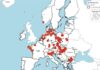


Between 28 February and 4 June 2026, Poland remained the European country most affected by highly pathogenic avian influenza (HPAI) in poultry, according to the latest quarterly monitoring report published by the European Food Safety Authority (EFSA), the European Centre for Disease Prevention and Control (ECDC) and the European Union Reference Laboratory for Avian Influenza (EURL).
During the reporting period, 154 HPAI A(H5N1) outbreaks were reported in poultry across 12 European countries. Poland accounted for 102 of these outbreaks, representing 66% of the total. The 102 affected establishments in Poland involved more than 5.7 million birds, representing 88% of the 6.53 million birds recorded in HPAI-affected poultry establishments across Europe during the reporting period.
According to the report, HPAI transmission persisted locally in Poland through multiple primary introductions and secondary spread between poultry flocks, making the country the main hotspot for poultry outbreaks in Europe during the spring. While overall HPAI activity declined compared with the winter months, virus circulation continued to be sustained in Poland.
Additional epidemiological information was available for 97 of the 102 outbreaks. These occurred mainly in commercial turkey, laying hen, breeder chicken and duck farms, with smaller numbers of outbreaks reported in broilers, geese and mixed-purpose poultry establishments. Indirect contact with wild birds was identified as the most likely source of introduction in 57 outbreaks, while indirect contact with poultry was considered the probable source in another 20 cases. Direct contact with wild birds was reported in one outbreak, and the source of introduction remained unknown in 19 outbreaks. Mortality was reported in 92 of the 97 investigated outbreaks.
The report notes that most outbreaks were recorded in the Mazowieckie, Wielkopolskie and Warmińsko-Mazurskie regions. Only seven of the 97 establishments for which additional information was available had outdoor access, while the remaining farms operated without outdoor access.
Across Europe, the overall number of HPAI outbreaks in poultry declined during the reporting period compared with the winter season. However, Poland continued to account for the largest share of outbreaks, underlining the importance of maintaining strict biosecurity and surveillance in areas with sustained virus circulation.
Also read: Avian influenza activity declines across Europe as spring ends
France lowers HPAI risk level and lifts nationwide poultry housing measures
First European detection of H9N2 clade G5.5 reported in Hungarian broiler farms