
Poultry meat production and trade increased in the European Union during the first four months of 2026. Imports grew faster than exports, while the average broiler price in week 32 was lower than one month and one year earlier.
The figures come from the latest European Commission poultry meat dashboard, updated on 13 August. The production and trade data cover January-April 2026, while the latest price refers to week 32.
EU poultry meat production rises by 5.1%
EU poultry meat production increased by 5.1% in the first four months of 2026 compared with the same period in 2025, according to Eurostat data included in the dashboard.
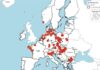
Production rose in most Member States, although national trends differed widely. Hungary recorded the largest increase, at 21.7%, followed by Poland at 15.1% and Romania at 14.8%. Output also grew by 12.4% in Latvia and 10% in Cyprus.
Several major producers reported lower volumes. Production declined by 1% in France, 2.7% in Italy and 4.1% in Germany. Sweden registered the largest fall, at 6.7%.
The dashboard also shows the structure of European poultry meat production. EU output totalled 14.32 million tonnes in 2025. Poland was the leading producer, with 2.89 million tonnes and a 21% share of the total.
Spain accounted for 13% of EU production, France for 12%, Germany for 11%, Italy for 10% and the Netherlands for 6%. Together with Poland, these five countries represented 72% of EU output.
Broiler meat accounted for 87.1% of poultry meat production. Turkey represented 9%, duck 2% and other poultry meat 1.8%.
EU broiler price down 6.7% year on year
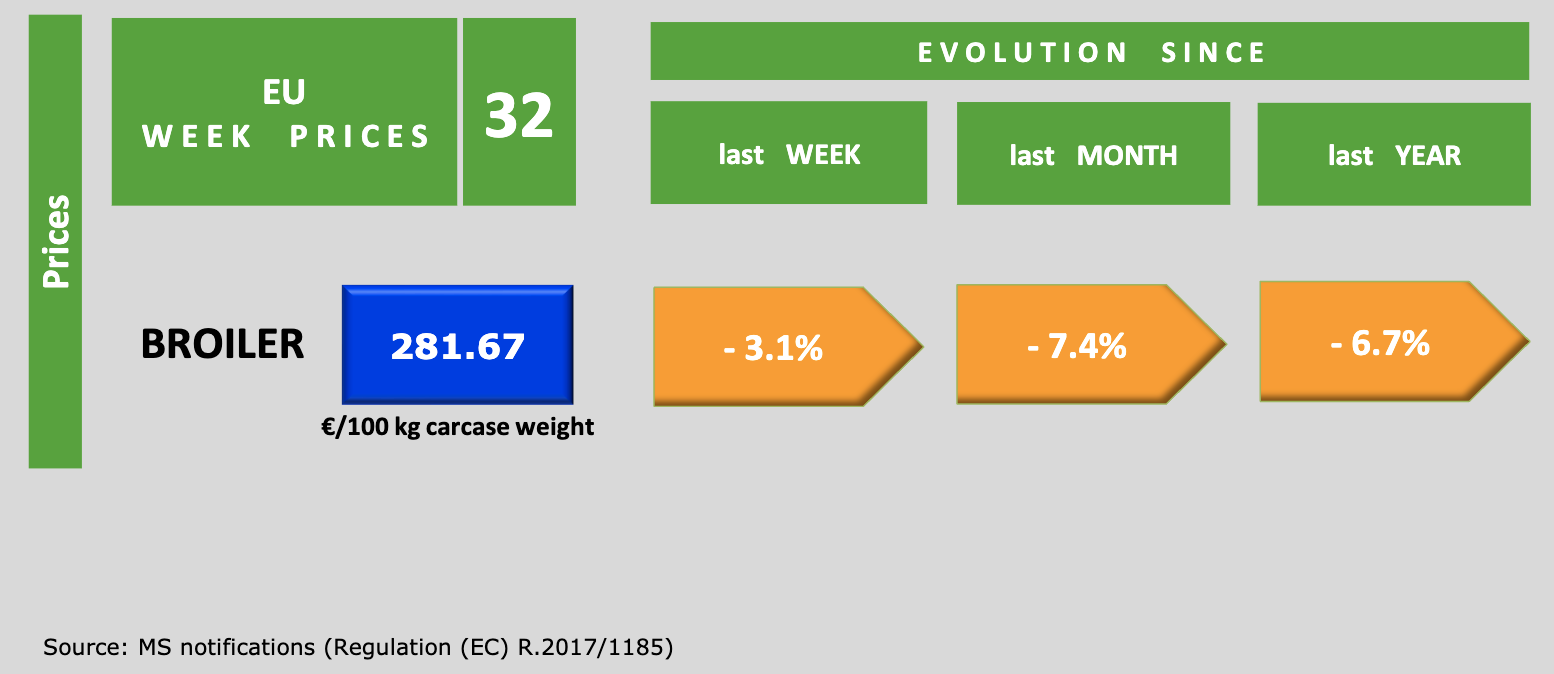
The average EU broiler price stood at €281.67 per 100 kg of carcase weight in week 32. It was 3.1% lower than the previous week and 7.4% below the level recorded one month earlier. Compared with the same week in 2025, the price was down by 6.7%.
The Commission also compares the broiler farm price with directly attributable fattening costs. Feed is the largest cost included in the calculation, followed by other costs and energy.
The chart does not cover every cost borne by poultry farms and therefore cannot be used as a complete measure of production costs or profitability.
Production and price figures also refer to different periods. The dashboard reports their respective movements but does not establish a connection between the increase in output and the decline in the broiler price.
 Poultry meat imports grow faster than exports
EU poultry meat exports reached 695,407 tonnes between January and April 2026, 2.1% more than in the same period of 2025. Their value increased by 3.5% to €1.74 billion.
The United Kingdom remained the largest destination, receiving 242,046 tonnes. This was 0.2% more than in January-April 2025.
Exports to Ghana rose by 18.5% to 70,444 tonnes, while shipments to the Democratic Republic of the Congo increased by 22.4% to 49,159 tonnes. The strongest percentage growth among the main destinations was recorded for the Philippines, where exports rose by 48.1% to 22,209 tonnes.
EU poultry meat imports totalled 362,326 tonnes, an increase of 7% compared with the first four months of 2025. Import value rose by 1.9% to €963.2 million.
Brazil was the largest supplier, with 154,649 tonnes, 31.7% more than in the same period last year. The country accounted for 42.7% of total EU poultry meat imports during the period.
Ukraine was the second-largest supplier, with 76,993 tonnes, an increase of 7.9%. Imports from Thailand rose by 6% to 61,811 tonnes.
Imports from the United Kingdom moved in the opposite direction, falling by 32.4% to 41,977 tonnes. The country nevertheless remained the leading destination for EU poultry meat exports. Imports from China also declined, falling by 5.6% to 20,678 tonnes.
Volume and value did not always follow the same pattern. Imports from Ukraine increased by 7.9% in volume but declined by 11.3% in value. The dashboard does not include a product-level breakdown that would explain the difference.
EU poultry meat market at a glance
| Indicator | Result |
|---|---|
| EU production, January-April 2026 | +5.1% year on year |
| EU exports, January-April 2026 | 695,407 tonnes, +2.1% |
| EU imports, January-April 2026 | 362,326 tonnes, +7.0% |
| EU broiler price, week 32 | €281.67/100 kg, -6.7% year on year |
EU poultry meat exports exceeded imports by 333,081 tonnes during the first four months of 2026. The EU therefore remained a net exporter in volume terms over the period covered by the trade data.
The dashboard presents three distinct developments: higher production, growth in both exports and imports, and a broiler price below the levels recorded one month and one year earlier. Imports showed the strongest rate of increase, while production trends varied considerably between Member States.
Source: European Commission, DG Agriculture and Rural Development, Poultry Meat Dashboard, updated 13 August 2026.
13 AUGUST 2026 Dashboard: Poultry meat