
At the mid-term TransRegional Eggspert Panel meeting in Ploufragan, France, the OMELETTE project presented its first results, highlighting how a more proactive and data-driven approach can support longer and healthier laying cycles. The event gathered 48 participants from five countries and 11 organisations, reflecting the broad European interest in improving hen longevity.
The OMELETTE project is part of the European Interreg North-West Europe programme and runs from 2023 to 2028 with a total budget of over €6.3 million, including €3.7 million EU funding. The project brings together partners from Belgium, the Netherlands, France, Germany and Switzerland to address one central challenge: how to keep laying hens productive for longer while maintaining animal health, welfare and farm profitability.
The project’s ambition is to make egg production in North-West Europe more sustainable and resilient by integrating longevity into everyday farm management. This requires not only technical innovation, but also better monitoring, knowledge exchange and behavioural change among farmers and advisors.
A first important theme presented during the meeting was lighting management. Dynamic lighting systems can influence behaviour by alternating between cold and warm white light. Cold light stimulates activity, while warm light supports rest and calm behaviour. Within OMELETTE, a decision-tree approach was developed to help farmers adjust lighting in response to pecking or aggression. However, researchers emphasised that lighting should be seen as a supportive tool, not a substitute for addressing underlying issues in the barn.
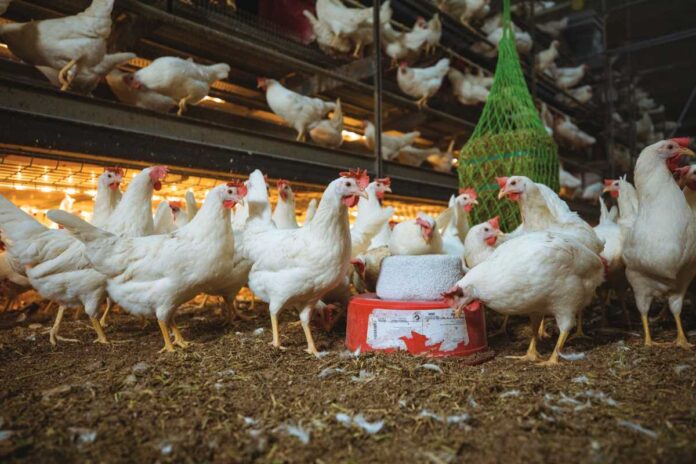
A second focus was enrichment materials. Trials showed that enrichment plays a key role in preventing harmful behaviour by satisfying natural pecking and foraging needs. Not all materials were equally effective: refillable enrichments performed best, as hens regained interest after refilling, while some objects quickly lost their appeal or even increased aggression. These insights underline the importance of active management, including rotation and renewal of materials.
 Digitalisation is another cornerstone of the project. Tools presented by project partners combine production data, health indicators and behavioural monitoring into integrated dashboards. These systems help farmers detect problems earlier and shift from reactive to preventive management. Camera-based monitoring further enhances this approach by enabling automated detection of feather condition, piling behaviour and other welfare indicators.
This strong focus on smart monitoring reflects the broader OMELETTE strategy, which combines digital technologies with practical farm management to support early detection and continuous improvement. By integrating real-time data and structured decision-making, the project aims to improve both individual animal follow-up and overall flock management.
Beyond technology, OMELETTE also addresses the systemic barriers to longer laying cycles. Interviews with farmers in Belgium and France show that profitability remains the key driver, but that success depends on a combination of factors such as pullet quality, vaccination strategies, nutrition, ventilation, heat stress management, and consistent lighting.
To bring these elements together, the project is developing a cross-border Longevity Action Plan. This plan is being tested on pilot farms across participating countries and combines structured farm visits, data collection, welfare scoring and tailored advice. The goal is to translate research findings into practical, farm-specific solutions that can be widely adopted across the sector.
In addition, OMELETTE places strong emphasis on training and communication. By sharing knowledge with farmers, advisors, authorities and consumers, the project aims to bridge gaps in understanding and build trust in the egg production chain. Demonstrations on pilot farms and targeted communication campaigns are key tools in this process.
The mid-term results confirm that extending the productive life of laying hens is feasible, but requires an integrated approach combining management, monitoring and collaboration. OMELETTE shows that with the right tools and support, hen longevity can become a realistic pathway towards more sustainable egg production in North-West Europe.
OMELETTE
OptiMise and Extend hen Longevity to Expedite the Transition to susTainable Eggs
Project objectives
Poultry farmers and sector in the NWE region take on board solutions to actively contribute to an improved hen longevity with ensured animal health and welfare, egg quality and economic viability as major premises for a future-proof resilient sector.
Project funding
The OMELETTE project is co-funded by the European Union through the Interreg NWE programme. NWE 0200174 OMELETTE.
Project partners
11 partners from 5 different countries are working closely on the OMELETTE project
https://omelette.nweurope.eu/partners
Contact details
Project Coordinator: Nathalie Sleeckx
Experimental Poultry Centre (Proefbedrijf Pluimveehouderij VZW),
Poiel 77, 2440 Geel (Belgium)
E-mail: nathalie.sleeckx@provincieantwerpen.be
Telephone: +3214562887
Website: https://omelette.nweurope.eu/