
When thinking about environmental enrichments in commercial broiler production houses, one might rightfully think of any provisions given to the birds so they can feed, drink, and play comfortably. However, research has shown that also the possibility to have a good rest and sleep, as well as a good light management act as influential environmental factors impacting behavior, welfare, and productivity of commercial broiler chickens. Good sleeping and resting, both at night and during the day, help prevent oxidative stress and abnormal physiological responses since, when sleeping, the organism replenishes antioxidants and the brain cleans waste and toxins accumulated during wakefulness off the body. Light management, instead, has a great influence on birds’ behavior, movement, and health, especially when there are high contrast and variability.
How to exploit light and darkness to promote broilers’ health and welfare
Chickens are naturally active animals that exhibit their behavior through activities such as dust bathing, scratching, and pecking. Lack of physical activity within a broiler flock is usually associated with limited space or confinement in the house. Therefore, especially when other interventions are hard to make, light management can be an effective way to promote movement. Although the specific mechanisms mediating the effects of light on the brain and, as a consequence, on behaviors remain unclear, we know that the environmental lighting inputs allow animals to integrate information coming from the outside with the internal brain states and, therefore, to induce appropriate behaviors. In nature, for example, a favorable illuminance helps the animals to perform basic survival actions, such as avoiding predators, finding food and conspecifics, and perform courtship.
In terms of light intensity, so far, commercial broilers have been kept in relatively low-light intensity houses where living conditions do not stimulate physical activity and increase resting time, with a negative impact on leg health and other lesions such as breast blisters (Figure 1A). Studies have shown, instead, that broiler chickens generally prefer brighter light, which promotes more pronounced daily rhythms, improves comfort, and encourages more active and energetic behaviours. Preference studies have also shown that, when they could choose among different light intensity areas, birds exhibited specific preferences: they tended to choose higher intensity light during active behaviors and dimmer areas when resting (Figure 1B), suggesting that receiving different contextual visual information (i.e., different light intensities) may have motivated better movement patterns. Furthermore, an alternating light schedule seems to stimulate change in locomotor activity compared to constant light.
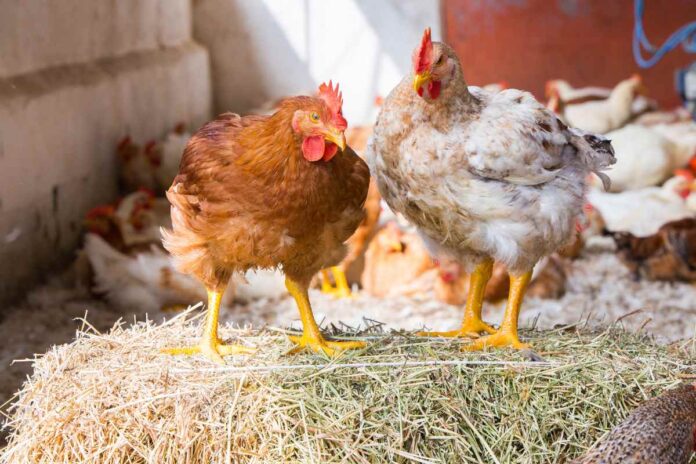
At the same time, however, exposure to darkness and the possibility of sleeping during the daytime have proved to be highly beneficial. An increase in melatonin levels is supposed to be the main reason behind such benefits. As a natural scavenger of free radicals, melatonin seems to not only prevent molecular destruction due to oxidative stress but also to rescue neurons from cell death. When chickens were provided with variable-lighting areas (Figure 1C), they showed active resting and napping behaviors during the daytime in darkness, which was associated with a positive physiological response, that is a lower feed conversion ratio and a greater daily body weight gain compared to those reared in a house with conventional continuous 20 lux of light intensity (Figure 1A). In the same houses where variable lighting was implemented, board, hut, and ramp environmental enrichments were tested and huts appeared to be the most advantageous enrichment for commercial broiler chickens, probably because they were an additional way to provide low-light-intensity areas for birds to rest (Figure 1D).
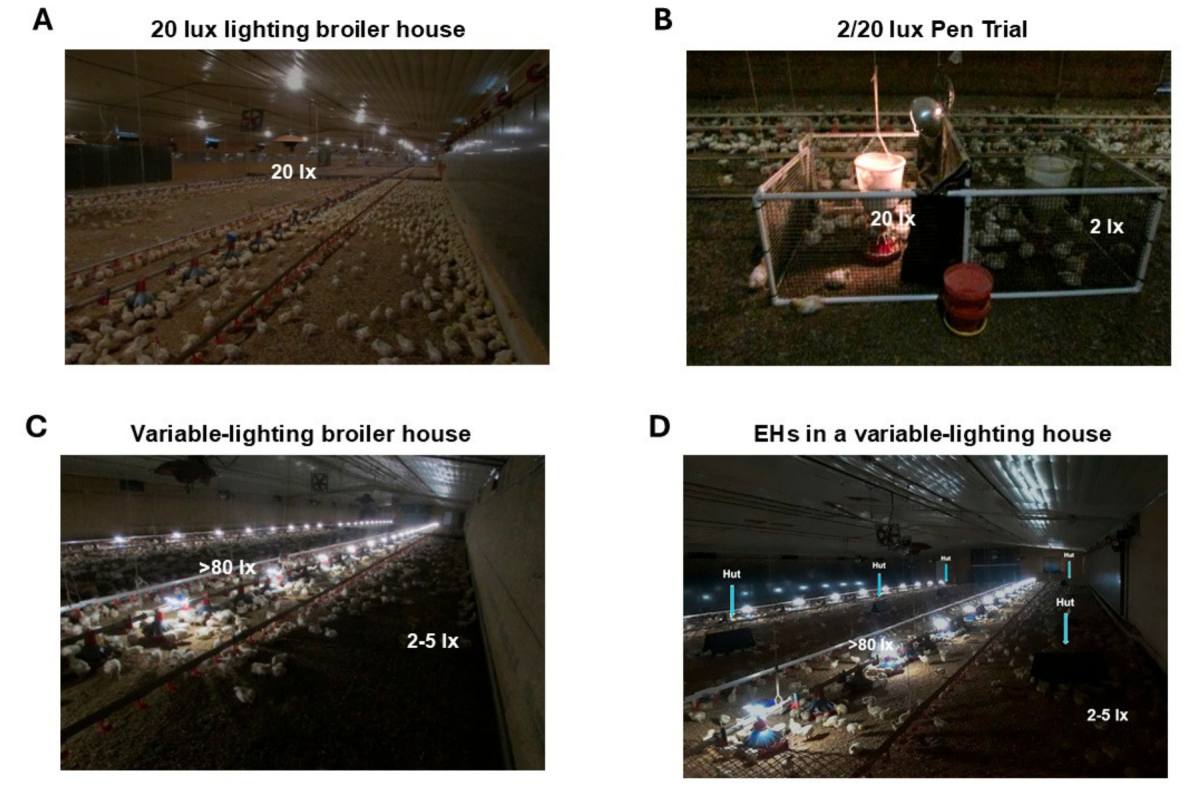
(A) House with conventional continuous 20 lux (lx, measured on the birds’ heads) of light intensity. (B) Preference testing pen (121.9 × 121.9 cm) with walls covered in black plastic film to exclude light; the pen was divided into two identical compartments yet preventing light penetration from the hanging light above (2/20 lx). (C) House with lighting variability: average light intensity around feed lines was over 80 lx, while in the middle and sidewalls of the house it was about 2–5 lx. (D) House with lighting variability and enriched with huts (35.6 cm wide × 76.2 cm long × 35.6 cm high; 3 huts/92.9 m2).
Adapted from Kang, S.W. Effectual Environmental Enrichments for Commercial Broiler Chickens. Animals 2025, 15, 2829. https://doi.org/10.3390/ani15192829
Why avoiding sedentary behavior and promoting physical movement is important
Physical inactivity during the daytime is associated with weight gain, muscle weakness, leg health issues, and elevated risk of developing metabolic syndromes. On the contrary, evidence has indicated that active behaviors improve broiler chickens’ leg and overall health and welfare.
From a physical and physiological perspective, the positive influence of locomotor activity has been increasingly recognized. Leg issues are one of the most frequent causes of culling and mortality in commercial broiler farming. Studies where variable lighting was implemented in commercial broiler houses reported an improvement not only in terms of leg health and culling rates but also in animal performance, that is daily weight gain and feed conversion ratio. Different lighting intensity areas stimulated voluntary walking behavior for consuming feed and water and taking rest, and animals tended to consume more feed in the brighter areas compared to the darker ones. Furthermore, physical activity is known to stimulate the release of myokines by the skeletal muscles of the legs. Myokines are molecules that support muscle recovery and contribute to maintaining the integrity and functional stability of bones as endocrine organs. Another positive consequence of movement is the enhancement of the antioxidant enzyme activity of the body with consequent greater antioxidant protection. Finally, also liver metabolic functions appear to be enhanced by physical exercise. The liver is a very important metabolic organ as it is responsible for maintaining blood glucose levels and controlling metabolic homeostasis, acting as the primary site for lipid metabolism. Sedentary living conditions cause both lipid accumulation in the liver and de novo lipogenesis, facilitating hyperlipidemia. In fact, there has been a study demonstrating that variable lighting and environmental enrichment with huts improved hepatic lipid metabolic functions in broilers, which were more efficiently supported nutritionally and, therefore, had better growth performance.
Besides the physical and physiological benefits coming from active behaviors, it is important to note that enrichments such as variable lighting and huts allow birds to satisfy their innate biological needs by voluntary choices rather than by compelling external incentives.
Final considerations
Finding ways to improve animal welfare for commercial broiler chickens also through environmental enrichments so animals can satisfy their biological and behavioral necessities is becoming crucial. Ensuring animals can have good sleep and rest, not only during the night but also during the day, as well as thoughtful management of light has been proved to be excellent strategies. Variable lighting and environmental enrichments providing birds with proper areas to rest (e.g., huts) were reported to increase voluntary active behaviors that, in turn, improved leg and overall health, animal welfare and performance, with reduced mortality rates and better daily weight gain and feed conversion ratio. Not only did these environmental enrichments improve the birds’ physiological status and responses but they also stimulated a voluntary behavior expression leading to increased movement and enhanced welfare that will result in better overall farm economic performance.
Source
Kang, S.W. Effectual Environmental Enrichments for Commercial Broiler Chickens. Animals 2025, 15, 2829. https://doi.org/10.3390/ani15192829
Licensed under the Creative Commons Attribution 4.0 International License (CC BY 4.0) (http://creativecommons.org/licenses/by/4.0/).
Text summarized and editorially adapted by the Zootecnica – Poultry Magazine editorial team.