
Livestock activity accounts for most of the total ammonia release worldwide, highlighting the call for implementing more environmentally friendly solutions. Also, prolonged exposure to high amounts of ammonia indoors may threaten the well-being and health of staff and birds if the ventilation rate fails to control ammonia concentration within safety thresholds. To reach this goal, feeding strategies can mitigate ammonia emissions from poultry barns.
How ammonia is produced in poultry barns
Upon digestion, proteins are broken down into amino acids for absorption and, then, reassembled again into proteins to support body functions. Once protein needs are satisfied, amino acids that are no longer needed are metabolised for carbohydrates and lipid synthesis by removing their amino group. Due to potential toxic effects at high concentrations, birds get rid of the amino groups in a timely manner through the urine (as uric acid). Upon excretion, faecal content and urine get together resulting in a high-quality manure with low water content and rich in biodegradable nitrogen. Yet, uric acid is quickly converted to ammonia once exposed to air and moisture.
Manure and litter cannot be removed daily from poultry barns, and the nitrogen in poultry urine is decomposed soon after excretion leading to ammonia formation. Studies indeed suggest that more than 50% of manure nitrogen becomes ammonia. Certainly, warm temperatures, moist manure (>50% water content), and litter pH around 8 are the best conditions to speed up the conversion of uric acid to ammonia (which are standard housing conditions for broiler and layers). For example, ammonia production increases exponentially when indoor temperature rises above 22 ºC and relative humidity is high (>70%). Given that lowering indoor temperature can jeopardize flock performance and is not practical, recommended management practices to mitigate ammonia emissions include addition of dry bedding materials (e.g., wood shavings) to absorb water content and reduce humidity, prevention of water spillage, and litter acidification. Under normal litter pH (7.5–8.5), ammonia is volatile whilst an acidic environment (pH <7 at conventional room temperatures) stops this process. However, dropping litter pH enough to halt full ammonia release may also bring welfare and health concerns due to high prevalence and severity of foot lesions, hock burns, and breast blisters if birds are in touch with acidic litter for long time.
How nutrition can mitigate ammonia emissions
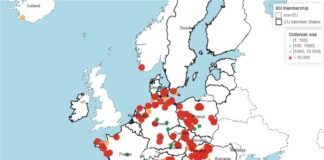
From a feeding management standpoint, cutting down the amount of nitrogen excreted by birds is key to curb ammonia production in poultry houses. The first step is to reduce high protein intake and improve protein efficiency (e.g., amount of protein consumed to gain one kilogram of body weight). Protein-rich ingredients are costly, and excess of amino acids are metabolised into wasteful nitrogen compounds that turn into ammonia under warm humid conditions. Research on poultry nutrition reported that ammonia emissions can decline up to 10% when the crude protein content in conventional diets lowers 1%. Best available techniques indeed encourage producers to feed low-protein diets as a cost-effective practical strategy to mitigate ammonia emissions. Still, a survey from the European Environment Agency estimated that less than 30% of poultry producers implemented low-protein feeding strategies across European countries.
Feeding poultry diets with low crude protein reduces undoubtedly ammonia production in poultry houses although this drop must not come at the expense of flock performance. To prevent this problem, poultry diets must be designed to meet amino acid requirements at an ideal ratio between them. The content of dietary amino acids, both essential and non-essential, has to be well-balanced since the first limiting amino acid can halt protein synthesis. Particularly when feeding low-protein diets, birds can metabolise essential amino acids into non-essential ones if their concentration has been overlooked during formulation. The amino acid profile of poultry diets is therefore crucial to enhance protein efficiency and ensure daily amino acid needs are fulfilled. For this reason, low-protein diets are commonly supplemented with amino acids to achieve a well-balanced amino acid profile.
On top of these protein-efficiency feeding strategies, phase feeding plays a crucial role at tailoring amino acid intake to metabolic requirements according to age and performance goals. As birds age, their nutritional requirements for protein and amino acid intake increase to support maintenance, growth rate, and laying persistency in hens but also their feed intake. So, starter diets have high content of crude protein and amino acids to account for low feed intake during their first weeks of age, and dietary protein and amino acid levels decrease progressively in grower and finisher diets. Within this interplay, the nutritional content in poultry diets should be refined accordingly throughout development and production phases to maximize protein efficiency. Certainly, implementation of phase feeding in broilers and layers is estimated to reduce ammonia emissions by 20%.
Minimizing the environmental footprint of poultry industry is becoming a hot topic due to its impact on the health of neighbouring ecosystems. Efforts in this regard also bring new opportunities for producers to become more protein efficient and create safer indoor conditions for birds and staff. As a take-home message, application of phase feeding strategies using low-protein diets with a well-balanced amino acid profile can reduce ammonia emissions while improving flock performance and well-being. In addition to these feeding mitigation strategies, refining litter management practices and housing conditions are also crucial to control ammonia production in poultry barns.