
A depth-camera and deep-learning system estimated current body weight in tom turkeys and maintained similar percentage errors when forecasting weight 7, 14 and 21 days ahead. Carcass prediction was less conclusive, with a negative R² in a small group of birds.
Weight forecasting without repeated handling
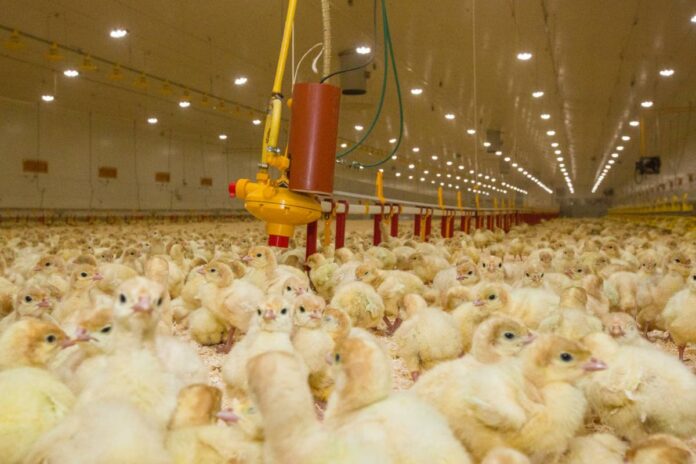
Researchers at Pennsylvania State University followed 30 Nicholas Select toms from 37 to 133 days of age to test whether overhead images could be used to estimate body weight and forecast it several weeks ahead. Seventeen birds remained through day 133 and provided processing data.
An Intel RealSense D435 camera collected RGB and depth images from above the birds. The image-processing pipeline combined YOLOv11 instance segmentation with a customized ResNet50 architecture. From 2,911 images sampled around weighing events, the researchers generated 3,477 individual turkey crops for model development and evaluation.
The segmentation model achieved a mean intersection over union of 0.90 ± 0.04 on the held-out test set. A three-channel input combining grayscale, depth and segmentation mask performed better for body-weight estimation than the five-channel RGB, depth and mask configuration, and was used for the subsequent analyses.
Leave-one-animal-out cross-validation by animal ID was used to avoid data leakage. Birds removed before the end of the experiment contributed only to training and validation; test animals were selected among those that remained throughout the study.
Body-weight errors changed little over three weeks
For same-day body-weight estimation, R² reached 0.96 ± 0.04, with a mean absolute percentage error (MAPE) of 7.39 ± 4.06%.
Moving from estimation to forecasting had relatively little effect on percentage error. At seven days, R² was 0.95 ± 0.04 and MAPE 7.69 ± 3.68%. At 14 days, the values were 0.95 ± 0.07 and 6.49 ± 3.84%, respectively. With a 21-day horizon, R² declined to 0.93 ± 0.06 and MAPE was 7.52 ± 3.46%.
Errors varied more during the earlier growth period, particularly around days 40–55, and became more stable later. Over the same experiment, flock uniformity increased from 46.7% at day 37 to 88.2% at day 133, while the coefficient of variation in body weight fell from 12.5% to 6.8%.
Carcass results tell a different story
Only the 17 birds that reached processing were available for the carcass analysis. Their chilled carcass weight averaged 18.59 kg, with a standard deviation of 1.358 kg and a coefficient of variation of 7.30%, giving the model a relatively narrow weight distribution to work with.
The results were substantially weaker than those obtained for body weight: R² was −0.49 ± 0.21 and MAPE 7.53 ± 4.30%. A leave-one-animal-out null predictor, calculated from the mean carcass weight of the other 16 birds, returned a lower MAPE of 6.66%. That benchmark, however, depends on carcass measurements that would not be available before processing.
Using images from the final week did not produce consistent evidence of reliable individual carcass-weight prediction. Daily MAPE ranged from 7.72% on day 127 to 6.56% on day 131. Rank correlations became positive only during the last two days, with Spearman ρ of +0.22 on day 131 and +0.15 on day 132.
The small dataset remains a major constraint on this part of the study. With 17 carcass observations, limited weight variation and potential overfitting, the authors call for testing in a larger and more variable population before the approach can be assessed for carcass-weight prediction.
Commercial conditions remain to be tested
The experiment depended on obtaining usable images of birds that were sufficiently isolated and correctly positioned beneath the camera. At commercial stocking densities, overlaps, occlusions and bird movement could reduce the proportion of frames suitable for analysis.
There are other differences between the experimental setup and a commercial application. Predictions were based on individual images at specific points in time, rather than image sequences used as time-series inputs. The analysis also relied on individual bird IDs, whereas individual identification is not commercially available for poultry in the setting considered by the authors.
For body weight, the study maintained similar percentage errors from same-day estimation through forecasts extending 21 days ahead. The next question is how much of that performance can be retained under commercial stocking conditions. Carcass weight is at an earlier stage: the results from 17 birds are not sufficient to establish predictive value.
Source
Molins M and Casella E (2026) Computer vision-based forecasting of body weight and carcass in tom turkeys. Frontiers in Animal Science 7:1868845. doi: 10.3389/fanim.2026.1868845.
Licensed under the Creative Commons Attribution License (CC BY 4.0).
Text summarized and editorially adapted by the Zootecnica – Poultry Magazine editorial team.