
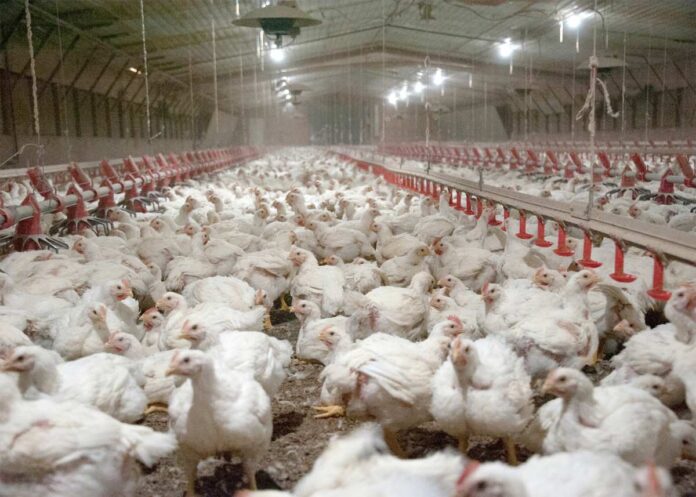
The European Commission has adopted new rules to reduce emissions from poultry and pig farms. The measures cover animal nutrition, manure management and emissions from housing, alongside simpler administrative procedures. Implementation will be phased in between 2030 and 2032.
On 8 October 2026, the European Commission adopted the Uniform Conditions for Operating Rules for Livestock (UCOL), setting common environmental requirements for poultry and pig farms covered by the EU directive on industrial and livestock rearing emissions.
For farms rearing only poultry, the provisions apply to installations with a capacity of at least 300 livestock units (LSU) for laying hens only, or 280 LSU for other poultry categories. The 280 LSU threshold also applies to mixed poultry farms, with a weighting factor of 0.93 for laying hens.
The rules address ammonia emissions and nitrogen and phosphorus excretion, which contribute to air and water pollution. By introducing minimum environmental standards across the EU, the Commission also intends to reduce administrative burdens and differences between national approaches.
What changes for poultry farms
The measures cover feed preparation and manure management, from collection and storage to treatment and land application.
Feeding practices are among the areas addressed. The techniques listed include lowering crude protein levels in feed, adjusting diets to different production stages through phase feeding, and using authorised additives to reduce nutrient excretion.
The annex also sets maximum ammonia emission levels for poultry housing, with different values depending on the type of poultry and installation. Member States may alternatively apply minimum ammonia emission reduction requirements, provided they achieve at least equivalent reductions. They may also assess compliance across all poultry houses on the same farm, provided this does not lead to an increase in net ammonia emissions from those houses.
For broilers, the limits are 0.05 kg of ammonia per animal place per year for new poultry houses and 0.07 kg for existing ones. Under the Annex, a poultry house is classified as new if its construction is authorised or registered after the applicable implementation deadline, or if it is completely replaced after that date.
For cage-free laying hens, the corresponding values are 0.10 and 0.13 kg. A higher limit of up to 0.25 kg may apply to certain existing cage-free laying hen houses with deep litter and a manure pit, where manure is removed infrequently and measures are taken to achieve a high dry matter content.
Maximum nitrogen and phosphorus excretion levels are also established for laying hens, broilers, ducks and turkeys. These numerical limits, as well as those for ammonia emissions, do not apply to organic production, although other relevant requirements remain in force.
Flexibility in farm management
Farmers will not be restricted to the techniques listed by the Commission. Other methods may be used if Member States confirm, on the basis of scientific evidence, that they provide at least equivalent environmental performance.
Options include improvements in manure handling, air treatment and housing conditions, allowing farms to select measures suited to their facilities.
The framework also provides for simpler administrative procedures. Member States may introduce registration systems instead of requiring full permits, but they may also retain permitting requirements for certain farms, including intensive poultry installations with more than 40,000 places.
Implementation deadlines
The timetable depends on farm capacity, measured in livestock units (LSU).
Under the Commission’s decision, the rules must apply by 8 October 2030 to farms with a capacity of at least 600 LSU, by 8 October 2031 to those with 400 to less than 600 LSU, and by 8 October 2032 to the remaining installations covered by the legislation.
Source: European Commission, Directorate-General for Environment, 8 October 2026; Commission Implementing Decision C(2026) 6899 final and its technical annex; Directive (EU) 2024/1785.