
EU Member States have given political backing to new environmental operating rules for large intensive pig and poultry farms, marking a further step in the implementation of the revised Industrial Emissions Directive (IED 2.0, Directive (EU) 2024/1785).
The Uniform Conditions for Operating Rules on Livestock (UCOL) are intended to translate the requirements of the revised directive into a common environmental framework for intensive livestock farms falling within its scope. Following the Member States’ political backing, the rules are expected to proceed towards formal adoption by the European Commission.
The development is part of the implementation of IED 2.0, which entered into force in August 2024 and remains the main EU instrument for regulating pollution from large industrial installations and intensive livestock farms.
The IED 2.0 framework
The revised directive aims to strengthen environmental performance across the activities it covers, contributing to the EU’s zero-pollution objectives while promoting greater efficiency in the use of energy, water and raw materials.
IED 2.0 extended the scope of EU industrial emissions legislation for intensive pig and poultry production, while continuing to focus on larger operations. According to the European Commission, the revised framework is expected to contribute to significant reductions in key air pollutants across the industrial and livestock sectors covered by the legislation.
Member States were required to transpose the revised directive into national law by 1 July 2026. National authorities are responsible for implementing and enforcing its requirements.
For livestock farming, the revised directive provides for a simplified regulatory system compared with that applied to large industrial installations. This includes the possibility of registration rather than individual permitting in certain cases, together with simplified reporting requirements.
The specific operating rules developed under the directive are intended to define the environmental requirements that covered livestock farms will have to meet.
Which poultry farms are covered?
The revised directive uses livestock unit (LSU) thresholds to determine which intensive livestock farms fall within its scope.
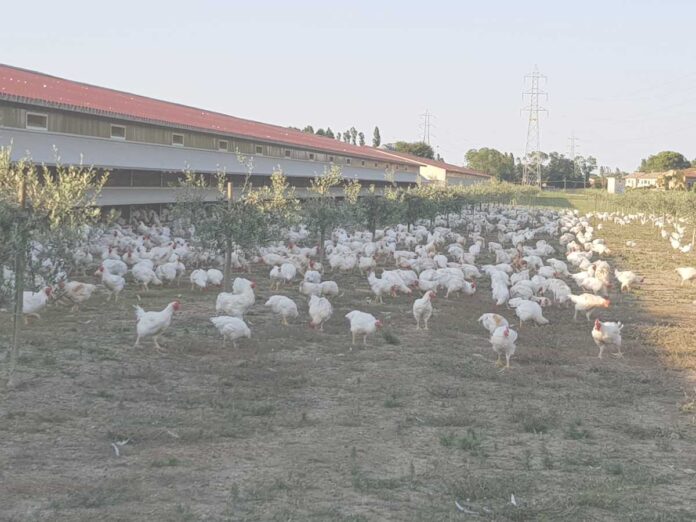
For poultry, the threshold is generally set at more than 280 LSU, with a threshold of 300 LSU for farms rearing only laying hens. Depending on the livestock conversion coefficients applicable to different poultry categories, this corresponds to large-scale operations such as farms with approximately 40,000 broilers or around 21,400 laying hens.
Mixed pig and poultry farms are covered above a combined threshold of 380 LSU.
These thresholds were established under the revised IED framework and are not a new element introduced by the latest operating rules.
Certain farming systems and activities are excluded from the directive’s scope or are subject to specific provisions. The precise application of these exclusions depends on the type of production system and the relevant provisions of EU and national legislation.
What the new operating rules cover
The operating rules developed under IED 2.0 are designed to establish harmonised environmental requirements for intensive pig and poultry farms covered by the directive.
They address areas including emissions to air, water and land, manure management and the efficient use of water, energy and other resources. The objective is to provide a common framework for reducing the environmental impact of intensive livestock production while taking account of the specific characteristics of the sector.
The revised directive also introduces a simplified system for permitting, registration and reporting for livestock farms compared with the regime applying to large industrial installations.
Implementation will be gradual. According to the European Commission, the new operating rules for livestock farms are expected to become applicable no earlier than 2030-2032, depending on farm size, giving operators and national authorities time to prepare for the new requirements.
A broader EU framework for industrial emissions
Beyond the provisions specifically affecting livestock farming, IED 2.0 strengthens the wider EU framework for controlling emissions from industrial activities.
The revised legislation introduces stronger enforcement provisions and penalties for serious infringements. It also strengthens public access to environmental information and introduces a right to seek compensation for health damage caused by illegal pollution from activities covered by the directive.
The new Industrial Emissions Portal will progressively provide more comprehensive information on emissions and environmental performance from regulated activities, increasing transparency across the sectors covered by EU industrial emissions legislation.
Cattle farming remains outside the scope
Despite the expanded coverage of intensive pig and poultry farms, cattle farming remains outside the scope of IED 2.0.
This exclusion has been criticised by environmental organisations, which argue that livestock emissions cannot be addressed comprehensively without considering the cattle sector. The European Commission is expected to report by the end of 2026 on possible measures to address livestock emissions more broadly, with particular attention to cattle farming.
For the poultry sector, the latest development represents another step in the implementation of the regulatory framework established with the revision of the Industrial Emissions Directive in 2024.
The July 2026 development does not introduce new farm-size thresholds. Instead, it advances the process towards the adoption of the operating rules intended to determine how the environmental requirements of IED 2.0 will be applied in practice to the large intensive poultry and pig farms already covered by the directive.
With implementation expected to take place gradually from 2030 onwards, the coming years will be important for poultry operators and national authorities as they prepare for the new requirements.
Sources
European Commission – Industrial and Livestock Rearing Emissions Directive (IED 2.0)
EUR-Lex – Directive (EU) 2024/1785 of the European Parliament and of the Council
European Environmental Bureau (EEB) – “New” EU pollution rules for pig and poultry farms weakened while cattle continue to get a free pass, 13 July 2026