
Summer heat stress severely harms broiler chickens, impairing production performance, gut health, immune function, and meat quality.
The article examines physiological effects (panting, reduced feed intake, metabolic changes), worsened by relative humidity and stocking density, with annual U.S. losses of $128-165 million.
Tom Tabler, Professor and Extension Poultry
Specialist, Department of Animal Science, University of Tennessee Institute of Agriculture
Yi Liang, Associate Professor, Department of Biological and Agricultural Engineering/Center of Excellence for Poultry Science, University of Arkansas
Logan Lewis, Extension Agent, University of Tennessee Extension, Montgomery County
Tanner Thornton, Graduate Research Assistant, Department of Animal Science, University of Tennessee Institute of Agriculture
Jonathan Moon, Extension Instructor, Department of Poultry Science, Mississippi State University
The effects of heat stress resulting from high environmental temperatures continue to threaten poultry production in the United States and around the globe. Heat stress (HS) is a condition in which animals are unable to dissipate excess heat in their bodies to the surrounding environment, resulting in an increase in body temperature (Sugiharto, 2020). Poultry are homoeothermic; however, modern-day broiler and layer chickens are highly susceptible to HS due to their inefficiency in dissipating heat from their bodies because of feather cover and the lack of sweat glands. During HS, the heat load is higher than the chickens’ ability to regulate it. As a result, this can disturb normal physiological functioning, affect metabolism and cause behavioral changes, respiratory alkalosis and immune issues in poultry. These adverse effects can reduce nutrient absorption and energy metabolism, consequently reducing production and causing economic losses (Mangan and Siwek, 2024).
Heat stress can be described as acute (short and sudden periods of extremely high temperatures) or chronic (extended periods of increased environmental temperatures) (Kpomasse et al., 2021). Both types can lead to serious physiological problems, immune suppression and gut microbial imbalance (Sohail et al., 2012; Lara and Rostagno, 2013; Attia et al., 2018; Chang et al., 2020; Wasti et al., 2021). Because birds lack sweat glands, they resort to reducing their physical and behavioral activities (less walking, increased resting, wing spreading and dustbathing), reducing feed intake to reduce heat production as well as increasing their panting and water consumption to dissipate heat loss by evaporation (Renaudeau et al., 2012).
These detrimental effects reduce production performance, health and food safety, subsequently causing high morbidity, mortality and consequently leading to economic losses. It is reported that in the United States, an estimated $128 to $165 million is lost annually by the poultry industry due to heat stress effects (St-Pierre et al., 2003; He et al., 2018; Kim et al., 2021), making it essential to find mitigatory strategies that will help ameliorate the detrimental effects of heat stress.
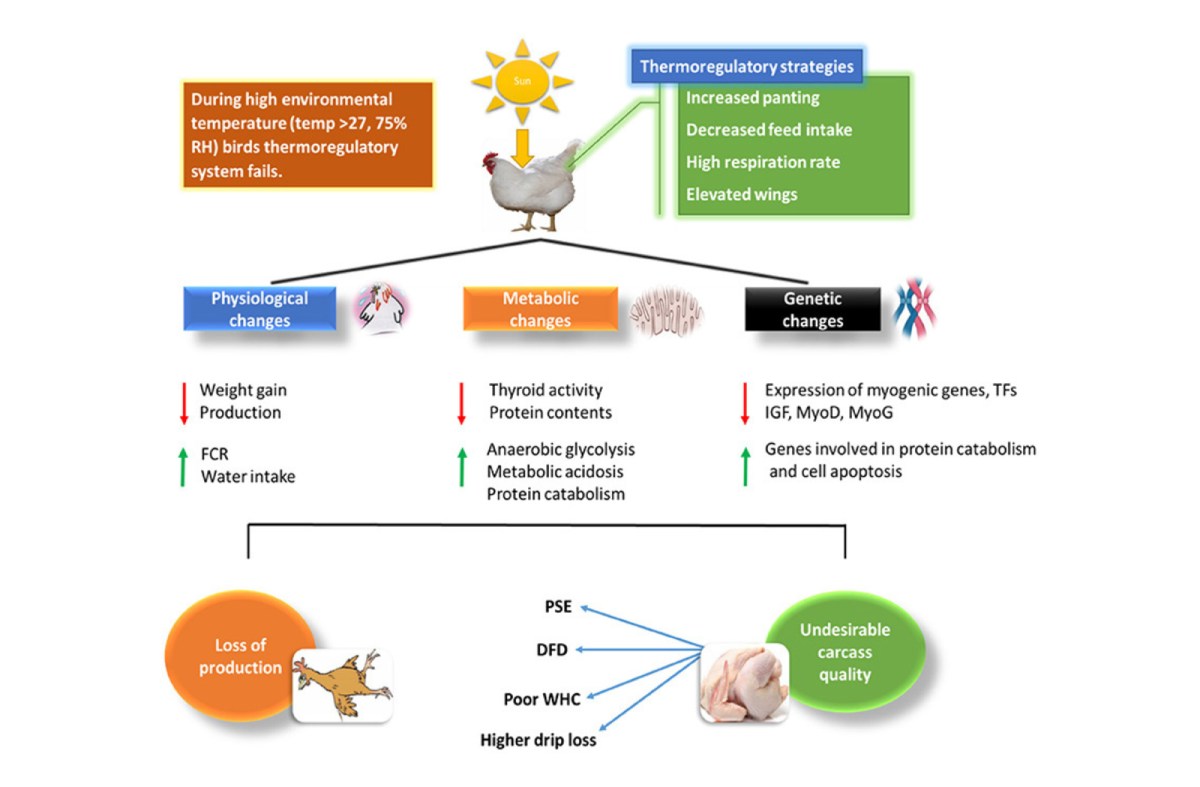
Source: Nawaz et al., 2021.
Heat stress factors to consider
Climate factors
Seasonal variations in poultry production occur in relation to the cyclical changes and fluctuations in the output of poultry over different seasons of the year. Seasons characterized by high temperatures (late spring, summer, early fall) present a series of obstacles for poultry growers. Lara and Rostagno (2013) discussed many of the consequences resulting from HS, including diminished meat quality, poor feed efficiency, altered behavior and increased mortality. Heat stress further compounds the variety of problems that poultry growers must overcome (Apalowo et al., 2024). Lin et al. (2005) emphasized that broilers exhibit increased water usage to adapt to elevated temperatures. Genetic aspects of heat tolerance introduce an additional level of intricacy, necessitating meticulous breeding programs and selection processes to improve overall resistance to HS (Lara and Rostagno, 2013). Broiler production is significantly impacted by seasonal HS, which adversely affects health, performance and economic outcomes. Therefore, it is critical that integrators and growers implement comprehensive management strategies, wise selection of genetic stock and advanced ventilation/cooling systems (adequate wind speed, sprinkler cooling, evaporative cool cells) to ensure sustainability and profitability of broiler production.
Temperature plays a major role in flock performance. Birds are homeothermic animals, possessing the capability to regulate their internal body temperature within a relatively constant range. The ability to regulate temperature occurs quite effectively when the birds are kept within a thermoneutral zone, ranging from 21 to 28 °C (~70 to 82 °F) (Soliman and Safwat, 2020), allowing them to maintain a stable internal temperature. A fluctuation in the environmental temperature above the upper limits of the thermoneutral zone leads to heat stress (Purswell et al., 2012), which affects the overall performance of the bird and can result in mortality. Due to their genetic potential for a high level of production, fast-growing broilers with a substantial body weight are extremely susceptible to HS when environmental temperatures exceed the bird’s thermoneutral zone. While in the absence of fully developed thermoregulatory organs, neonatal chicks are vulnerable to cold stress. The optimal temperatures at which the bird can function most effectively are determined by its age, body weight, housing system, feeding level, relative humidity, air velocity and overall health (Olanrewaju et al., 2010). Chickens in high ambient temperature situations have greater energy requirements than those under thermoneutral conditions.
Relative humidity plays a key role in mortality losses during high environmental temperature periods. It is not high temperature alone that kills chickens in summer. It is the lethal combination of high temperatures and high humidity. Chickens can tolerate some fairly high temperatures if the humidity can be maintained at or below 70 percent. Heat dissipation is an additional aspect of heat management that is subject to the influence of several variables, in addition to heat production. Evaporative heat dissipation is a critical mechanism significantly influenced by the relative humidity of the surrounding environment (Apalowo et al., 2024).
Elevated humidity reduces evaporative heat loss. The effect of humidity on the thermal regulation response of broilers is affected by the age of the birds and air temperature (Lin et al., 2005). To optimize the thermal comfort and well-being of broilers under a variety of climatic situations, it is critical to control these climate variables.
 Management factors
The adverse effects of heat stress on poultry production are a global concern. Chickens are particularly susceptible to environmental heat stress, owing to their physiological characteristics, which include a lack of sweat glands, panting to lose body heat and metabolic heat loads associated with rapid growth (Chowdhury et al., 2012; Vandana et al., 2021). While temperature has been the focus of most studies, both temperature and relative humidity of the in-house environment are major factors that cause thermal stress (Zhou et al., 2019).
Housing. Proper management of poultry housing is critical in reducing heat stress. Previous research has highlighted the importance of ensuring adequate temperature regulation and ventilation controls in environmentally-controlled housing for preventing HS (Saeed et al., 2019; Rostagno, 2020). There are multiple factors (outside conditions, stocking density and heat produced by the birds, internal environment, the roof and the degree of insulation, the process of fecal matter biodegradation, etc.) that contribute to the overall HS load on chickens, which is reflected in the internal environment of the poultry house. Addressing these factors to the extent possible is critical for maintaining a healthy environment for the birds and avoiding heat stress-related problems, particularly in near-market-age flocks. Achieving effective HS management in poultry production requires examination of the various heat generation sources present in the broiler house, as well as development of solutions to alleviate the detrimental effects these sources have on the birds (sprinklers, cool cell pads, fans and tunnel ventilation are common methods to reduce heat stress).
Water. It is critical to take into consideration the availability, temperature and quality of water when growing broilers, especially when HS is a factor. Water that contains harmful bacteria or other contaminants can affect the digestive system and weaken the immune system (Martinez et al., 2021). Birds drink more water when they are hot as a natural cooling mechanism, but any contaminants in the water might worsen health conditions and lower productivity. An increase in water temperature in the drinker lines may occur because of HS and high ambient temperatures (Yahav, 2009). Hot water in the drinker lines can cause birds to drink less water, which can make them even more dehydrated and increase the adverse effects of HS (Wilson and Edwards, 1952). Sufficient water is necessary for broilers to regulate their body temperature and keep their physiological functions operating smoothly. Lack of water intake because of HS can make it harder for nutrients to be absorbed, which can affect growth and performance. During periods of heat stress, it is vital to have an adequate water supply for drinking and cooling use and control the temperature of drinking water to offset detrimental HS impacts.
Welfare. Heat stress has detrimental effects on the welfare of broiler chickens. Heat stress can be divided into two categories depending on the duration and intensity of the stressor. Acute HS refers to a sudden increase in temperature and humidity over a short period of time while chronic HS occurs when there is a sustained period of high temperature and humidity. In poultry, HS can range from 27 C to 38 C (~81 F to 100 F) for one to 24 hours (acute), seven days (moderate), and more than seven days (chronic) (Vandana et al., 2021). Poultry are most susceptible to HS because of their inability to dissipate heat due to the presence of feathers and the lack of sweat glands (Zhang et al., 2017). Multiple studies have shown that HS can negatively affect the health, physiology and efficiency of broilers (Quinteiro-Filho et al., 2012; Hosseini-Vashan et al., 2020; Hu et al., 2022; Sun et al., 2023), laying hens (Deng et al., 2012), ducks (Oluwagbenga et al., 2022; Ma et al., 2014) and turkeys (Farghly et al., 2017). Broiler stocking density is often reduced throughout the warmer months to lessen HS and prevent overcrowding. Research has indicated that broilers are more likely to experience the effects of HS due to overcrowding, including decreased digestion and absorption, mucosal injury and compromised intestinal processes (Li et al., 2019). Intestinal mucosal injury in broilers is closely linked to the increase in corticosterone, which is caused by stress connected to high stocking density, including factors like competition for feed and water space, elevated ambient house temperature and increased litter moisture and ammonia levels (Law et al., 2019).
Meat quality
The broiler industry faces a serious challenge from HS each summer, which increases production costs and can severely damage the meat quality due to poultry’s susceptibility to heat because of their rapid metabolic rate and high growth potential (Nawaz et al., 2021). Metabolic changes occur in broilers reared in a HS environment, causing a considerable decrease in breast muscle size (Nawaz et al., 2021). In addition, HS is also responsible for the reduction in the protein content of muscles (Zhang et al., 2012). Both acute and chronic HS may cause a sharp decline in the metabolism of broilers, which in turn will induce serious complications regarding growth and performance, such as a change in meat color, a decline in muscle pH, water-holding capacity and juiciness of chicken meat (Song and King, 2015; Gonzalez-Rivas et al., 2020). Numerous studies have revealed that high ambient temperature causes oxidative stress by producing reactive oxygen species (ROS, Reactive Oxygen Species). These ROS have severe implications on skeletal muscle development, as they are responsible for lipid peroxidation in muscles (Altan et al., 2003; Kumar, 2012). Thus, understanding the underlying mechanisms, the causes and the effects of HS and strategies that can be put into place to control its effects can be beneficial in addressing global food insecurity issues. Figure 1 illustrates the physiological, metabolic and genetic changes amid HS and its relation to meat production and quality in chicken.
Heat stress can impact meat production in multiple ways (Nawaz et al., 2021) including:
- Reduction in feed intake and poor weight gain
- Increase in fat and reduction in protein contents of poultry meat
- Excessive production of ROS impairs meat quality
- Acidosis lowers water-holding capacity and damages meat texture
- Thyroid hormone imbalance under HS impairs skeletal muscle development
- Drip loss
- Development of pale, soft, and exudative meat
- Production of protein carbonyls
Heat stress is becoming more challenging for the poultry industry to overcome. Genotype selection in broilers for higher growth rates to meet the ever-increasing food requirement has made broilers increasingly vulnerable to HS. It is increasingly difficult for modern broilers to withstand HS, resulting in substantial economic losses to the industry, triggering increasing food security issues. Genetic selection for heat tolerance in poultry will be critical to addressing the negative implications of HS.
Effects of heat stress on gut health and the immune system
Gut health plays a vital role in ensuring efficient digestion and absorption of feed, water and electrolyte balance as well as in immune system development (Rostagno, 2020). Heat stress can alter the gut microbiota, therefore, leading to gut dysbiosis (an imbalance of the types of organisms present in the gut) and subsequently affects gut barrier functions (Brugaletta et al., 2022). Multiple studies have demonstrated the effects of HS on the gut microbiota composition and health of birds (Ringseis and Eder, 2022). The precise mechanisms underlying the effects of HS on the structure and function of the gut microbiota remain elusive (Kers et al., 2018), however, it is well-known that the intestinal tract is extremely sensitive to HS and all other forms of stress (Slawinska et al., 2019). Poultry production requires the birds to have an efficiently functioning intestinal tract because the intestinal tract greatly affects the birds’ overall well-being and productivity (Kadykalo et al., 2018). The integrity of the intestinal barrier is compromised by HS, leading to an increase in intestinal permeability.
Alhenaky et al. (2017) indicated that an increase in permeability and localized inflammation along the small intestine are significant consequences of HS on the intestinal barrier. Heat stress causes morphological alterations and mucosal damage in the intestines of chickens because it reduces blood flow, nutrient and oxygen availability, and feed intake (Quinteiro-Filho et al., 2017).
Knowing how HS impacts the immune response in chickens is the subject of much research. Multiple studies have shown that HS weakens the immune system of both broilers and laying hens (Apalowo et al., 2024). As previously mentioned, when birds experience severe heat stress, their bodies produce more ROS, which causes oxidative stress. Reactive oxygen species overproduction causes oxidative stress by taxing the bird’s immune system to the breaking point. The immune system responds by producing heat shock proteins (HSP). These HSP aid in the correct folding of other proteins, stop misfolded proteins from clumping together, and speed up the breakdown of damaged proteins, and they are necessary for cell production (Apalowo et al., 2024). The primary function of these HSP is to allow cells to deal with and recover from stress.
Concentrations of HSP tend to rise when HS is applied to broilers and laying hens. This suggests that their cells are responding by reducing the harmful effects of ROS (Prieto and Campo, 2010).
Future directions
Extensive research across numerous studies consistently demonstrates that HS negatively impacts various aspects of poultry production, including production performance. The poultry sector’s transition towards environmental sustainability and resource-efficient practices highlights the role that precision livestock farming (PLF, Precision Livestock Farming) practices will play in the future.
Resolving HS issues in broiler production in the future will require combining intelligent sensors and real-time data analytics along with other PLF practices that optimize environmental conditions for the comfort and performance of broilers. Environmental stewardship and sustainable practices are evolving as guiding principles of poultry production going forward. The environmental well-being and longevity of broiler production are enhanced by the implementation of sustainable measures such as optimized feed formulas and waste management systems (Boliko, 2019). In addition, future research into more climate-resilient genetics and more water-efficient broilers must continue and even increase. Addressing HS in poultry today requires a multifaceted, complex approach and is a journey that, from this point forward, will be built on precision agriculture techniques, genetic selection and sustainable practices.
References are available on request
By courtesy of The University of Tennessee Institute of Agriculture and UT Extension