
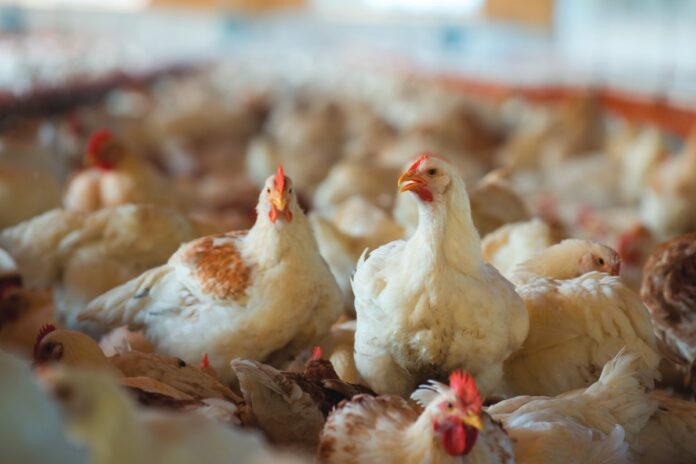
Pakistan’s poultry sector provides an important example of the challenges associated with the intensification of broiler production and antimicrobial resistance (AMR). Rapidly expanding production, substantial antimicrobial use — particularly preventive use — and shortcomings in biosecurity and farm management can create conditions that favour the selection and dissemination of antimicrobial-resistant bacteria.
A rapidly growing sector under sanitary pressure
Pakistan has a large and rapidly expanding poultry industry. According to the Pakistan Economic Survey 2025–26, the poultry sector has grown at an average annual rate of 8.1% over the past decade. The country is the world’s eleventh-largest poultry producer, and poultry contributes approximately 43.3% of Pakistan’s total meat production.
Punjab is one of Pakistan’s main poultry-producing regions, with a high concentration of commercial broiler farms. The scale of production makes antimicrobial stewardship and disease prevention increasingly important.
Extensive antibiotic use: evidence from commercial farms
Several studies have documented extensive antimicrobial use on Pakistani poultry farms.
A 2023 cross-sectional survey of 40 poultry farms in rural Punjab found that all the farms surveyed used antibiotics. Sixty per cent of farmers reported obtaining antibiotics without a veterinary prescription, while 45% reported using antibiotics as growth promoters. Colistin, either alone or in combination with amoxicillin, was reported by 60% of the farms. The study also identified significant shortcomings in farm infrastructure: 85% of the farms had no wastewater drainage system.
The findings should, however, be interpreted within the scope of the study: the survey covered 40 farms in Pindi Gheb, Attock district, and therefore cannot be considered representative of all poultry farms in Pakistan.
More recent research provides detailed data on antimicrobial use in commercial broiler production. A 2024 study covering 100 farms, 225 flocks and 741 group treatments found that 34% of treatments were administered for therapeutic purposes, while 66% were used prophylactically. A large proportion of treatments were administered during the first week of production.
Colistin accounted for 17% of group treatments, followed by enrofloxacin at 8%, while neomycin and amoxicillin each accounted for 7%. Procaine penicillin and streptomycin each accounted for 6%. Overall, 57% of the active substances identified in the study were classified as critically important for human medicine, including 30% classified as highest-priority critically important antimicrobials.
These findings do not mean that every farm uses antibiotics in the same way, but they highlight the extent to which antimicrobial use remains embedded in some commercial broiler production systems.
Resistance genes and dissemination along the production chain
The potential consequences become particularly significant when resistance genes are detected at several stages of the poultry production chain.
A 2026 study investigated antimicrobial-resistant Escherichia coli in a vertically integrated broiler production system in Pakistan. Researchers collected 200 samples in 2024 from four successive stages: broiler breeders, day-old chicks, 30-day-old broilers and retail poultry meat.
Eighteen E. coli isolates were recovered using selective media for colistin- and tigecycline-resistant bacteria. Of these isolates, 11 carried the tet(X4) gene, which is associated with resistance to tetracyclines including tigecycline, while seven carried mcr-1.1, a gene associated with transferable colistin resistance. One isolate carried both genes.
The mcr-1.1 gene was detected at all four stages of the production chain. Genomic analysis also identified an ST-1011 lineage showing a pattern consistent with clonal transmission of tet(X4) across successive stages of the integrated production system.
The findings therefore provide molecular evidence consistent with the dissemination of resistant bacteria and resistance determinants across an integrated poultry production chain. They do not, however, constitute definitive experimental proof of a continuous farm-to-fork transmission pathway. Nor did the study demonstrate that consumers became infected. Its public-health significance lies instead in the potential for foodborne exposure to bacteria carrying clinically important resistance determinants.
Antimicrobial resistance is also present in backyard poultry
The problem is not limited to intensive commercial production.
A 2023 study of backyard chickens in Pakistan analysed 320 cloacal swabs and recovered 164 E. coli isolates, including 74 extended-spectrum β-lactamase (ESBL)-producing isolates.
Among the E. coli isolates, approximately 71% were resistant to enrofloxacin, 70% to colistin and 77% to cefotaxime. Resistance was also high for several other antimicrobials.
Although backyard and commercial production systems differ substantially, these findings indicate that antimicrobial resistance is also present in non-commercial poultry populations.
Regulation and national action plans
Pakistan has introduced measures aimed at addressing antimicrobial resistance. The country’s National Action Plan on Antimicrobial Resistance adopts a One Health approach and includes measures to improve antimicrobial-use optimisation, surveillance and stewardship, as well as actions aimed at phasing out the use of antimicrobials as growth promoters.
At provincial level, Punjab’s poultry legislation prohibits the use of colistin and ciprofloxacin as antimicrobial growth promoters in poultry feed. This should not be interpreted as a general ban on these substances for all veterinary or therapeutic purposes.
The existence of regulations, however, does not automatically guarantee effective implementation. Research assessing antimicrobial-use governance in Pakistan has identified weaknesses in legislation, enforcement and surveillance, while the 2024 farm-level study also noted the absence of formal nationwide surveillance of antimicrobial use in food-producing animals.
Biosecurity and good management: the farmer-veterinarian perspective
The experience of Pakistani veterinarian and poultry farmer Adnan Shoukat, reported by the Financial Times, illustrates how improvements in farm management may help reduce reliance on antibiotics.
Shoukat manages around 54,000 chickens near Faisalabad and has implemented a series of biosecurity and environmental measures, including vehicle and personnel disinfection, water treatment with citric acid and controlled ventilation.
According to his own estimate, these measures have reduced his annual expenditure on antibiotics by around 25% per bird.
This is a farm-level example rather than the result of a controlled scientific trial, so the figure should not be interpreted as proof that these specific interventions necessarily produce a 25% reduction in antibiotic use across poultry farms. Nevertheless, it illustrates how disease prevention and environmental management may reduce the need to rely on antimicrobials.
A public-health and economic challenge
Antimicrobial resistance is not only a veterinary issue. It is one of the major global public-health challenges of the coming decades.
Projections from the Global Research on Antimicrobial Resistance (GRAM) project indicate that bacterial AMR could directly cause more than 39 million deaths worldwide between 2025 and 2050 if current trends are not reversed.
For a large and rapidly developing poultry sector such as Pakistan’s, responsible antimicrobial use is therefore relevant both to public health and to the long-term sustainability of production.
The issue is also becoming increasingly important for international trade, as importing markets introduce stricter requirements concerning antimicrobial use, residues and food safety.
What is needed now
Reducing antimicrobial resistance in poultry requires more than simply limiting the number of antibiotics used. The priority should be to reduce the need for antibiotics in the first place.
Key measures include:
- stronger enforcement of existing regulations;
- greater transparency and control throughout the feed supply chain;
- systematic monitoring of antimicrobial use at farm level;
- improved farmer and veterinarian training;
- stronger biosecurity protocols;
- effective vaccination programmes;
- improved ventilation, litter and environmental management;
- rapid diagnosis and targeted treatment of bacterial diseases;
- and integrated AMR surveillance covering farms, animals, food products and the environment.
Better data are particularly important. Standardised monitoring of antimicrobial consumption can help identify where and why antibiotics are being used and determine whether interventions are actually reducing their use.
A challenge for the entire production chain
The Pakistani case illustrates a broader problem facing intensive livestock production worldwide.
High animal density, frequent disease pressure and extensive antimicrobial use can create favourable conditions for the selection and dissemination of resistant bacteria, particularly when preventive measures and biosecurity are inadequate.
The solution is therefore not simply to remove antibiotics from the production system. It is to build production systems in which antibiotics are needed less often: systems based on effective biosecurity, vaccination, environmental management, accurate diagnosis and responsible veterinary oversight.
The detection of resistance determinants such as mcr-1.1 and tet(X4) at multiple stages of an integrated poultry production system demonstrates why this approach must extend beyond individual farms. The available genomic evidence is consistent with the dissemination of resistant bacteria and resistance determinants along the production chain, although the precise transmission pathways require further investigation.
The challenge for Pakistan — and for poultry production more broadly — is to make disease prevention the first line of defence, with antimicrobial treatment reserved for situations in which it is genuinely necessary.