
Today, however, a structural shift appears to be underway. According to the Foreign Agricultural Service (FAS), China’s poultry industry is becoming increasingly self-sufficient while strengthening its position as an exporter, supported by industrial consolidation, investment in genetics and vertically integrated production systems.
Production growth is only part of the story
The report forecasts China’s chicken meat production to reach 19 million metric tonnes in 2027, up from an estimated 18 million tonnes in 2026. While the increase itself is significant, the underlying drivers are arguably more important than the numbers alone.
Growth is expected to come mainly from the white broiler segment, which benefits from highly integrated production systems and rising demand from foodservice operators and processors. By contrast, production of traditional yellow-feathered broilers is projected to remain relatively stable as consumer preferences continue to evolve.
This reflects a broader transformation of China’s poultry market, where efficiency, product standardisation and large-scale production are becoming increasingly important.
Industrial consolidation is reshaping the sector
One of the most notable trends identified in the report is the rapid consolidation of China’s poultry industry.
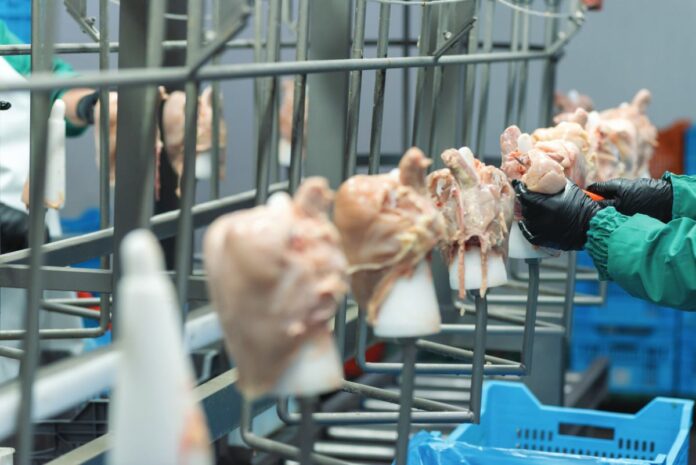
Large integrated companies continue to expand investments across the entire production chain (from breeding and hatcheries to feed manufacturing, commercial farms, slaughterhouses and processing facilities) while smaller producers face increasing pressure from higher production costs and stricter environmental requirements.
According to the report, new pollution control regulations for livestock and poultry farms (China’s Ecological and Environmental Code) scheduled to take effect in August 2026 are expected to further accelerate this consolidation process, favouring companies with greater financial resources and more advanced production systems.
This trend mirrors developments previously observed in other major poultry-producing countries, where economies of scale and vertical integration have become essential competitive advantages.
Building resilience through self-sufficiency
Another strategic objective emerging from the report is China’s effort to reduce dependence on imported breeding stock.
The report notes that domestic breeding programmes continue to expand, reflecting the country’s long-term strategy of strengthening national genetic resources and reducing reliance on foreign suppliers.
This approach extends beyond genetics. Investments throughout the poultry supply chain (including hatchery infrastructure, feed production and processing capacity) suggest that China is pursuing greater resilience against geopolitical tensions, disease outbreaks and disruptions to international trade.
Rather than simply increasing production, China appears to be strengthening every stage of its poultry value chain.
From a major importer to a more competitive exporter
Perhaps the most significant implication of the FAS China outlook concerns international trade.
As domestic production expands faster than consumption, poultry imports are expected to continue declining, with imports forecast at around 170,000 tonnes in 2027.
At the same time, exports are gaining momentum. Between January and May 2026, China’s poultry exports increased by 51% year-on-year, reaching 546,000 tonnes, while exports for 2027 are forecast to rise to 1.8 million tonnes.
Although China remains far behind Brazil and the United States in overall export volumes, these figures indicate a gradual repositioning of the country within global poultry trade.
China is increasingly becoming not only one of the world’s largest consumers, but also a more significant supplier.
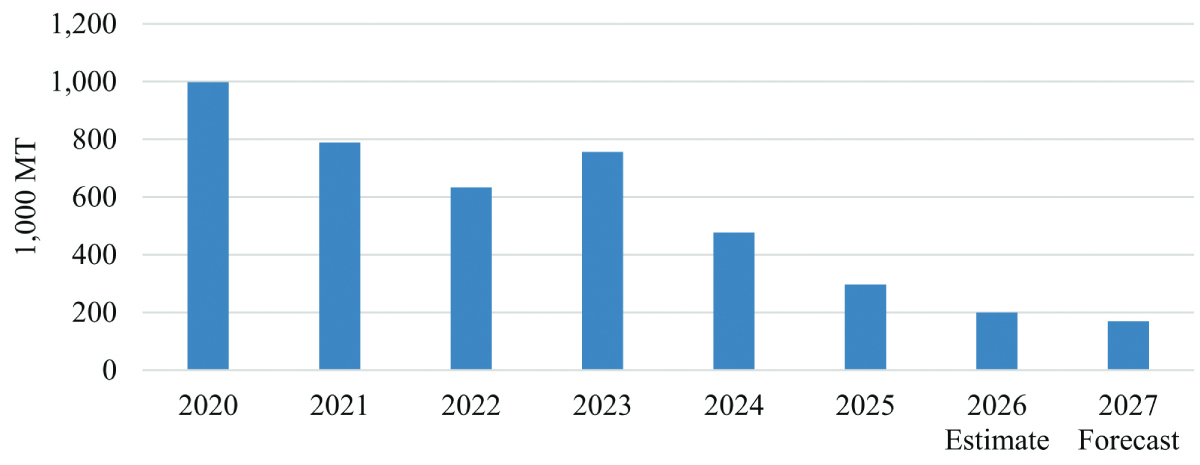
Source: USDA Official Data and Post Forecast .
In this report, unless otherwise specified, chicken imports and exports refer to the following HS codes: 020711, 020712, 020713, 020714, and 160232.
Global implications
The consequences extend beyond China’s domestic market.
For traditional poultry exporters, a reduction in Chinese import demand could intensify competition in alternative destinations, particularly in Asia, the Middle East and Africa.
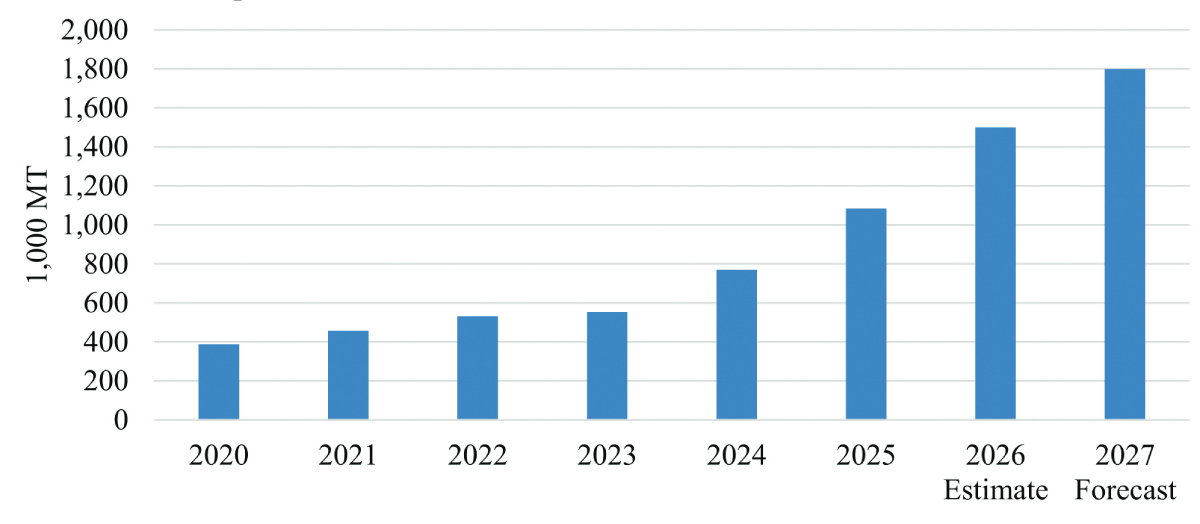
Source: USDA official data and post forecast.
Conversely, China’s growing export capacity introduces another competitive player into regional markets. The country’s combination of large-scale production, integrated supply chains and continuous investment may strengthen its international competitiveness over the coming years.
The report also notes that the recent reopening of the Chinese market to poultry products from several U.S. states is unlikely to have a major short-term impact because domestic production remains strong and import demand continues to soften.
A long-term transformation
China will continue to consume most of the poultry it produces, and imports will remain necessary for selected products and market segments.
Nevertheless, the FAS China outlook suggests that the country’s poultry industry is undergoing a structural transformation rather than experiencing a temporary production cycle.
Growing production, industrial consolidation, investment in domestic genetics and expanding exports all point in the same direction: China is gradually evolving from one of the world’s largest poultry importers into an increasingly influential player across the entire global poultry value chain.
References
USDA Foreign Agricultural Service (FAS). 2026. Poultry and Products Annual – China, Report CH2026-0087, prepared by FAS China, July 13, 2026.