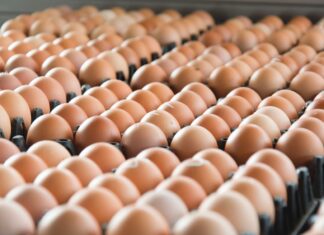

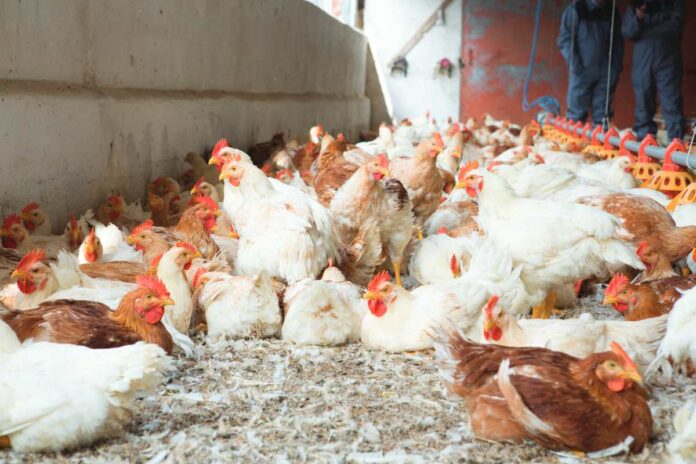
The German poultry sector looks towards the future with optimism thanks to the ever-growing demand for poultry among local customers, which maintains generally high sales.
According to preliminary calculations by the Federal Information Centre for Agriculture (BZL), the overall meat consumption in Germany has been rising for three years running, with the biggest increase being observed in the case of poultry.
At present, poultry remains one of the main drivers of the German meat market and the fastest growing segment. According to calculations by the Federal Information Centre for Agriculture (BZL), with per capita consumption of about 14.7 kilograms, it reached an all-time high in 2025, accounting for almost 27% of total meat consumption in the country. That led to the growth of domestic production. According to the German Farmers’ Association (DBV), gross domestic production of poultry meat in Germany last year amounted to 1.745 million tons of carcass weight, which was by 1% higher than in 2024. The growth is also ongoing this year.
Analysts of the Central Association of the German Poultry Industry (ZDG) expect the demand for poultry in the German market to continue to grow in years to come.
In recent years the German poultry sector has faced a sharp rise in costs, caused by tightening production, environmental and other industry standards.
As Hans-Peter Goldnick, President of the Central Association of the German Poultry Industry (ZDG), said in an interview with the German top agrar magazine, the German poultry industry operates on the basis of high legal and voluntary standards these days, delivering high-quality products to domestic customers. According to him, maintaining such standards is, however, associated with huge production costs for producers, which put significant pressure on them at present.
“Our farmers work responsibly and with great personal commitment every day. The protection and well-being of poultry are at the heart of every business decision”, Goldnick said. In his opinion, already now poultry farming in Germany is among the most strictly regulated in the world.
According to Goldnick, a further development of poultry farming in Germany on the basis of high standards should require a bigger support from the state. In addition, representatives of producers also believe that prices for German poultry in the domestic market should also be higher. That means that the current market value of German poultry, according to representatives of producers, remains largely underestimated. That leads to lost income of local farmers.
“More animal welfare means more effort, higher costs, and lower efficiency. This additional effort must be reflected in the market price,” says Goldnick.
According to him, it is important that consumers pay the higher price for products, which are produced with the use of superior farming methods through the corresponding price premium.
In the meantime, the German federal government is aware of the current problems of the industry. Amid the ever-growing energy and other costs, the German federal government in recent years has approved a package of measures aimed at supporting the industry. Still, despite this, most local farmers have become largely unhappy with the amount of provided compensations and the list of other measures, considering them too small.
Hans-Peter Goldnick commented: “Poultry and livestock farmers want to earn their income in the market and not depend on the uncertain vigilance of changing government programs”.
Overall, representatives of producers are also unhappy with the stalled reforms in the German poultry and agriculture sectors, which have been carried out in recent years as well as traditional German bureaucracy, which traditionally leads to serious delays in implementation of some crucial solutions for the industry.
At the same time, according to analysts, the current climate goals of Germany (such as minimization of CO2 emissions) are in conflict with current approaches in the field of poultry farming, which are used in the industry. In other words, according to producers, higher poultry standards in Germany require more space, land and resources. This is also associated with bigger negative effects on the local environment.
According to experts of ZDG, the use of some modern practices in the field of poultry farming inevitably results in the growth of CO2 emissions per kilogram of poultry produced.
In the meantime, most producers, such as Hellmann Poultry GmbH & Co. KG, HelloFresh Group in Berlin, Rothkötter Unternehmensgruppe and some others also prepare for the further tightening of standards of poultry farming in the coming years and the requirements for poultry from some local customers and German retailers.
In accordance with the requirements of some German leading retailers, by 2030, fresh poultry should largely come from higher animal welfare standards. In practice, this means lower stocking densities and longer fattening periods.
As for producers, they put big hopes on their further development in years to come. On the consumer side, their biggest expectations are related to younger population of German consumers, where the demand for poultry remains especially high at present. This has been recently confirmed by Dr. Ingo Stryk, Managing Director of Marketing at Wiesenhof Geflügelkontor, one of German leading producers of poultry products, during the 34th German Meat Congress. Dr. Ingo Stryk commented: “The younger the generations, the higher the proportion of poultry consumed. The older generation, which focused heavily on pork, is passing away, while the younger generation continues to favor poultry”.
As producers also believe, the recent increase of poultry prices (which are currently almost equivalent to pork prices) in Germany will not lead to a serious drop of demand for it from local customers, as expected by some analysts. They hope that the demand for poultry will remain stable, which is also due to a better image than those of beef and pork.
Regarding further prospects of the industry, most local analysts do not expect a significant increase of poultry output in Germany, as well as the growth of the local stock. According to statistics from the Central Association of the German Poultry Industry, the German poultry stocks and production have shown resilience compared to other livestock sectors since the 2020s, with a high of roughly 170 million birds recorded in 2020.
In terms of the industry’s structure, according to German Federal Office for Agriculture and Food, more than 156 million chickens are kept on German poultry farms. Of these, the German Federal Office for Agriculture and Food says that laying hens and broiler chickens accounted for 93% of the poultry population. Turkeys came in second with around 9 million birds. Ducks took third place with approximately 1.6 million birds.
At the same time, poultry populations vary considerably across Germany with Lower Saxony being considered a major center for chicken farming in Germany. According to statistics of Central Association of the German Poultry Industry, Lower Saxony holds over 50% of Germany’s total poultry stock. Of these, around 50% of chickens (every second bird) fattened in Germany come from Lower Saxony. As for turkeys: Lower Saxony holds a 40% share in German turkey farming. With regard to laying hens, in August 2025, the state maintained the highest number of laying hens, with 17.3 million animals.
Earlier, representatives of Lower Saxony poultry sector expressed serious concerns that improved animal welfare may lead to the decline of poultry output in the entire Lower Saxony region.
As Friedrich-Otto Ripke, Chairman of the Lower Saxony Poultry Industry Association, recently said in an interview with the German NDR TV channel, the decline of poultry output in major German producing regions could trigger a wave of cheap meat imports from countries like Poland. The association is therefore calling for a ban on imports of food products that do not meet EU or German standards.