

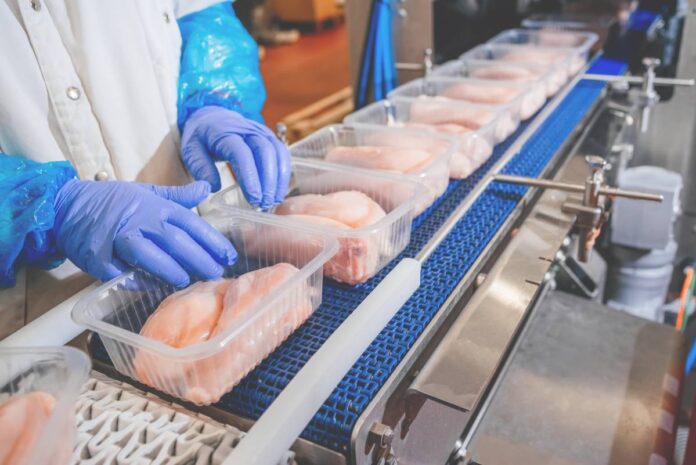
The September FAS outlook projects further growth in EU chicken meat production and consumption. Its forecast of lower imports assumes that Brazilian supplies remain excluded throughout 2027, although a favourable EU audit report, released on 28 September, has since moved Brazil closer to regaining access.
EU chicken meat production is forecast to rise by around 2% to 13 million tonnes in 2027, following estimated growth of 3.4% in 2026. The Poultry and Products Annual report, published by USDA’s Foreign Agricultural Service (FAS) in Paris on 14 September 2026, attributes the increase to sustained domestic demand and reduced competition from Brazilian imports.
Consumption is projected to reach 11.89 million tonnes in 2027, up 1.6% from 2026. Growth is closely tied to population growth, with per capita consumption also expected to rise slightly. Chicken remains a relatively affordable source of animal protein, with demand supported by consumers switching from beef and pork. Sales of less expensive cuts, including legs and wings, are increasing. In France alone, chicken-based fast-food chains now account for a market worth €1.2 billion, up 8% in a year.
Production growth varies across Member States
Poland is expected to remain the EU’s largest chicken meat producer, accounting for more than 21% of output. Its industry depends heavily on sales beyond the domestic market: around 44% of Polish production is shipped to other EU Member States and 26% to non-EU destinations.
Spain’s production is forecast to expand, supported by positive margins and steady domestic demand. In Italy, output is expected to grow in both 2026 and 2027, returning to levels not reached since before the highly pathogenic avian influenza (HPAI) outbreaks in 2020. German production is forecast to increase by less than 1.5% annually over the same period, with difficulties obtaining permits for new poultry houses limiting expansion.
Dutch production is expected to stabilise or decline slightly in 2026 and 2027. The main factors are competition from Polish and non-EU suppliers, notably Thailand, and government plans to cut nitrogen emissions, whose precise effects on farmers remain unclear.
Feed costs expected to rise
Drought and heatwaves in western and central Europe in 2026 reduced grain availability and are expected to increase feed costs. FAS anticipates that chicken producers will be able to pass these increases on to retailers, as they have during previous periods of high feed costs.
Chicken meat prices were already rising in the first half of 2026, supported by strong demand. Higher feed costs could add further upward pressure on chicken meat prices in 2027, particularly if restrictions on Brazilian imports remain in place.
Poultry diseases remain a production risk, although FAS considers the impact of HPAI on the EU chicken meat sector generally limited, since most cases have involved laying hens, turkeys and ducks. In Poland, most HPAI outbreaks in the first half of 2026 affected turkey and laying hen farms, while Newcastle disease also affected commercial poultry holdings.
Brazil: the key assumption
EU chicken meat imports are forecast at 640,000 tonnes in 2027, compared with 740,000 tonnes in 2026. This assumes that the restrictions on Brazilian chicken meat introduced on 3 September 2026 continue throughout 2027. Under the relevant EU regulation, Brazil was removed from the authorised list because the European Commission had not received sufficient guarantees that the necessary measures would be in place to meet EU requirements on antimicrobial use.
Under that assumption, Thailand would become the EU’s largest supplier. Its shipments consist mainly of cooked chicken meat and processed or salted preparations, with demand supported by the hotel, restaurant and institutional sector. Additional supplies from other countries are not expected to replace Brazilian volumes fully. Imports from Ukraine are forecast to remain broadly stable.
Since the FAS report was published, Brazil’s agriculture ministry announced on 28 September that the European Commission’s final audit report had favourably assessed Brazilian controls for poultry meat and honey. The ministry said administrative and regulatory steps were still required before exports could resume. The FAS trade figures should therefore be read as one scenario, based on the rules in force when the report was published.
Exports face greater competition
In the same scenario, EU chicken meat exports are forecast to fall by 1.3% to 1.75 million tonnes in 2027. FAS expects stronger competition as Brazil redirects supplies to alternative destinations, including markets served by EU exporters. Higher EU chicken prices and a stronger euro are also reducing export competitiveness.
The UK remains the largest destination, accounting for 35% of EU chicken meat exports. Sub-Saharan African markets are important outlets for low-priced frozen cuts, particularly dark meat, and mechanically deboned chicken meat. Shipments of these products to the region are expected to decrease.
Source: USDA Foreign Agricultural Service (FAS). 2026. Poultry and Products Annual – European Union. Report E42026-0072, prepared by Xavier Audran, FAS Paris, 14 September 2026. Production, consumption and trade figures are the report’s FAS post estimates and forecasts.
Additional sources: Commission Implementing Regulation (EU) 2026/1189 of 4 June 2026; Brazilian Ministry of Agriculture and Livestock, statement on the European Commission’s final audit report on poultry meat and honey production, 28 September 2026.